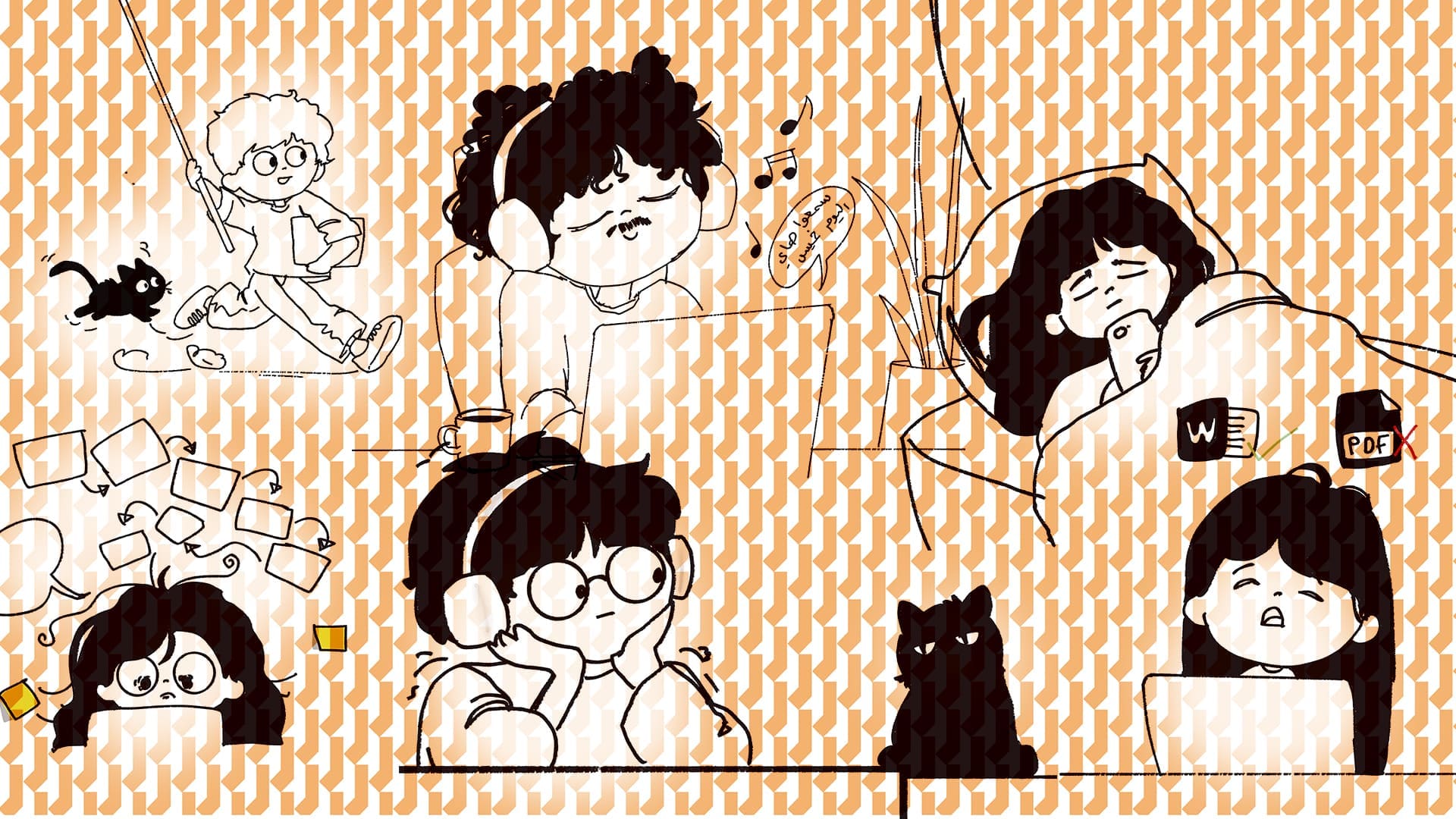

I wake dreaming of the news I will cover: politicians crowd my mind where my boyfriend might have been. I charge my devices, fearing power cuts and surges. Otherwise, ‘Who will finish the schedule?’
The news repeats: protests, corruption, harassment, women being murdered. I seek fairer ways to tell these stories and carry unheard voices. From my small room in Iraq, I sometimes work nine unbroken hours, replacing bias with inclusive language. My family argues between noon and one, as usual. I have learnt to work under pressure, sometimes under violence.
I live with a contradiction I have never shared. I write about rights I do not have, fighting through my writing for other women. I write about abused women even when I have suffered violence just half an hour before a meeting.
I live on the second floor, where heat overwhelms my laptop. As a woman, I cannot go to a café alone, even when power cuts or storms destroy my connection, even if the house burns down. Permission depends on arguments and my family’s mood.

Yet this room connects me with activists, lawyers, writers and women realising their dreams. Work offers travel, sometimes forbidden days before departure. I cannot visit a doctor or market alone, but sometimes travel alone, in exchange for money or help at home.
During my period, my workplace respects my body. Still, taking leave brings guilt: the rights I receive confront inherited beliefs that deny women’s bodies respect and rest.
Reporting women’s murders is my most harrowing work. My family would not hesitate to kill its daughters, and would do so with pride. Every report confronts me with my own possible murder.
I remember Yanar Mohammed, our courageous defender, killed by two bullets to the head. Could I be next, killed by the concrete slab outside our house?
I remember Kawthar, the beautiful young girl in the black hijab. The calls, two reports, confirming her photograph, our work with The Guardian: tears ran through it all. My heart ached. How would my family kill me if they knew I say ‘period’ without embarrassment in Tuesday meetings? That fear never leaves me.
At checkpoints, I tremble. What if they seize my laptop and discover that this girl in a hijab and abaya writes about them, demanding accountability?
Each day ends with the feeling of running on the spot. Yet I love my work. With each story, I feel I am making a difference. I believe that if I am killed, I will at least have helped build journalism that treats murdered women with dignity. Loving colleagues will miss me.

An openness to new experiences has always shaped my choices. It led me to Jummar, an experience I have come to cherish above all others.
When I saw the vacancy, rejection was not what frightened me. I feared what journalism would demand of me: confronting the stories of repression and murder that I had already found too painful to follow.
I had stopped reading the news as everything happening in our society left me afraid and unsafe; nightmares followed me every night. Ignorance offered temporary, false reassurance.
‘There is nothing I can do.’

My attempts to assert myself had also brought rejection. Saying ‘no’ to my father provoked anger; expressing my thoughts to friends felt like being insulted. I withdrew from reading and trying to understand, choosing peace despite it being an illusion.
Then, in the August heat, came the opportunity to join Jummar. I wrote myself a letter by hand to soothe my fears and comfort myself, as I always did.
What I feared happened. I read and submitted work in tears. I looked at the graves of women killed for ‘honour’. A file titled ‘Kawthar’s murder’ brought sleepless nights: her brother had killed her. We shared a name, a place, the same social attitudes. What separated us? I am no better off than she was. Should I thank chance for sparing me while she suffered until her final moment?
Yazidi survivors’ accounts of torture, rape and rebuilding their lives remain with me.
Being asked to write about women who had lost custody, I listened to Nour, my body freezing as she spoke softly. Close to my age, she had married as a child to a man 15 years older, who raped her. She feared the same fate for her daughter under the Ja‘fari Code. I could not find words equal to her story. I feared I would never convey it as she had. It still keeps me awake.
How do I turn that pain into words, give her a voice, convey her disappointment and betrayal? I could have been Nour, Kawthar, any of these women.
Something shifted. Fear remained, but I became determined to listen, read and write. We hear the stories, we ache and grow angry. Yet, ‘there is something I can do.’
I began this work afraid for my mental health. It became a means of expressing my own reality. I fight my family countless of times only to still be told ‘no’. I argue simply to leave home, battle over clothes, moisturiser and lipstick. My mother, saw me as worthless and weaker because I am a woman. I have faced harassment and judgement even over my voice.
These are no longer distant lives. I write about what I know, have lived and continue to live.
Every morning, I dream of safety. Perhaps that is why I belong at Jummar. Nobody insulted me for expressing my opinions or defending my rights. I found encouragement, support and space to speak aloud.

When looking for work, I have two priorities: an independent organisation and room to be creative. ‘Everything else will fall into place,’ I tell myself. Designing for journalism left me uncertain how to define my role. Was I a designer, a journalist, or both? How did each role define me?
At first, the task seemed straightforward: present writing in a visually compelling form that helps people understand. Yet every design must consider the views of at least seven colleagues, the people featured in a story, algorithms and an often sensitive and even angry audience. Carrying that responsibility daily is exhausting. The result can be a success or an unintended disaster.

‘Read the piece’ became my most important lesson. An editor’s comment about colour or font size could require rearranging a composition I had carefully built. I knew the editor was pointing to something I should have noticed in the text, but not always why it should transform the design. For an editor, pink or a bright colour beside a ‘heavy’ story could be ‘a bit tricky’.
I saw pink as a colour of anxiety and warning. When I used it to draw attention to a post about women’s lives, colleagues questioned the stereotypes attached to the colour and whether it was appropriate. Many readers agreed. There was no definitive rule, but the priority was clear: convey the information without making its appearance a distraction. The fewer decorative tricks we used, the clearer it became.
My first responsibility was to make the story clear to readers. For a post about rising bread prices, I might be tempted to place artist Saadoun al-Saadi on a loaf of samoon with one end bitten off. But the real creative challenge was to convey the strain on families whose monthly bread costs had risen from 30,000 Iraqi dinars to more than 60,000.
‘Half the post is writing; half is design.’
From then on, my understanding of colour changed. Each shade seemed to speak in several languages, its meaning shifting with the story it carried.

I joined Jummar just three months ago. In that short time, I have learnt a great deal, and my perspective on the world and society as a journalist has changed.
At most news organisations where I previously worked, I never signed a contract. Signing one that clearly outlined my rights, responsibilities and duties marked the beginning of a different, more professional experience. What I found at Jummar extended beyond administrative discipline: it was a supportive working environment.
Jummar also feels like a small family. Support and collaboration come readily, particularly for new colleagues, without formality or barriers of age or position. When someone needs help, others are there to discuss, offer feedback and work through difficulties together.
What struck me most was the frequency of meetings. In three months, I have attended more than in all my previous years in journalism. Their value, however, lies in their substance. These discussions lead to ideas, decisions and tangible improvements in our work.
I have learnt that journalism extends beyond writing a news story or preparing an article. It requires sustained discussion, revision, an exchange of perspectives and collective effort.

‘Why are the children’s faces visible?’ Questions like this revealed how closely colleagues hold one another to journalistic ethics. Details I might once have considered ordinary, or overlooked entirely, receive serious attention: protecting children’s privacy, using inclusive and balanced language, safeguarding individuals and ensuring that reporting exposes no one to danger. Respect for the rights of those whose lives we cover, alongside the rights associated with published material and sources, is integral to responsible journalism.
I also value our refusal to take issues at face value. We look beyond an event to examine its causes, unpack its complexities and understand its consequences for society. Reporting what happened is only the beginning.
Iraqi journalism has long suffered from institutions tied to political or financial interests. Some media outlets have become little more than shops serving particular interests rather than the public.
Here, no single person determines what we write. We do not seek to please a funder, an official or a political party. No outside authority dictates our subjects or how we approach them. We write what we judge warrants coverage, guided by the professional and ethical principles we believe in.

‘You’re driving me mad. What do you actually do?’
My uncle is trying, for the thousandth time, to understand my work. As usual, I laugh. I have given up trying to explain.
My dear uncle, I work in journalism. I write about Iraq and for Iraq, develop projects and pursue opportunities for Jummar, all online. That is what a project manager does.’
Because my work is online, incomprehension comes with dismissal.
‘So what if you have work’ my grandmother asks. ‘Tell them the internet’s down and come to the wedding.’

‘I can use mobile data.’
‘How would they know?’
A friend suggests joining my Tuesday meeting, saying I can only listen, then going out for lunch.
I understand. A society accustomed to offices and clocking in struggles to recognise eight serious hours at a computer as work.
I joined Jummar two and a half years ago because I believed in its mission and welcomed the prospect of working in journalism online. I remember its beginnings and how far it has come. Yet I cannot always disclose my work.
Reporting corruption, examining laws and asking why things happen invite suspicion, even within families. My brother believes I hate the state because I am a journalist. He expects loyalty against outsiders: polish the country’s image rather than ask why women lack rights, Iraqi universities lag in international rankings, or my shower water smells foul.
To people I trust, I am a writer, translator, editor and project manager. To others, I am a teacher.
At Jummar, I have learnt all these journalistic roles, and how to take over when war, power cuts or lost connections interrupt a colleague’s work. War reaches journalism, too. We move rapidly between stories: Is this true? False? Generated by AI? What would this government decision mean for Iraqis?
For those of us working in Iraq, the question of how to continue is inseparable from how to survive. How do we work when gas shortages leave us without electricity in summer, or winter storms expose the failures of our infrastructure? How safe are we when the authorities can search our devices as we travel? Whom can we trust with the knowledge that we are journalists, that we do not say ‘Long live the leader’ to secure our survival?
How do we continue when we cannot be certain of surviving tomorrow? Yet if we stop investigating and writing, who will take our place? Who will put question after question to the state, and insist that it answer?
Journalism means explaining news. As a colleague says, both someone who never reads journalism and a political analyst should understand a post. That commitment to accessible explanation and context has taught me about Iraq, myself and my supposed rights. It is what I love about Jummar.
But back to the beginning, what do we actually do?