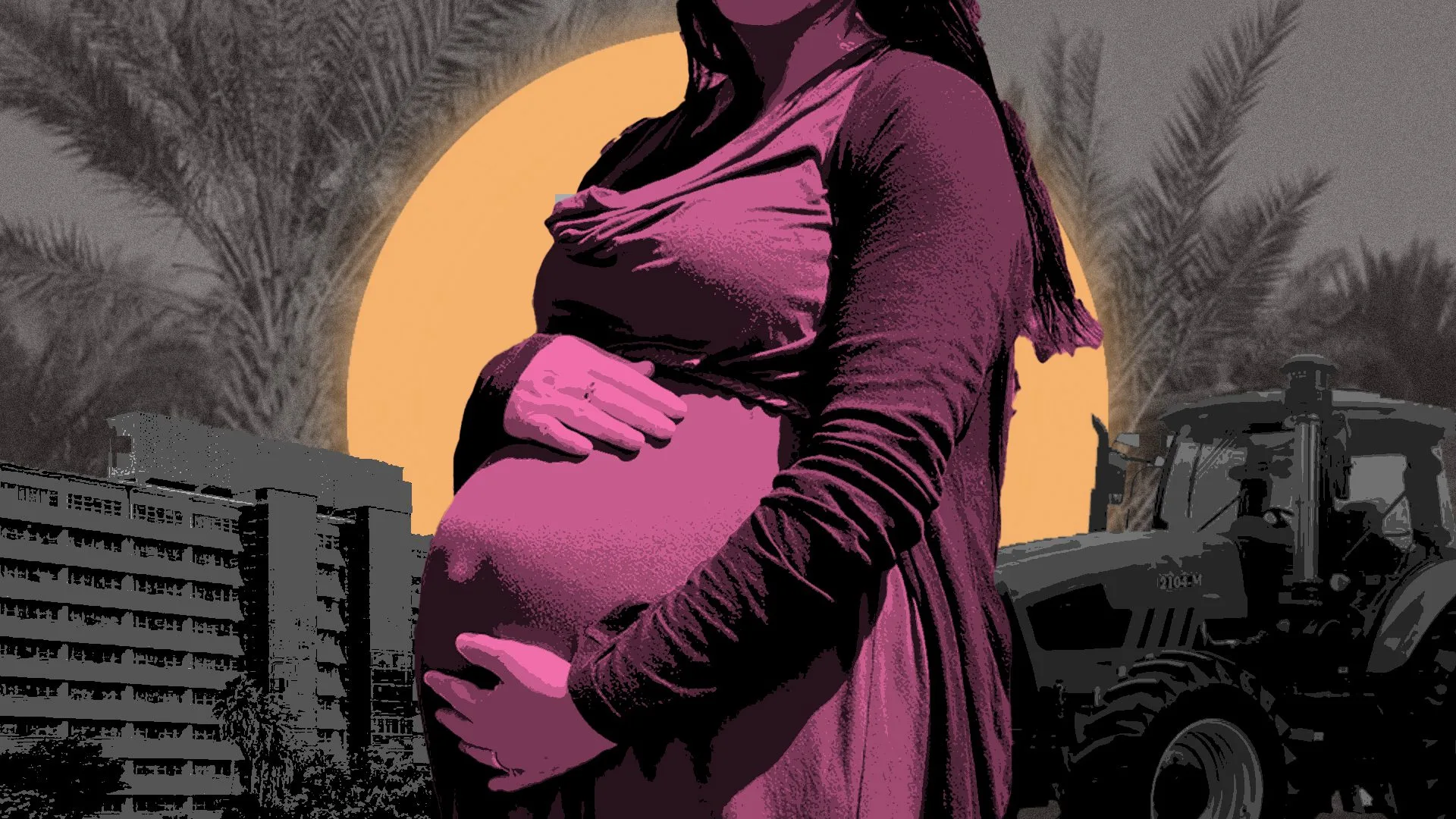
‘I went into labour while I was gathering crops in the field’ said Wazira, 25, working in a field when labour pains took her by surprise. She had no choice but to give birth there, with the help of the women working alongside her.
These are the stories we usually hear from our grandmothers, believing they belong to another time. Yet Wazira, a farmworker from al-Sa‘d in Abu Ghraib district, is one of many women across rural Iraq whose days are still spent working long hours in the fields.
Their days begin at dawn, at five or six in the morning, and stretch late into the night. After at least eight hours in the fields,only to continue with care work at home, cooking, cleaning and looking after their families until late at night.
Women make up around 30 per cent of Iraq’s rural agricultural workforce, yet carry 85 per cent of the agricultural burden, compared with 15 per cent borne by men, according to a study on rural women’s role in agricultural production.
That burden takes a physical toll. Dr Batool al-Musharraf, a gynaecologist in Abu Ghraib, said her patients suffered from severe exhaustion, anaemia and acute vitamin deficiencies. Despite her repeated advice to rest and eat well, few followed their treatment in full.
Like Wazira, most women return to work after giving birth, ending up experiencing intense pain that at times lasts up to a week. Rural women call it ‘al-has’. They believe that, after cradling the baby for nine months, the womb misses it and begins searching for it, causing unbearable pain. To silence it, a mother places a knife beneath her head and pricks the place that hurts whenever the pain returns.
Umm Omar, 42,recollects how the pain of al-has was most severe at night. She would wake in a rush to find the knife and prick the source of the pain.

‘The pain did not last long. It stayed for only three days, then it went away. After that, I went back to moving around and working as usual.’ she said.
Pregnancy between daughters-in-law and mothers-in-law
‘There is no rest. The body has to keep working, and if I have a job to do, I have to finish it,’ Wazira said. Many rural women are still expected to work in the fields throughout pregnancy.
‘My daughters-in-law work the fields and harvest, and nothing has happened to them. Work does not kill you,’ said Hajja Talba, a woman in her seventies from the village of Ibrahim bin Ali in Anbar. Older women often compare their own youth, when they worked without pause as daughters-in-law, with the lives of pregnant women today. They believe younger women exaggerate their pain and need for rest, describing some as ‘Lay’s-crisp mothers’ meaning to say they’re as delicate as crisps and demanding too much rest.
Other families reflect a gradual shift. Zainab, 38, from the village of Talba, is the mother of four daughters. Her husband does not burden her with agricultural work or strenuous tasks while she is pregnant. He encourages her to rest and, each month, he and his mother accompany her to the doctor. His care has attracted criticism from people who try to turn him against her right to rest.‘They even try to put the idea of marrying another woman in his head. They tell him, “You are far too good to her. We swear to God she has the upper hand over you.” He does not answer them. He just tells me, “To me, you are the whole world.”’ said Zainab.
The support Zainab receives from her husband and his family strengthens her sense of safety and comfort. It eases the physical and psychological pressures many women face during pregnancy, which can harm both the mother and the baby. Such stress raises cortisol levels, increasing the risk of premature birth and other complications compared with pregnancies unaffected by stress, according to a 2023 study published on the website of the US National Library of Medicine.
Some women secretly use contraception in the face of pressure to continue having children, particularly boys. Faliha, 35, from Khan Dhari in Baghdad, took contraceptive pills as regularly as she could, yet became a mother of eight.
‘Here they are in front of you: eight, and I lost two,’ she said with a heavy laugh, referring to her repeated attempts to manage the number of children she had.
Physical exhaustion is not the only burden rural women bear. Psychological pressure weighs just as heavily. Some still face pressure from their families and husbands to ‘have a boy’, who is seen as carrying on the family and its name. For some families, having daughters is not considered enough to secure social standing or influence, leaving women to contend with expectations they cannot control.
‘Inshallah , this time we will have our Allawi.’ Asma’s husband repeated this phrase with every pregnancy. Asma, 33, is the mother of four daughters from the al-Salimiyat area of al-Shu‘la, where she herds cattle and sells dairy products. From the beginning of their marriage, she felt her husband’s pressure to have a boy,when he began openly expressing his disappointment. The strain left her psychologically exhausted, resentful towards her daughters and less enthusiastic about motherhood.

Conditions have begun to improve in some places. Tayba, 28, a content creator from Yusufiya, said her family was understanding and that women in her area no longer faced the same pressure to have boys as before.
Giving birth on a tractor
Karima, 31, faced a different hardship. There was no hospital near Western Radwaniya, west of Baghdad, where she had gone to stay with her mother as her due date approached.
When labour began unexpectedly, her mother gave her castor oil and gathered swaddling cloths and an umbilical wrap. The nearest hospital was a three-hour drive away. There is no health centre in Western Radwaniya, according to journalist and activist Hussein al-Fayez.
Karima gave birth before they reached the hospital. Halfway there, her pain intensified as she lay on a tractor driven by a relative. With the help of her mother and sister-in-law, she gave birth to her daughter in difficult conditions, but the birth ended safely.
‘My mother gave me three spoonfuls of castor oil when the pain started. The taste was impossible to swallow, but thank God, the Lord made it easy,’ Karima said.
The shortage of medical facilities in rural areas leaves many residents reliant on folk medicine. Cases like Karima’s are common, women who need medical intervention may have no choice but to give birth in a field, at home or even on an agricultural tractor.
Women in Zubaydiya district face similar hardships .
‘We go to the centre of Kut or to Aziziyah to reach the nearest doctor. The journey takes a full hour,’ said Amal, 25. She recalled falling ill and deteriorating after being delayed on the unpaved road.
Residents of Wasit have appealed for local hospitals for over 12 years. In 2012, the Ministry of Health announced preliminary approval for a 100-bed hospital in Zubaydiya and a 200-bed hospital in Aziziyah. Both remain on hold. In 2024, 57 health projects were stalled across Iraq, according to a statement by Ministry of Health spokesperson Dr Saif al-Badr.
For all these reasons, Iraq ranked near the bottom of the world for healthcare,95th out of 97 countries in 2025,according to Numbeo, a website concerned with countries’ living standards and the quality of their healthcare.
How many women have endured unbearable pain while waiting for the hope of a hospital that has yet to be born? These projects remain ink on paper, doing nothing to improve the lives of women who suffer in silence.
Delaying these health projects is not merely neglect. It is a failure to provide an inherent and fundamental human right. Every woman in rural Iraq has the right to dignified healthcare that keeps her safe through the most difficult moments of her life,pregnancy and childbirth.
Hands that deliver life, and others that threaten it
Where health institutions are absent from rural areas, local midwives step in. Yet rural women must travel to find one.
‘Umm Mohammed is my second mother, and my children love her,’ said Iman, 27, from al-Jazeera subdistrict in Anbar. The midwife stayed beside her through labour, encouraging her and reciting Quran verses while she gasped in pain. ‘With her prayers, her patience and the stamina she had, she helped me through the birth.’
The midwife stayed with Iman for5 hours when labour began. The castor oil she had given Iman did not take effect.

‘Umm Mohammed kept encouraging me and reciting verses while I gasped in pain. She would tell me, “That is not good, not good—the baby will move back up.” With her prayers, her patienceand the stamina she had, she helped me through the birth.”’
For many women, a midwife is more than a provider of care. She accompanies them through the most intimate and frightening moments, offering the reassurance of a mother.
‘The greatest fear among the women who give birth with me is death. they cry, “What if I die?” or “What if the baby dies?”’ said Umm Tayba, 54, a Baghdad midwife who worked as a nursing technician at al-Yarmouk Hospital.
‘I keep reassuring her and giving her strength, and I recite Surah Ya-Sin so she feels at peace.’
Trained midwives can provide up to 90 per cent of essential sexual and reproductive healthcare, according to a 2021 report by the United Nations Population Fund, the World Health Organization and the International Confederation of Midwives. But without training and oversight, the hands that deliver life can also endanger it, exposing mothers and their babies to severe complications—and even death.
Rabi‘a, 45, from west of Baghdad recounted how an unlicensed midwife left her unable to have more children. The midwife had misled Rabi‘a and her family into believing that she was qualified and licensed.
‘People recommended her to me and spoke highly of her,’ Rabi‘a said. Despite the midwife’s popularity in the area, her lack of knowledge and experience almost cost Rabi‘a her life.
‘She kept me with her for eight hours while the contractions continued, and gave me three injections to speed up the birth. After the first injection, I was in severe pain. My family were waiting, and she told them, “She will give birth now,” but it did not work. She gave me the second, then the third. I went out to my husband and told him, “I am going to die.” He fainted, and they took me to hospital.’
At Fallujah Hospital, doctors performed a caesarean. ‘The baby was transverse,’ Rabi‘a said, meaning the baby was lying sideways in her womb rather than head down, making vaginal birth impossible.
Rabi‘a spent 15 days in intensive care. When she regained consciousness, doctors told her she would not be able to have children again. Her uterus had been damaged by the labour-inducing drug that the midwife had insisted on injecting three times.
Jasim al-Azzawi, a former head of the Doctors’ Syndicate, said untrained midwives must not administer labour-inducing drugs, use extraction instruments or perform episiotomies without specialist medical supervision. Midwives are restricted to uncomplicated vaginal births; any complication requires specialist intervention or immediate transfer to hospital. Families should verify that a midwife is qualified and has accredited training, he said.
Al-tabi‘a, a Jinn?
Al-tabi‘a literally means ‘the female follower’. In the folklore described here, she is a female jinn, also known as Umm al-Subyan, ‘mother of boys’, and is blamed for infertility, miscarriage and harm to newborns. She has no single form. Some women see her in nightmares as an old woman in an abaya; elsewhere, she is depicted as an ugly woman with cow’s legs who can disguise herself as a beautiful woman, while a Persian depiction gives her wings, horns and talons.
Her precise origins are uncertain. Some religious scholars link the belief to pre-Islamic Arab culture, while a nineteenth-century Arabic manuscript records spells intended to ward her off. Researchers have also noted similarities to older female spirits associated with childbirth and infant death across Mesopotamia and neighbouring traditions.
The absence of healthcare, including mental-health services, also leaves rural women vulnerable to belief in al-tabi‘a. This mysterious force is thought to prevent women from having children and take control of their dreams, leading some to move between sheikhs and charlatans in search of deliverance.
Zaman, 27, from a village in Diyala, began having nightmares after giving birth to her first son. She later miscarried every time she became pregnant and felt that something hidden was pursuing her. She described waking in terror and cold sweat after seeing a strange old woman in an abaya approach to strangle her or threaten her baby. Each nightmare was followed by severe bleeding that ended her pregnancy within days.
Like many women distressed by belief in al-tabi‘a, Zaman lives in constant tension. ‘I cannot live through one ordinary day, laughing and talking. I always end up distressed,’ one woman said. Another added, ‘My body feels broken and I lose my temper over the smallest thing. Sometimes I just sit in silence and do not speak.’
Amid fear, anxiety and constant stress that harm their mental and physical health, many women find themselves searching endlessly for a way to escape a nightmare that threatens their lives and their dreams of motherhood.
As the belief spreads in rural areas and cities, women become vulnerable to people promising magical solutions or ‘spiritual cures’. Some pay large sums to charlatans who claim they can break ‘spells’ and drive away al-tabi‘a.
Religious scholars reject this belief. Cleric Mohammed Sanqour wrote that the idea of a jinn called al-tabi‘a, or Umm al-Subyan, causing miscarriages or harming children has no basis in Islamic law. In a fatwa, Islamic scholar Husam al-Din Afana described it as a superstition inherited from pre-Islamic Arab culture.
‘Miscarriage has many medical causes related to the health of the mother and the baby,’ he said.

A Baghdad cleric recalled the case of a woman in her mid-thirties who had been unable to have children despite having no diagnosed medical problems. At the urging of her mother and aunts, she visited a well-known sheikh. He recited precise details about her life to gain her trust, then claimed that a spell was preventing her from having children and demanded a large sum of money to break it. He gave her an amulet, instructed her to use water mixed with herbs and told her to burn a frog until it turned to charcoal.
‘These fraudsters know how to gain their victims’ trust, but in reality they exploit women’s fears and lie to them,; the cleric said.
For women in rural Iraq, the hardships of pregnancy and childbirth stretch from the fields where they work to the distant hospitals they struggle to reach. Through belief in al-tabi‘a, these hardships follow them into their sleep. Inadequate services and limited community awareness leave them vulnerable to unsafe care and to those who prey on their fear and grief. Their bodies and hopes for motherhood continue to carry the weight of the doubts, beliefs and duties that shape their lives.