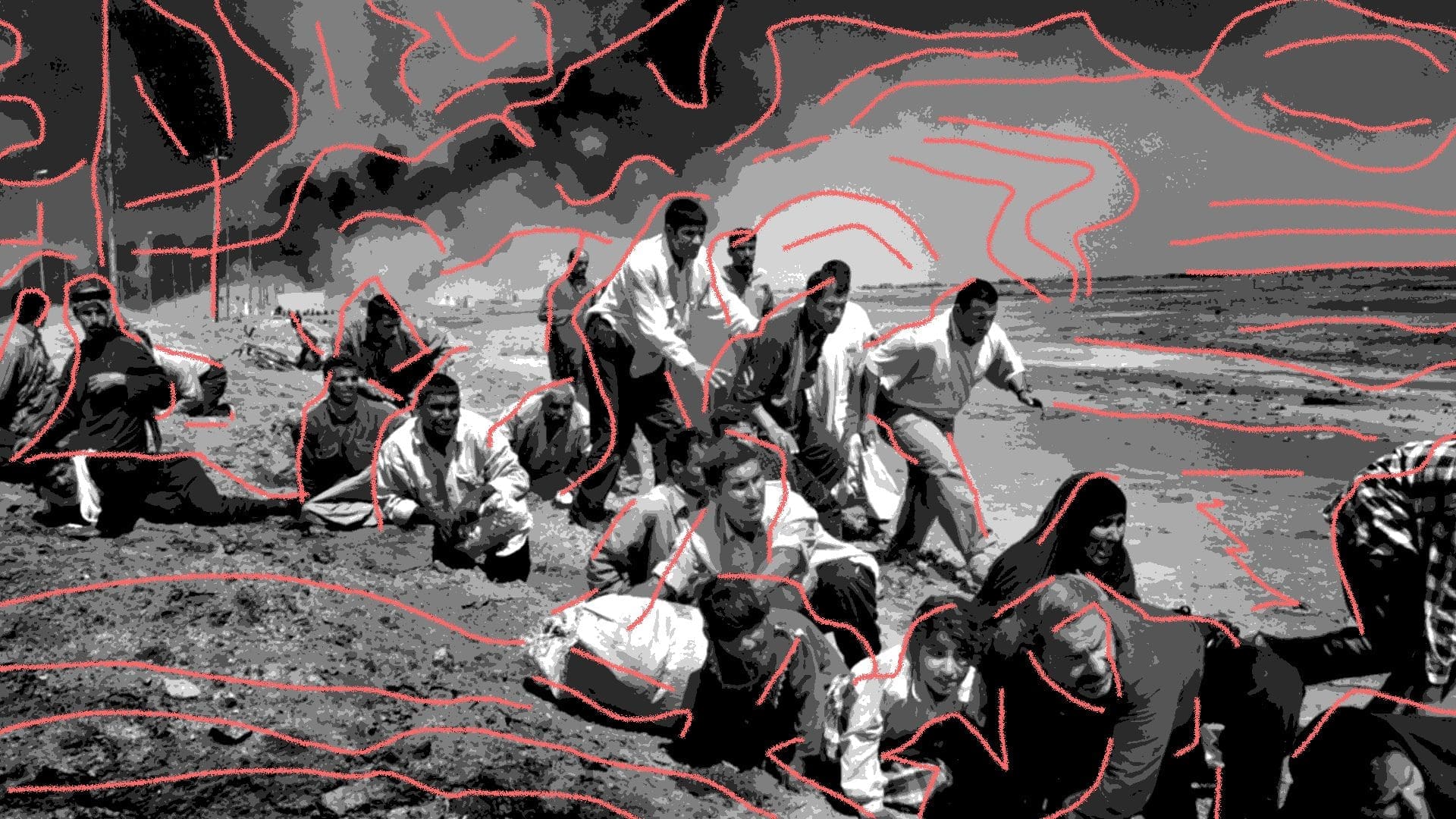
The 2003 U.S. invasion of Iraq
Those rough khaki blankets, the ones we used to avoid in winter because of how coarse and harsh they felt against our skin, my father hung them over the windows that day. He fixed them carefully with nails, while securing the glass panes in an X shape with brown adhesive tape.
I didn’t fully understand what the blankets were doing there, but I felt a strange comfort seeing them hanging on the window instead of on my body, as if they had suddenly shifted from being a daily burden into something that protected us.
It was March 2003. I was ten years old. When the US war on Iraq began, we sat waiting, listening to the radio. Then the sirens sounded. My mother turned off the lights, and we all huddled together in a corner, the six of us: myself, my father, my mother, my older sister, two years ahead of me, my younger sister, who was six, and my four-year-old brother.
All I remember are my younger siblings’ questions: Why did we turn off the lights? What will happen?
I was afraid. We were all afraid. But we didn’t cry or scream, afraid that someone might hear us and that one of their bombs would reach us. We curled up in that narrow corridor between the two rooms, a space we used as a small kitchen. It was an ordinary corner, nothing special, but it remained in my memory more than any other place.
Fear lends ordinary places an added meaning. And children trust their parents completely, even when all they can offer is waiting.
The days passed to the sound of explosions and the flare of red that accompanies them, followed by smoke filling the sky. After each blast, we would sneak to lift a small corner of the blanket covering the window to see how close it had been, then thank God it was farther than we had feared.
As for the news coverage and the voice of the announcer, all I understood was the name Saddam Hussein, repeated again and again. It was a name I knew before I even knew how to write the alphabet.
They wanted to get rid of him, but I didn’t understand why, what had he done? Then the Americans entered the country, the explosions drew closer, and on April 9 the fall of Baghdad was announced. I didn’t understand what “fall” meant, just as I didn’t understand the joy that spread through the family. Weren’t we afraid before that?

The electricity was cut. Communications stopped. We were completely isolated from the outside world. We knew nothing about our relatives or loved ones. I wondered about my school friends, about my cousins. Would we play again? When?
Finally, the roads opened. My father told us to get dressed so we could go check on my aunt’s house. We stepped out, our eyes adjusting after a long stillness. The streets were quiet, but it was a silence saturated with fear, visible on the faces of neighbors, women, men, and children alike. A fear that moved from face to face, making everyone look the same, giving the subtle sense that this fear was not ours alone.
When we reached the main road, an American military convoy passed in front of us. I was struck by the way the soldiers sat atop the tanks, by the machine guns and barrels pointed toward us. It was the first time I had seen a tank this close. But what surprised me even more was the children cheering for them, and the joy of people welcoming their arrival.
I did not welcome them. It was my first experience, as a child, of a conflict between fear and joy, a joy I wanted to share with the other children, yet could not justify within myself. These feelings were tangled with an overwhelming number of unanswered questions I did not dare to ask: What is fear? What does it mean to feel joy in war? Why all the ululations? Who are these soldiers who do not speak our language? Where did that man go, the one whose picture was printed on the first page of my schoolbooks?
In that fleeting moment, as I stared at the passing tank, an image suddenly came to mind: Adnan from the cartoon Future Boy Conan, standing on his toes atop the barrel of a cannon. I only knew tanks from cartoons, where they always symbolized danger and evil, where their barrels brought nothing but death, and whoever stood against them was the hero, the embodiment of good.
In a childish moment, I imagined that if we got closer to the tanks, we might be able to do what Adnan did, to stand lightly on top of them and defy this danger. But our reality was nothing like the cartoon. We did not have that lightness. I thought children in other places must have something we lacked, perhaps courage, or perhaps a world less filled with fear.
The convoy passed. My father hailed a taxi, and we headed toward Al-Adhamiyah.
We didn’t know what awaited us, whether we would find them alive or not. From that moment, even though I didn’t know Baghdad well and only knew the road to school and back, I felt that I had lost this country. I cried without fully understanding why.
Destruction was everywhere. The streets were empty, covered in grey, a color that has never left me since. A color that clings to memory. The color of a childhood forced to grow up too early, when a child sees fear in their parents’ eyes and finds no explanation for what is happening.
We arrived at my aunt’s house. They were unharmed. We embraced and cried. My aunt and my mother didn’t wait for the moment to settle before they began sharing stories of those nights and how they had passed. Meanwhile, my sisters, my cousins, and I ran off to play. They pulled us toward the balcony and began telling us how Saddam’s Fedayeen forces had been launching rockets from right in front of their house, and how they threw down their weapons and fled once the Americans entered Baghdad.
From that moment, when we began sharing stories that were not meant for children, something inside me began to erode. Childhood did not end all at once. It receded slowly, leaving behind small details: the streets we used to run through near my grandfather’s house, playing in the mud when it rained, sneaking out during afternoon naps, the heat of asphalt under our bare feet in summer, entering abandoned houses still under construction, playing “house,” building homes out of pillows. All of it began to drift away, as if it belonged to someone else.
Silence and a sense of shame around playing replaced those games. Amid so much death and fear, we had to grow up to find answers to our questions. So we left the games behind and chased answers instead: Why did this person die? Why was the neighbor displaced? Why did they kill my closest friend’s father? Why did Israa disappear before I could say goodbye?
Sectarian violence, 2006
I was thirteen when everyone began to flee to survive. Some went to Syria, others to Jordan. Leaving was not a sudden event, but a series of quiet farewells: homes closed without certainty of return, conversations whispered as if the walls could hear. We stayed, despite wanting to leave.
My mother suddenly found herself alone after her siblings left. She stood in the house as if guarding what remained, unsure whether she was protecting it or slowly bidding it farewell. As for us children, we had to adapt to the idea that play could happen in isolation, that laughter had to be quieter, that going outside was no longer a right but a risk.
The emptiness left by those who departed was more than the absence of people. It was the absence of an entire life we had never noticed while it surrounded us. The house became unbearably quiet. What followed the departure of neighbors and relatives was even harsher, because we didn’t just learn how to live without them, but how to live with fear.
A fear that does not arrive all at once, but seeps in slowly, entering through doors and windows and through other people’s stories. The fear that our turn would come. That our door would be knocked on as theirs had been. That we would become the story whispered among houses. That we too would be taken in cars to unknown destinations.
We learned to watch everything: footsteps in the street, the movement of cars, unfamiliar faces, even the silence of the night. We learned to read fear in adults’ eyes before it was spoken, to understand what was never said, to behave cautiously inside our own home as if it were not safe, to lower our voices, to ask fewer questions, to always wait.

Waiting became the only possible form of life. We were no longer children who played, but children training to survive, as if childhood were something that could be skipped when necessary.
We grew up witnessing clothes torn in grief over lost sons, hearing neighbors scream as they were threatened or forcibly displaced, their voices met by shuttered houses, no sound, not even a glance from behind curtains.
Survival meant looking away, pretending what was happening had nothing to do with you, telling yourself, “It’s none of our business.” A small phrase, but enough to justify silence and protect what remained of life, even if the cost was abandoning others.
There are many scenes. Some have faded, others lie hidden, waiting to be triggered. But some images refuse to disappear. Like the man killed near the school. I was twelve. The students passed around the news an hour after we arrived. No one was allowed to carry his body, as if this were punishment upon punishment. He was left lying on the ground in his brown dishdasha, his upper body covered with a piece of cardboard. He remained there until we left school at midday. People passed by as if he did not exist. Shops around him continued selling goods. Customers haggled, chatted, even laughed. It was as if that cardboard, which covered only his face, had hidden him completely.
I went home and saw him every time I closed my eyes. I counted to one hundred to fall asleep. I did not imagine that I would keep seeing that scene from the same angle for months, even imagining the features of a face I had never seen.
Every day, he stood there, at the corner where he was killed, suspended in time, while I alone moved forward.
Al-Hurriya Market bombing, 2008
I was fifteen. Nothing had changed, except that I was older and my fear clearer. An explosion shook the area. My father did not answer the phone. People ran toward the sound. I stood at the door, half of me wanting to go out, the other half clinging to staying inside, because I did not want to know more than I already did. One word was enough: explosion.
In that moment, I made a promise to myself: I would not have children in this country. I would not allow another soul to live this fear, to look at their father every time he leaves as if it might be the last time.
My father returned. But the area filled with mourning tents, with the sound of Qur’an recitation and condolences, and with a question that had no answer: how many times can we escape death? How many times will we evade it?
Could I ask my whole family never to leave the house again?
Fear followed me whenever my father or mother went out, even when my siblings went to play in the street. I kept it inside, quietly. Every night we were all together, with no one missing, I felt luck was on our side. But the fear of tomorrow always returned.
These events were followed by others. But I no longer remember the war in sequence. I remember it by what it left inside me. Memory does not preserve chronology, but impact.
Even after I left, after long attempts to understand that child, that adolescent, that young woman, and to ease the panic that settles in the body before the mind, I thought I had crossed beyond it all. That borders could separate me from what happened. That a new place could offer a different life.
But what we carry does not remain behind us. It follows us wherever we go.
What we lived through was not exceptional, nor the story of a single family. This chaos has many names, studies and terms that try to explain what happened to us as children. When I read them now, I feel both anger and a kind of relief.
In a study by researcher Abdul Karim al-Obaidi on children’s mental health in Iraq, he writes that years of violence, displacement, family loss, and instability have created an entire generation burdened with anxiety and fear.
In Baghdad, where I lived, post-traumatic stress disorder appears in 14 percent of children. In Mosul, it reaches 30 percent. It is estimated that 37 percent of Mosul’s children suffer from psychological disorders.
I did not know these numbers then. But I know what they mean.
I knew the man lying near the school. I knew the sound of the explosion. I knew what fear looked like in my mother’s eyes.
Anxiety, depression, behavioral disorders are just names that came later. What truly happened was that childhood broke. Researchers say these effects continue into adulthood. Perhaps that is why nothing ever truly ends.
How did war affect us as children?
There was no shelter. No place to return to. Not even within the family was there a stable sense of protection, because everyone was afraid. Everyone was trying to survive.

We grew up watching our parents face what we faced, without anyone able to reassure us. So we learned early that safety is not a fixed state, but a temporary attempt that can collapse at any moment.
What I now call “illusory safety” is the search for an ordinary day, a boring day, without war news, without fear, without constant check-in calls, without memory suddenly opening onto old scenes. To live without a survival mindset. To stop calculating what we might carry if we had to leave. To stop watching the door.
The year 2026 began with the sound of drones and missiles overhead. I am not in Baghdad, but I hear them through my family there. I call them. They try to turn what is happening into a joke. I know this is part of resisting fear, a small attempt to summon safety. But it does not come. What comes instead is something else: the fear of loss, returning larger, heavier, unrelenting.
I thought of my grandmother. How many wars has she lived through? Her children, then us, the third generation, and those who come after. I wished that even one generation could live a full life without war, without learning early how to survive.
I felt that anger rise in my chest. When will we heal? How did we inherit all this? And how will we pass it on?
War does not end. It only passes on.
This piece is part of a special edition marking the 2003 US-led war on Iraq. Explore other articles in the series here:
- Protest as Inheritance: Growing up under the aftermath of the Iraq war by Hannah al-Khafaji