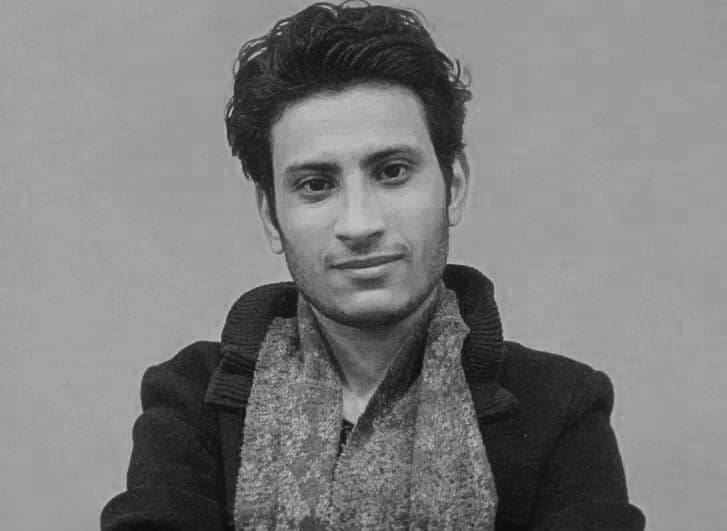
For as long as I can remember, I was known as “the son of a missing man”, and I lived with that title throughout my childhood and adolescence.
Hussam did not escape this label until he joined the military in 1997. By then, he had become a man with an identity of his own. By coincidence, he was sent to Al Tayeb in Maysan, the same town where his father had once served.
His father, Mohammed Amin, disappeared during the Iran-Iraq War in 1981. Hussam was only five and remembers neither his face nor his voice. Yet he has spent his life following the traces of a missing man. Hussam’s mother was 19 when her husband disappeared. For 45 years, the image of the absent man remained fixed: a soldier in uniform, covered in dust and blood. Hussam describes the father his family pieced together from the stories left behind.
“My mother died in 2019 still hoping my father would return,” he says. “Some said he had been executed in the snow in Iran. Others portrayed him as a national hero who rebelled against his guards in captivity and killed them. There were countless rumours, but each of us carried a different image of that missing father.”
The family once met a former prisoner of war who claimed to have been held captive with Mohammed Amin. “When we asked him for proof, he said, “Mohammed Amin was quick-tempered. Whenever he lost hope, he would cry, “Oh Mother, Fatima, why did you bring me into this world?”’ He later told us that whenever a Red Cross delegation visited, my father and a particular group of prisoners would be hidden away.” From these fragments, an indistinct, almost spectral image of Mohammed Amin emerged. His family lived for decades on the possibility that he might still return.

Due to his disappearance, the state granted the family a plot of land in his home province, Wasit as well as a vehicle which led to disputes between Hussam’s mother and her father-in-law. She chose to refuse the car and take 5 dinars instead.
These were the state’s compensations to families of martyrs and missing soldiers. Money and property that could neither replace the dead nor heal the wounds of children forces to grow up too son. Husam was no older than 12 when he began working on Baghdad’s Al Rasheed Street. Every grant or payment offered in place of the absent father required another application, another queue and another journey through government offices. Mohammed Amin was no longer only a missing man; he had become an endless administrative file. For Hussam, the clearest memories attached to his father are of waiting in line.
After 2003, nearly two decades later, the status that had entitled these families to compensation became a source of suspicion. After the change of government in 2003, those killed or missing in the Iran-Iraq War were no longer granted the same recognition. “The new state did not recognise the victims of the Iran–Iraq War.” Hussam says. “They were treated as traitors.” Rather than abandon his father’s case, Hussam began a second struggle with the state bureaucracy. He spent two years trying to have Mohammed Amin’s official status changed from “missing” to “martyr”.
In Iraq, “martyr” is not merely an honorary title. It is also an official category that can determine whether a family receives recognition, a pension or other state benefits.
In 2005, 24 years after his disappearance, Mohammed Amin was officially declared a martyr. He was a martyr without a body, without a coffin and without mourning women carrying news of his death through the neighbourhood. He existed as dead only in the records of the state. A quarter of a century after his body disappeared, Mohammed Amin was finally allowed to die. Even then, the decision did not pass without dispute.
“The argument continued for years.” Hussam says. “They told us that those who died in the war with Iran were not considered martyrs. That was the most despicable thing I had ever heard said about my father.”
The relationship between the absent father and the son pursuing his case shifted with the state’s language. Men once celebrated through the slogan “the martyrs are more honourable than all of us” were later recast as “traitors” or “Baathists”. Hussam explains this change as being partly due to the political alignments and priorities of the post-2003 government.
There are rumours—though their accuracy is uncertain—that some of the men now in government once tortured Iraqi soldiers held prisoner in Iran,” he says. “Sometimes I imagine that a minister or director-general today might have tortured my father while he was defending the country in a war against another state.”
Hussam, his brother and his sister grew up without their father. During one of her many journeys to pursue his case, their mother was involved in a road accident that nearly killed her. It left her with limited mobility and unable to support her children, forcing their grandparents to take responsibility for them.
This is but one chapter in Iraq’s long history of death; a history of compensation and of bureaucratic promises, in which loss is clothed in honour, until martyrdom itself comes to resemble a reward.
“Imagine,” Hussam says. “Some people envy me because my farther was martyred in the war with Iran, all because of the money the state gives us.”

New paperwork for new deaths
The state’s paperwork did not end with those killed or disappeared during the Iran-Iraq War. New conflicts produced new deaths and new claims for the families left behind.
Sadiq has struggled to regain any sense of normality. Since 2003, he has lost two brothers in two different conflicts. Firas was 22 when he was killed on Baghdad’s Haifa Street during the sectarian violence that gripped Iraq from 2005 onwards. Mohammed was 21 when he was killed in Syria in 2012.
“I imagine them now,” Sadiq says. “Firas would be 40, and Mohammed would be over 30. I ask myself: what would my life have been like if they were still with me?”. The wars may have taken different forms, but to Sadiq, both deaths remain senseless. His brothers’ faces are etched into the memories of those who knew them, and however long the survivors live, the same questions endure.
“Why did they die? What had they done? They and dozens of other young Iraqis were lost, and for what?”
Running alongside that grief stand promises, applications and years of paperwork. Sadiq exhausted his time and energy in government offices, trying to secure even the most basic rights. “We needed someone to follow up the claim, and we bribed several people to obtain Firas’s entitlements,” he says. “After three years, all we received was a meagre pension. Even now, my mother is still struggling with unresolved parts of his case.”

Firas’s pension was finally approved in 2008 and is now paid to his mother. Not a day has passed in which she has not mourned the fate that took two of her sons.
“My mother lost both her physical and mental health,” Sadiq says. “Money cannot compensate for her grief. Still, she has become an expert in martyrs’ applications. Everyone at the Martyrs Foundation knows her.”
If death during the sectarian conflict was imposed upon its victims, other wars required people willing to volunteer. Firas was pulled into a war he did not choose. Mohammed’s death followed a different path; he volunteered to fight in Syria.
“My brother Mohammed went to Syria of his own accord,” Sadiq says. “He believed it was a religious and ideological war.” As the machinery of war turned, certain groups financed and encouraged young men to join. Death was presented not as destruction, but as a necessary sacrifice through which a community, faith or nation could survive. Alongside this came promises that the martyr’s rights and families would be protected.
“Mohammed used to say that if he died, we would receive a house,” Sadiq says. “He said the group he belonged to would become an eye watching over the family. He had only been married for a month when he left for Syria. My mother tried to stop him, but he chose that path.”
One cold evening in December, an unknown caller phoned Sadiq.
“Are you Mohammed’s brother?” the man asked.
“Yes,” Sadiq replied. “Go ahead.”
“Mohammed has been martyred. His body will arrive on Friday. His fellow fighters here send their greetings and condolences.”
Sadiq could manage only one response: “May God be with you.”
He did not know whether he was saying it to his brother or to the man who ended the call. Sadiq was standing in the street. He remained there, stunned, wondering how he could return home and tell his mother. At first, he decided to conceal the news. Then he called a friend.
“My brother Mohammed has been martyred in Syria,” he told him. “I’m standing in the street. I don’t know what to do. How am I supposed to go home and face my mother?”
His uncertainty did not last long. Mohammed’s friends posted announcements of his death on Facebook, and the news spread before Sadiq reached home. People began arriving in mourningwhile he was still unable to comprehend that his brother was dead.
“It took a year before I finally felt it,” he says. “It was as though all feeling had been removed from me. How can one person lose two brothers in a single lifetime? It is unbearable. Iswear to God,it is truly unbearable.”
Their mother wanted no compensation for Mohammed’s death. She refused to begin another application and chose to live on the pension she received for Firas.
“But every so often, they send her money or gifts,” Sadiq says. “Once they gave her a cardboard box. When she opened it, there was a plastic children’s train inside. Perhaps they assumed that, like most martyrs, he had left children behind.”

The family still occasionally receives money from the group Mohammed joined, which Sadiq asked not to name. But no payment could restore what his death had taken from them. “Grief has drained the life from my mother” he says. “All she does is wail and cry. She remains that way even today. Whenever I enter the house, it feels as though my brothers died that very day.” To Sadiq, compensation is little more than a cosmetic treatment applied to the family to make death easier to accept. His mother mourns her sons:
“All the years i gave you, my son, are lost.
I had no fortune strong enough to keep you safe.
Had fortune been for sale, I would have bought it.
But since you left, sorrow is all I have carried”
“تعبي ييمه ضيعيته
وبخت اليحفظك مالكيته
لو ينشرى البخت اشتريته
بس التعب بعدك حويته”

An American sniper on Haifa Street in Baghdad in 2007. Source: Wikipedia.
Citizens in death: How the state creates a martyr
The stories of Hussam and Sadiq reveal that the Iraqi state does more than record and compensate death. It classifies the dead, ranks their sacrifices and decides whose loss may enter national memory.
The title of “martyr” therefore performs two functions. It is sacred, granting death a higher religious and moral purpose. But it is also administrative, determining which families receive official recognition, pensions, land or other benefits.
In this sense, the modern state has inherited part of the role once occupied by theology: the power to give death meaning. Religion promises the martyr paradise; the state promises his family a pension or a plot of land. The rewards are not equivalent, but the political mechanism is similar. In both cases, private loss is transformed into a larger story of sacrifice. The missing body no longer belongs solely to the grieving family. It becomes a symbol through which the state asserts its authority and justifies the violence committed in its name.
Martyrdom is a deeply rooted religious concept. Within the Abrahamic religions, the martyr is understood as a witness before God and is rewarded for dying in defence of faith. Its use within secular politics may therefore appear contradictory. Secular societies have no single doctrine defining who qualifies as a martyr. Yet the term continues to be used for people said to have given their lives for freedom, national values or political ideals.

The distinction between martyr and hero have consequently become blurred.
“When I was young, I saw my father as a hero because that was what people told me,” Hussam says. “They called me the hero’s son. His death had not been confirmed, so he was not yet a martyr, but he was still a hero.”
Martyrdom does not shed its religious origins when it enters secular politics. In modern Europe, it has drawn closer to heroism, with sacrifice rather than divine reward at its centre. In more collective Asian societies, it has come to signify the surrender of the self for a wider community, without expectation of reward.
In the Arab political context, its religious meaning remains more explicit. The martyr dies for God but has also been recast as a national hero who sacrifices himself for an Islamic nation.
The modern Arab-Islamic state has appropriated this sacred meaning of death. By deciding when killing becomes sacrifice, it transforms the martyrs into symbols of its sovereignty and conceals its violence behind their heroism. If religion promises paradise, the state constructs its own earthly “paradise” through the offer of money, land and social recognition.
In Iraq, this fusion of religious and political authority became particularly visible during the Iran-Iraq War. The state did not speak of its war dead simply as soldiers or citizens. It called them martyrs.
One of the most prominent examples is Baghdad’s Al Shaheed Monument, among the largest works of art produced by the Iraqi state during the war with Iran. Official discourse repeatedly invoked Saddam Hussein’s declaration that “the martyrs are more honourable than all of us”. Yet this religious framing remained bound to the fragility of the state, the martyr was both a Muslim citizen and, above all, a hero of the state.
Harith Al Sudani – The hero the state lives and dies by
The state has always sought to monopolise the meaning of martyrdom. After 2003, Iraq no longer recognised those killed in the Iran-Iraq War as martyrs, depriving their families of some of their rights.
Post 2003 Iraq however, created its own categories of recognised martyrs, recognising victims of terrorism and those killed while serving in the Ministries of Defence and interior ministries. Those killed fighting the US occupation, however, were not granted the same consistency.
This was evident in the treatment of those killed from the Sadrist movement. Their families received their rights only after the movement became deeply embedded within the state, while their recognition as martyrs remained confined to the movement’s own religious and ideological framework.

The state constructs and often controls the narrative of its martyrs, whether in literature or on screen. Television drama has become one of the most effective ways of reinforcing this narrative and beautifying death in the service of authority. Iraqi television rarely imagines a hero who confronts the state. More often, it creates a hero whose death allows the state to survive.
The television series Al Naqeeb, which dramatises the life of Harith Al Sudani, offers a clear example. Death is not presented as a human tragedy or the senseless consequence of history. It becomes a test of patriotic purity. Each scene constructs a version of the “ideal citizen”: a person willing to disappear so that the state may endure. On screen, Harith’s body becomes a bridge across which authority passes, cleansing itself of the shame of corruption, violence and institutional collapse.
Harith is not presented as a complex individual but as a familiar political archetype: the state’s loyal hero, a son of its institutions, its soldier and its model citizen all at once.
Television portrays his sacrifice as blind faith in authority, the state, as though heroism can only be fulfilled through complete absorption into its sovereign body. Harith is killed for the “homeland”, but this homeland is not a civic space. It is a sacred entity that requires a regular supply of blood to survive.

This beautification is visible in every detail. The camera lingers over the moment of death. Music directs the audience’s grief. Religious and nationalist language merge until loyalty to God and loyalty to the state become almost indistinguishable. The viewer is not permitted to confront the vulnerability of the body or the senselessness of its destruction. Instead, they are invited to weep and applaud, to participate in normalising the idea that dying for the state is itself a form of life. Death becomes a symbolic commodity, displayed on screen as proof of the state’s moral worth.
Yet behind the spectacle, a question remains: what of those whose deaths never reached the screen? Those denied a hero’s role by the camera and the title of martyr by the state? Among them, Mohammed Amin.
Official dramas of heroism erase individual suffering, pressing it into a ready-made national mould that reshapes public consciousness. Harith does not die alone: with him dies the idea of the ordinary person. In his place emerges a new citizen, purified, free of doubt and fit for circulation in the state’s symbolic economy.
The post-2003 political order excluded many victims of the Iran-Iraq War from the status they had once held. Before 2003, the former Iraqi regime celebrated those same victims as martyrs, while refusing that title to those killed during the 1991 uprising against it.
Each political system therefore creates its own hierarchy of the dead. It absorbs selected deaths into a religious and national narrative, distinguishing between victims according to political and ideological allegiance. In both systems, individuals cease to be recognised simply as people whose lives were taken. Their bodies become material to be absorbed into something larger: the state, religion or nation.

What remains absent is any justice in deciding who is allowed to become a martyr and whose death is permitted to remain only a private grief.