
At exactly ten o’clock on Friday morning, my only day off each week, I was sitting with my therapist, opening doors onto fears I had never dared approach before. We spoke at length of death, not as the end of my own life, but on the concept of loss. I told him that I was less afraid of dying than of losing those I loved. My girlfriend, my friends and my cat, Kamal.

I spent the rest of the session trying to understand and unpick that fear. My therapist described it as a form of acute anxiety, reassuring me that the scenarios I imagined were unlikely, that there was no immediate threat to those I loved. I tried to believe him, if only for a few days.
Kamal was not just a cat. Bringing him home had taken months of persistence and countless attempts to persuade my family, who had long resisted the idea of having a cat in the house. I first saw him in a photograph sent by a friend, whose cat had recently given birth. Among the entire litter, he was the one who immediately caught my eye.
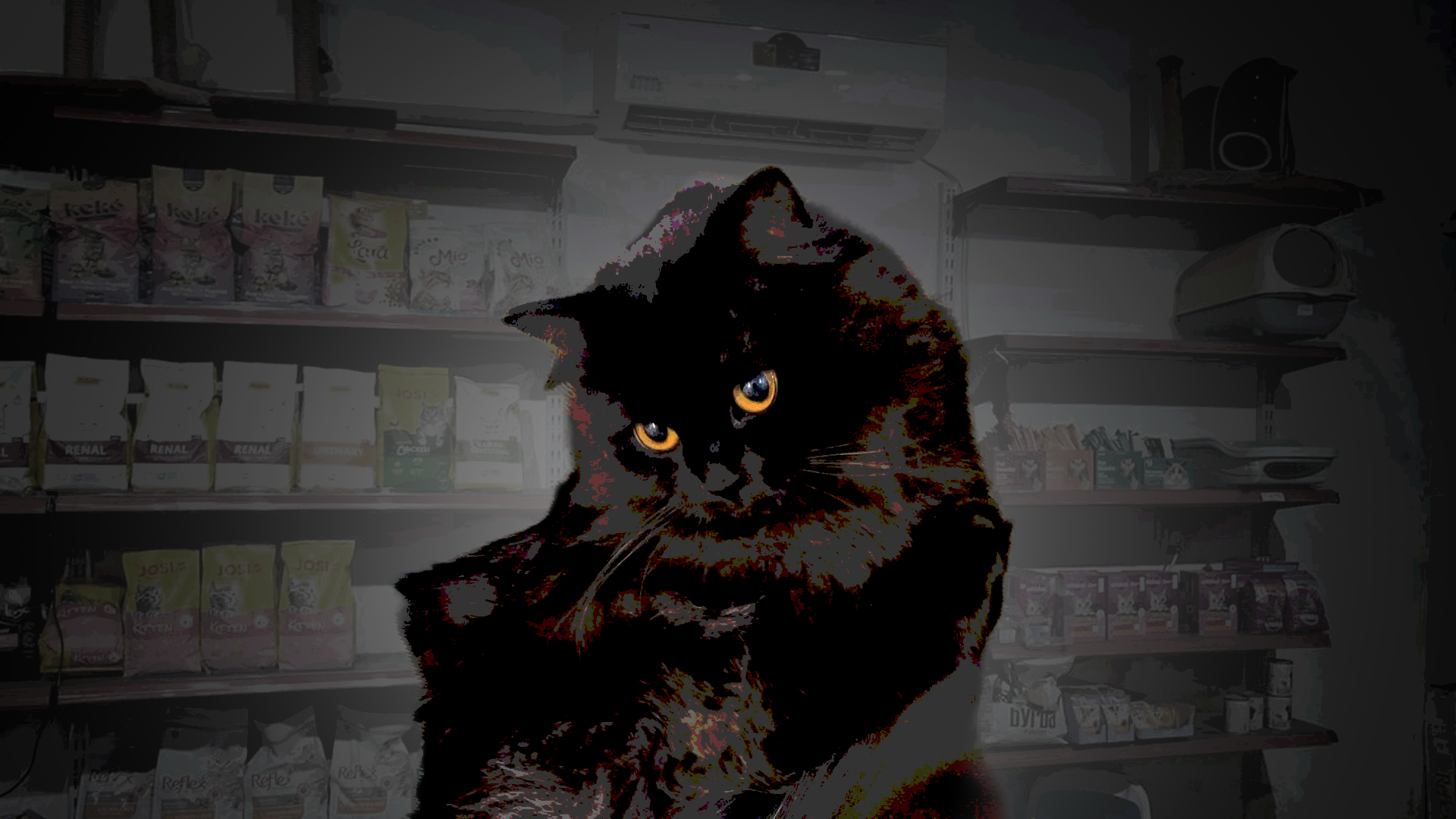
He was a long-haired crossbreed, black with shades of grey. When he arrived, he was calm and affectionate, doing his best to win over my parents, who had initially been against the idea of having him. In time, he became part of the family, pampered and mischievous. Leaping from room to room, making his presence known in every possible way, as if he understood that everyone had grown to love him.
Most nights, he slept beside me, or on the chairs and bags whose warmth and texture he liked. He never missed an opportunity to investigate our food, stretching his head towards the table with quiet curiosity as though he were one of us.
Over time, Kamal found his own ways of making his boredom and anger known. If work kept me away for too long, he would open my bedroom door and scatter my belongings across the room, as if to say, “Why did you leave me?”. I began locking it before I left, placing one of my old shirts on the sofa instead. He would sleep on it until I returned, comforted, perhaps, by the familiar scent.
When I left my therapy session and went home to feed Kamal, the fears I had spent the morning trying to unravel were suddenly before me. For two days, he refused to eat. He had become unusually quiet and weak, and there was something unfamiliar in his eyes. It marked the beginning of a gruelling search for answers across Iraq’s veterinary clinics.
In the days that followed, I took Kamal to six different clinics and received a different explanation at each one. One dismissed him as simply ‘spoilt’. Another advised me to withhold food until he gives in. A third prescribed costly nutritional supplements typically given to older or recently neutered cats, during recovery or in cases of chronic illness, as well as to balance a homemade diet. Such supplements may support an animal’s nutrition, but they cannot replace a proper diagnosis or medical treatment. Yet with every visit, it became harder to escape the impression that profit mattered more than saving a sick animal’s life.
When I requested specific tests, such as bloodwork or viral screening, I was ignored or mocked, as though Kamal was no more than a disposable luxury.
After weeks of going from clinic to clinic, it became clear that my experience was not an isolated one. Many vets confirmed that similar incidents recur across several Iraqi provinces.
Dr Lilian, a vet, animal rights activist and owner of Lilian Veterinary Clinic, says these are not isolated failures. Animals go without basic tests, guesswork replaces scientific diagnosis, and expensive medication is prescribed needlessly.
Some vets dismiss and downplay the seriousness of an animal’s condition, meeting worried owners with ridicule or sarcasm. Treatment often ends when the animal leaves the clinic, with no follow-up and no attempt to establish whether the medication has worked. Other vets rely on “personal experience” rather than current medical protocols, turning treatment into trial and error, with the animal bearing the consequences.
For Dr Lilian, these practices reflect a deeper crisis: poor oversight has allowed some veterinary clinics to prioritise profit over care, treating animals as business rather than patients and putting revenue ahead of their welfare and lives.
“Our experiences with unqualified clinics or people practising without a degree are always frustrating and harmful to the animal,” she says. “Most of them lack the necessary knowledge and proper equipment, which can delay diagnosis or even cause serious complications.”
A properly equipped clinic cannot rely on clinical examination alone, she adds. At a minimum, it should have equipment such as a complete blood count machine, X-ray or ultrasound facilities and appropriate sterilisation equipment.
“When this equipment is not available, the vet has to rely on guesswork,” she says. “That leaves us stuck in the same place and prevents veterinary medicine from developing.”
A divide between city centres and outlying areas
By Friday, with most clinics closed, Kamal’s condition was deteriorating at a frightening pace. He had become withdrawn in a way I had never seen before, his eyes half-closed and his meows barely audible. Rather than coming towards me, he retreated into corners, as cats often do when they are gravely ill or nearing death. His body had grown frail; every movement was slow and strained, and he vomited until there was nothing left in his stomach. I watched him fight to stay on his feet, rising only to take a few steps before collapsing from exhaustion.
Each day, I carried him into a taxi, wrapped in a blanket on my lap, trying to calm him whenever he began to tremble or vomit. He was sick in several cars, angering some drivers and prompting others to end the journey altogether. In the heat of the sun, I moved from one taxi to another with Kamal in my arms, listening to his broken breathing and fearing that at any moment he might stop moving.
On some days, I had to administer intravenous fluids at home, trying to give Kamal enough strength to make the journey. Nearby clinics would promise to wait for us, only for me to arrive and find their doors locked and my calls unanswered.
Eventually, I found an open clinic 35 minutes from my home. The vet examined Kamal with concern and told me that his illness had reached an advanced stage. Treatment should have begun a week earlier, he said. Kamal was placed on daily supportive care, but his condition showed no improvement.
As Kamal’s condition continued to worsen, I contacted a recently qualified vet, whom I will call Leila. From the beginning, she had feared that we were not dealing with an ordinary case of gastritis, but a virus. Gastritis, she explained, usually causes clear diarrhoea or constipation, as well as a distinctive change in the smell of the animal’s stool. Kamal had shown none of these signs.Vaccinated cats can develop subtle symptoms, including hidden mouth sores that make eating so painful they gradually stop.
Leila suggested an ultrasound to rule out constipation or an obstruction, but at the time I could not find a single clinic in the city offering any form of scans. She then advised me to have Kamal tested for viruses. Treatment for gastrointestinal inflammation is generally slow but safe, she explained, whereas a viral infection progresses more quickly, carries greater risks and requires urgent intervention.
International protocols call for a full assessment, including blood tests, viral screening and, in some cases, diagnostic imaging. “Even when the symptoms appear clear, tests are essential to confirm the diagnosis,” she said. “A single mistake or delay can determine an animal’s fate.”
The search exposed stark disparities between clinics. Some lacked basic equipment, while others operated with severely limited resources, raising a wider question, of whether this was simply a shortage of resources, or a failure rooted in the veterinary market itself?
Dr Asaad Al-Mousawi, owner of Al-Narjis Veterinary Clinic and director of Najaf Veterinary Hospital, says these disparities are also shaped by location. On the outskirts of cities, veterinary work is largely focused on cattle, poultry and other farm animals raised for economic purposes. In city centres, clinics treating companion animals such as cats and dogs are more common.
Al-Mousawi says, “This difference is reflected in the standard of service.Clinics in outlying areas may be less well equipped because of the kinds of cases they receive, while those in city centres require more specialised equipment to diagnose illnesses in cats and dogs.”
A thorough diagnosis, Al-Mousawi explains, begins with the animal’s medical history, followed by a clinical examination and laboratory testing. Temperature, heart rate and breathing must be measured, while blood and other bodily samples may also need to be analysed.
“Without these steps, the diagnosis remains incomplete,” he says. “An incomplete diagnosis can lead to serious harm.”
Kamal bore the consequences of those failures. Each delay made him sicker, pulling him into a cycle of unsuitable medication and conflicting diagnoses. A rapid viral test should have brought answers. Instead, the vet misread it and claimed Kamal had feline plague a serious disease he said could spread to humans. His recommendation was blunt: euthanasia, before Kamal endangered my family.
I refused, took a photograph of the result, and began searching for answers myself, only to discover that the vet had misread it and that the disease was not, in fact, transmissible to humans.
By then, treatment had become another form of suffering. Kamal was given unmeasured doses of intravenous fluid, while repeated blood tests left his legs swollen and dislodged his cannula more than once. Soon, he feared every touch. He trembled and cried when he recognised the road to the clinic, stopped eating and drinking, and fought anyone who tried to treat him.

After weeks of suffering, we finally found a skilled vet willing to treat Kamal at home. He came every day, administering medication and fluids with a patience and gentleness Kamal had not experienced in weeks. He refused to take any payment. Thanks to his efforts, slowly, Kamal began to stabilise. He ate from my hand again and answered my approach with a faint meow. Little by little, life seemed to return to him.
Malpractice and oversight
As I searched for a way to save Kamal, another truth emerged. The woman I had trusted as a vet for years was not a vet at all, but a pharmacist awaiting a government appointment. I later discovered that the owners of four other clinics I had visited were facing legal action for posing as veterinary professionals.
This apparent impunity may be no coincidence. Speaking on condition of anonymity, sources said some of those operating fraudulent clinics have ties to political parties and influential figures, shielding them from accountability. Fearful of reprisals, they would not name the clinics or their owners. Attempts to expose these networks, they said, are met with threats and intimidation.
By then, Kamal’s illness was no longer the only danger. Behind signs promising “compassion for animals” stood a network of corruption operating with little oversight. As I carried him from clinic to clinic, I began to understand that the threat was not only inside his body. It was built into a system that left animals, and the people desperate to save them, vulnerable to neglect and fraud.
For Dr Lilian, the consequences arrive at her clinic every day. “We see animals that have already suffered severe harm elsewhere,” she says. “Some were given the wrong medication, others underwent surgery without proper sterilisation, and many were treated on the basis of arbitrary diagnoses.”
Dr Asaad Al-Mousawi acknowledges that such violations exist and says they are handled by the Iraqi Veterinary Medical Syndicate and specialist committees. But their reach is limited. “The syndicate’s procedures are adequate to a point, but they are not enough.” he says. “Unqualified practitioners have been entering the profession for years. Tackling the problem requires cooperation from the Economic Crime Directorate and the organised crime authorities. No single body can hold them accountable alone.”
I contacted the Veterinary Medical Syndicate several times in search of precise figures but received no response. The anti-crime authorities, which should play a central role in holding offenders to account, did not respond either.
After weeks of journeys between clinics and constant fear, Kamal recovered. But neither of us emerged unchanged. He became afraid of roads, strangers and, at times, even me. I still tremble whenever he falls ill or grows quiet.


Kamal now. Source: author.