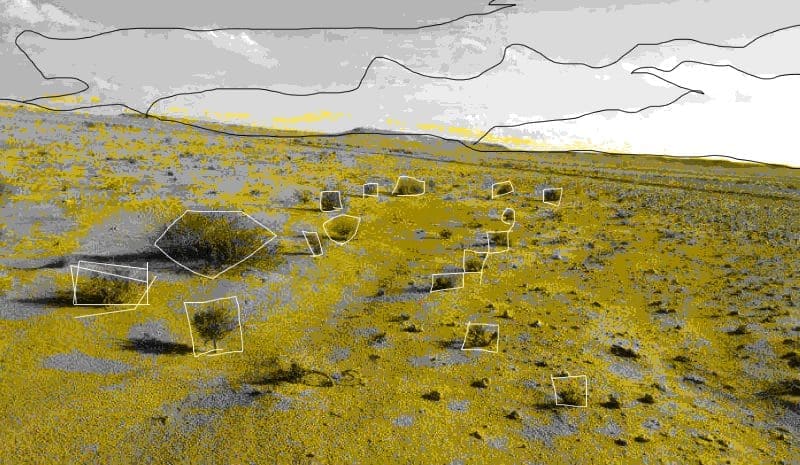

In Nimrud, a southern subdistrict of Nineveh where land once shimmered gold with wheat and green with barley, farmer Abed Ibrahim stands above cracked soil. He bends down, gathers a trace of dry soil between his fingers, as if pleading for the life that vanished with the rain.
With a voice full of anger and sorrow, he says: “The farmer is exhausted. Bread has become the reason for his sorrow. You took his wheat — give him his dues. The rest is up to God.”
Abed is no stranger to this land. He inherited it from his father and grew up farming it. He still tends the plots of his eight siblings who left the countryside for the city.
But now, in his sixties, he faces a season he has never witnessed. “We plated,” he says bitterly, “but the rain was scarce. We got nothing. Everything is lost. We sowed eight tonnes of wheat and six of barley, and there was barely a harvest.”
His words are not an isolated grievance. They encapsulate the tragedy of hundreds of farmers in a province once known as “Iraq’s food basket”, now pushed toward abandonment under the weight of relentless drought and governmental neglect.

For years, the province accounted for roughly 43 percent of Iraq’s cultivated land and alone produced more than a quarter of the country’s wheat, according to the Agricultural Statistics Directorate.
The numbers back Abed Ibrahim’s account: Nineveh’s Agriculture Directorate reports that average rainfall this year barely reached 100 mm, compared to 500 mm last year — less than one-fifth of normal levels.
Weather stations in the cities of Mosul, Tal Afar, and Rabia recorded extreme fluctuations between 2022 and 2024. Mosul at one point saw only 43.3 mm of rainfall — its lowest ever — with an annual average of just 83.9 mm, making it among the hardest-hit by drought.
The collapse in rainfall meant poor soil nourishment, falling groundwater levels, and wells drilled to depths of 200 meters instead of 45.
But lack of rain is only a part of Abed’s crisis. “Farming has become a gamble,” he says. “If rain comes and the crops grow, that’s good. If drought comes, we lose everything we paid for: seeds, pesticides, and supplies.”

Many farmers have abandoned their land entirely, waiting for a better rainy season because they cannot afford to dig deeper wells.

Abdullah Hamo, director of the Nineveh Agriculture Directorate, acknowledges that the situation deteriorated under the latest agricultural plan. The plan approved only areas irrigated by sprinklers — just 10% of the province’s total farmland. Later, a further 59,000 hectares were added outside the plan, but the state ultimately recognised only 320,000 hectares.
This means that Abed’s land is not officially recognised under the government’s plan, and the state has no obligation to buy his harvest.
While Hamo speaks in the language of figures and policy, Abed’s response lands with a different weight: “Praise be to God. Everything is in his hands. Whatever comes, we accept.”
A stark contrast: a man facing his land with bare hands, and a government counting seasons through tables and circulars.
Environmental researcher Muna Abdel Qader tells Jummar, “Nineveh has faced harsh climate conditions. Low rainfall, higher temperatures, repeated droughts. Even the wet years no longer make up for the dry ones. The region has become extremely fragile.”
Abed doesn’t read climate reports. He simply sees his land is dying in his hands.
“The government is slow and weak in its support,” he says. He believes it has leaned on imported grains while leaving farmers to face drought alone.
The Ministry of Trade argues that limited storage capacity and budget constraints caused crops to pile up, leading to heavy losses. It denies purchasing wheat from farmers at low prices; but farmers, however, insist these justifications reflect administrative mismanagement rather than the actual conditions on the ground.
Between Abed’s tears falling onto cracked soil and officials’ spreadsheets declaring the season a failure, one thing becomes clear: Abed’s story is not isolated. It is the story of an entire province at the brink of desolation.
Drastic cuts with far-reaching consequences
Across the stretch of farmland between the cities of Nimrud and Hamdaniya, farmer Khaled Al-Nujaifi points to the hundreds of hectares his family cultivates.
This year’s agricultural plan, he says, has pushed farmers to a breaking point: “It broke the farmers’ backs,” he says. “We planted around 400 dunams [hectares], but only 220 were approved under the government’s plan. We submitted additional requests and delivered 2,400 tonnes yet 900 tonnes were never collected. For the crops they did collect, we were paid only 1 percent of what we were owed.”

Khaled Al-Nujaifi’s frustration reflects a province-wide gap between what farmers produce and what the state is willing to acknowledge. Official figures underline the scale of this gap: according to Abdullah Hamo, head of the Nineveh Agriculture Directorate, planned agricultural land has collapsed from 195,000 hectares in 2022 to just 32,000 this season.
The drop is so steep that last year’s achievements feel almost implausible. In 2024, Nineveh topped Iraq’s wheat output, producing 1.394 million tonnes over more than 350,000 hectares according to to data from the Central Statistical Board.
Under the new rules, any land farmed outside state-approved zones is not officially recognised. The government is therefore not obliged to buy the harvest, even when the crops are healthy and in demand.
This policy has prompted protests across the province, including from Al-Nujaifi, who says the measures hit both large producers and smallholders.” This isn’t a plan,” he says. “It’s a way of forcing us off our land. How can anyone farming thousands of dunams [hundreds of hectares] survive losses like this?”
Al-Nujaifi is not alone. Abdulhamid Al-Jubouri, head of the Farmers’ Union in Nineveh, says the crisis is now province-wide. “The laws are unfair,” he tells Jummar. “The federal government has no proper strategy and no qualified agricultural advisers. Farmers don’t receive meaningful support, and they don’t receive full payments.”

He explains that those delivering 25 tonnes of wheat are paid only 25% of its value — the same proportion applies to 50 tonnes, and those delivering 100 tonnes receive less than 20%. Some farmers were paid nothing at all.
Al-Jubouri argues that fuel, fertiliser, and seed allocations should be provided by the government before planting season to prevent farmers from turning to black-market suppliers. Instead, “payments are delayed by up to six months,” he says.
Further, “obtaining fuel permits can take months because of security procedures.” Al-Nujaifi adds that: Land without updated deeds, especially plots tied to Article 140 or inherited informally, is automatically excluded from support. Even registered agricultural deeds create complications, requiring every heir to formalise their share, leading to unworkable divisions of seed and grain allocations. This has deterred many farmers from collecting what they are entitled to.
This maze of bureaucracy is reshaping the reality of farming. In Nimrud, cultivated land has fallen from around 12,500 hectares annually to just 1,900 hectares this season.
Thousands of farmers have been unable to sell their crops, and many believe Nineveh is being treated more harshly than other provinces granted greater flexibility by the federal government.
Al-Jubouri describes the situation as “catastrophic.” He says, “farmers are drowning in debt. The agricultural bank is pursuing them. The markets offer no guarantees for revenue.” If the government wanted to help, he says, it would at least pay farmers on time. Instead, it refuses to receive crops grown outside the approved plan — even those irrigated through official channels.

“We protested outside the Ministry of Trade in Baghdad,” he says. “They accepted crops for two days, then shut their doors.”
This experience has left Al-Nujaifi disillusioned: “All this talk about supporting farmers is just words. We plant, we risk everything, we pay from our own pockets — and in the end, no one buys our harvest or even covers the cost of seeds.”
As Al-Nujaifi describes the strain on major growers and the Farmers’ Union relays the anger of thousands, it is clear that what began as a climate-driven crisis has deepened into something structural — a policy environment that is pushing farmers off their land and turning agriculture into a losing risk.
Food security under threat
On the outskirts of a small town in the Nineveh plains, farmer Khalifa Al-Jubouri stands over his parched field. He digs through a handful of soil, letting it crumble through his fingers, as though bidding farewell to the memory of past harvests. “We no longer plant,” he says quietly. “We wait. We wait for a decision that does us justice, or for a season that won’t destroy us.”
His words echo the predicament of thousands of farmers facing two equally grim choices: plant and risk total loss due to lack of water and state support, or abandon the land and look for a different way to survive.
For many, the land no longer feels like a source of life, a mother that shelters them — but a burden that weighs heavily on their shoulders.

Yet the implications extend far beyond Nineveh. Environmental researcher Muna Abdel Qader warns that the province’s agricultural collapse poses a direct threat to Iraq’s food security. Given that the province of Nineveh is one of the main producers of wheat and barley, its decline will push Iraq further toward imports, raise food prices, and further undermine livelihoods across rural areas.
“Food security is at risk,” she says. “Climate change, combined with dependence on water inflows from neighbouring countries, has made agriculture extremely fragile.”
Falling water levels at the Mosul Dam, driven by reduced flows from Turkey, have weakened supplies for irrigation and drinking water. Groundwater is being overdrawn. Some wells have dried up entirely.

The crisis, Abdel Qader stresses, is neither localized nor temporary. It is part of a national emergency that requires long-term planning rather than short-term fixes.
She outlines possible solutions: drought-resistant crops, improved irrigation systems, rainwater harvesting, sustainable farming models, a national water emergency plan, and infrastructure repairs.
But her assessment is grim: “There is no sign of a government plan for the next season — and no indication that weather patterns will improve. The only hope is that the coming rains save what remains.”
As policymakers debate long-term strategies, Khalifa Al-Jubouri’s voice returns — a reminder that farmers cannot survive on policy recommendations, but on what the land yields. “It’s not just planting and harvesting,” he says, turning away from the barren earth. “This is our life. If we leave it — what do we have left?”
His words carry a sobering warning: When a farmer leaves his land, he does not leave alone. The loss is collective — wheat, barley, the bread on Iraqi families’ tables, and food security all leave with him.
Nineveh — once Iraq’s food basket — now stands on the edge of becoming barren ground. Its farmers are trapped between a sky without rain and a government without a plan, waiting for decisive government action or for mercy from the rain.
This article is adapted from Arabic, available here.