
The Hindiya Barrage stands across the Euphrates, its concrete pillars and iron gates regulating the flow into the riverside town of Al-Sadda in Babylon Province. Life here follows the rhythms of the river. People fish, drink fresh milk, go to bed early, and rise to enjoy one of Iraq’s most famous breakfasts.
In its quiet villages, people do not need alarm clocks to wake them. The bellowing of buffalo from nearby pens is enough to announce the start of a new day. With the first light of dawn begins a tradition passed down from fathers and grandfathers for more than a century. That is the tradition of making qaimar, the rich white cream that is a standout item of the Iraqi breakfast table.
Do not expect this creamy delicacy to arrive rolled and artfully arranged. It is simply a white square in a moat of milk, its humble appearance concealing an extraordinary taste.
But behind its rich flavour and distinct aroma lies a story of drought, soaring feed prices, and indigenous Euphrates buffalo struggling to survive. It is also the story of breeders who possess little beyond their patience, their hopes, and the sweat they have poured into a life bound to the river.
On the eastern side of the town, in the district of Al-Zawiya, a single household remains responsible for producing this national delicacy: the home of Umm Abdullah, the qaimar maker who passed away two decades ago.
The road to the house begins where the tarmac ends, on a muddy lane enveloped in shrubbery barely wide enough for a single vehicle. At the end of this road sits the river and wide stretches of green pasture and farmland.

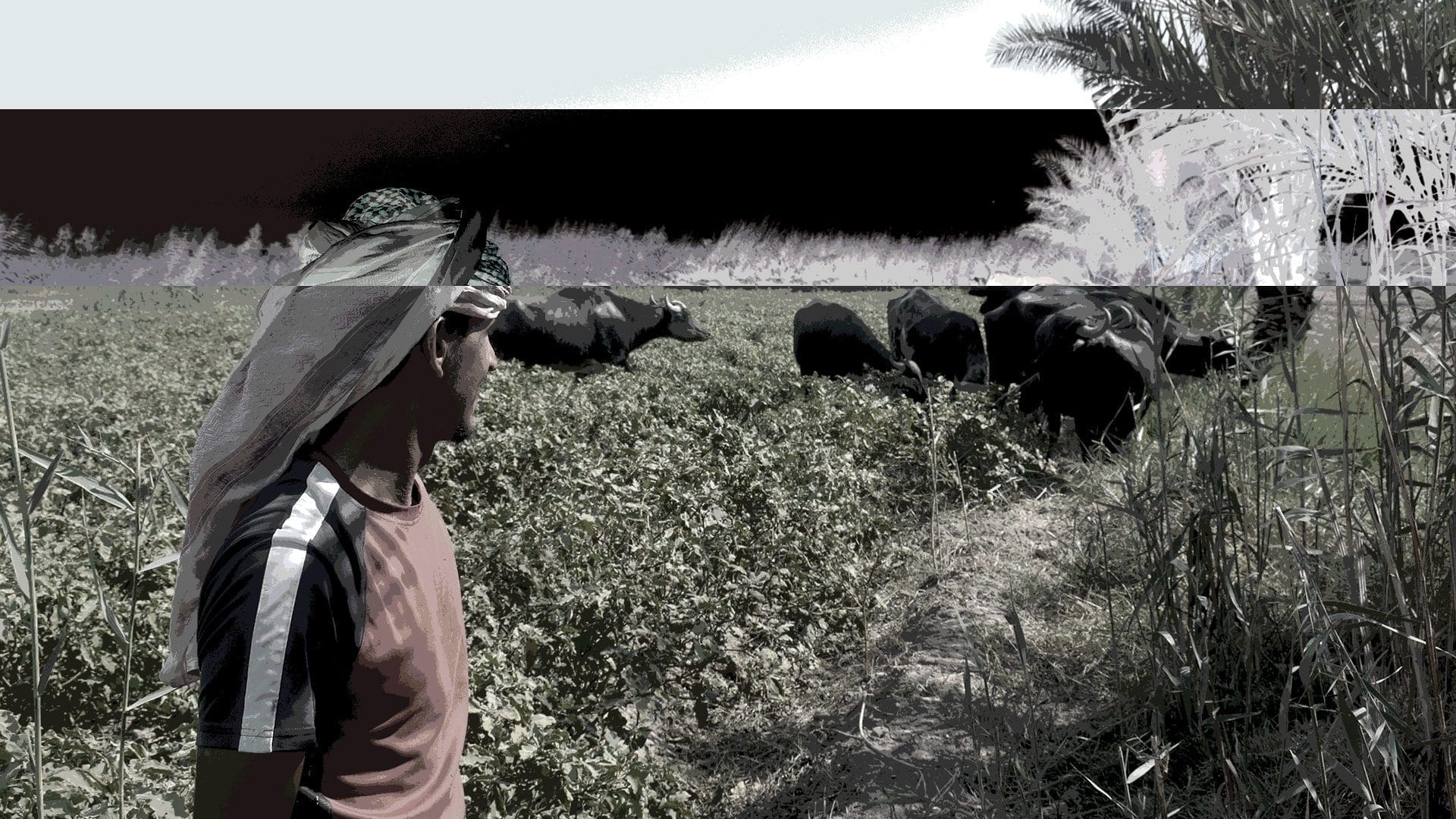
Here, under a blazing mid-morning sun and temperatures above 40°C, dozens of buffalo move lazily, chewing and observing the world through their calm, dark eyes. Standing among them was Muslim Abdullah, Umm Abdullah’s grandson, planted firmly between his herd of Euphrates buffalo, his stick driven into the ground like a commander among his troops.
Muslim carries generations of expertise in buffalo rearing and the production of authentic Iraqi qaimar. But with the locally recognised water source of Al-Sadda being impacted by drought, he worries for the future of the buffalo breeding that has run in his family for generations.
“Two years ago, before drought became a reality, we were blessed,” he says while gazing at the herd with eyes revealing both affection and concern. “We used to produce between 25 and 30 kilograms of qaimarevery day. But once the drought hit, we were forced to sell some of our animals just to buy feed and keep the others alive.”
Muslim’s weathered features reflect years of experience and an intimate understanding of every aspect of buffalo life.
But he is not only a buffalo breeder. A graduate of the Faculty of Agriculture at Al-Mustansiriya University, he often shared his family’s renowned qaimar with fellow students in Baghdad.

Today, only 60 to 70 buffalo remain, down from around 150.
“Everything has changed,” he says. “Production has fallen. We have to provide different types of feed, wheat straw, bran, flour, and cottonseed, which increases the milk’s fat content. All of it has to be bought at high prices. Buffalo feed is extremely expensive, but we must preserve the herd. The only way is to sell some animals in order to support the rest.”
In July 2025, Iraq’s Ministry of Water Resources announced that the country was experiencing its driest year since 1933. The flow of the Tigris and Euphrates rivers had fallen to just 27 percent of the previous year’s level, while water reserves in dams and reservoirs had dropped to only eight percent of their storage capacity, a decline of 57 percent compared with the year before.

This dry season has also struck Al-Sadda. What was once known as a water-rich area has become, in local terms, a “water waster” rather than a “water chest” as the Euphrates has receded. The change has profoundly affected buffalo, whose lives depend entirely on water.
The Euphrates buffalo
“Heeeeyaa, Rabaa’a! Heyaa, Wooord! Come here, come here!”
This is Muslim’s call to the buffalo. The sounds seem to come from deep within him. They are neither words, nor dialect, but calls formed with different tones and rhythms. At the sound of its name, the buffalo will stop feeding and raise its head in response.
Pride shines through him whenever he speaks about the animals.
“The first requirement for good qaimar is the quality of the livestock, and our buffalo are pure Euphrates stock. The second is what they eat, like bees whose honey taste better when they feed naturally.,. Our buffalo are native Euphrates buffalo, and this breed completely determines the flavour of the qaimar.”
He adds, “We preserve this lineage because it is important and rare. It has been passed down for centuries and differs greatly from the marsh buffalo in appearance, milk flavour, and many other characteristics.”
Most of the animals in the field have little body hair. They are large, powerful creatures with muscular frames, bright black eyes framed by long lashes, crescent-shaped horns that curve outward, and a gentle, curious gaze.
Thamer Al-Khafaji, Director of Agriculture in the Babylon Province, told Jummar that the buffalo originally came from India. “It is a magnificent East Asian animal that has been raised in Iraq and has a very high productive yield compared with other livestock.”

He notes that the province is particularly known for this breed, valued for its beauty, large size, and abundant production.
The milk produced by these animals is transformed into distinctive products such as the famous qaimar Al-Sadda and high-quality cheese.
“This breed forms part of the province’s agricultural and culinary identity,” he says proudly.
According to Al-Khafaji, buffalo breeding in Babylon is concentrated mainly around the Hindiya Barrage and Al-Ayfar areas, as well as other scattered locations.
“The buffalo are mapped out against the riverbanks,” he explains. “They rely heavily on water and ponds where they can swim. The aquatic environment is crucial to their survival and productivity.”

Muslim recalls a visit by an elderly Kurdish expert, accompanied by a delegation from the Food and Agriculture Organization (FAO), who admired their Euphrates buffalo and described them as among the finest buffalo breeds.
With pride, he points to a buffalo which was more than 20 years old.
“You can see that all the horns look alike. None point sharply up or down. They remain close in shape. We call this akur. It’s proof that they belong to the same lineage. This buffalo is 20 years old and still strong and productive.”
He looks affectionately at the animal that accompanied him from childhood into fatherhood.
Drought
Dwindling water supplies have become a serious threat to the survival of the buffalo. “Drought has affected us enormously,” says the thirty-something farmer. “Water is becoming scarce, and buffalo need large quantities of it to survive and continue producing milk. We try to provide water wherever possible. We create small ponds, clean them, and let the animals swim to ease the summer heat.”
“If we do not intervene, drought will continue to affect milk production, and preserving this heritage will become increasingly difficult.”
He adds regretfully: “The future doesn’t look good. Every day conditions become harder for the livestock. Water accounts for about 75 percent of milk production. Any shortage leads to a noticeable decline in qaimar production.”
On breeding cycles, Muslim explains that “From September onwards, the breeding season begins. At the start of summer, production drops, so qaimar is more abundant in winter than in summer. During the summer, we often have to sell calves and young animals to afford feed.”
A buffalo typically produces around 15 kilograms of milk a day, he says, although quality depends on proper care and nutrition.
A walking dairy factory
Muslim explains that buffalo feed changes with the seasons.
“In winter we use dry straw, bran, flour, cottonseed and clover. In summer we feed Iraqi alfalfa, maize and bran.”
Iraq remains an important home for water buffalo, most of which are concentrated in the southern marshlands.
Archaeological evidence, including depictions dating back some 4,600 years, indicates the presence of buffalo in ancient Mesopotamia.
Today, however, those ancient animals face an uncertain future. Climate change and declining water resources continue to place buffalo populations under severe pressure.

Al-Khafaji, the Director of Agriculture, believes preserving this resource is a government responsibility. “We call for support for buffalo breeders because this animal could disappear from Iraq,” he says.
Al-Khafaji noted that the Directorate of Agriculture conducts weekly field visits through its livestock department and veterinary teams to monitor and care for the animals.
Qaimar Al-Sadda
Muslim remembers only fragments of his grandmother’s life spent among milk, smoke and fire. He inherited the craft of qaimar-making from her.
“We milk the buffalo twice a day, at five in the morning and five in the evening. The morning milk is immediately cooled in freezers. Cooling is the most important step because any delay can spoil the milk.”
“In the afternoon, we mix the morning milk with the evening milk and place it in saffari pots (special vessels heated over a fire using traditional methods). We use a wooden stirrer made from the branches of the takitree. We never use metal utensils such as ladles,” he stresses. “Metal affects the flavour of the qaimar.”
“We stir the milk for an hour, then cover it with a basket woven from pomegranate branches and leave it exposed to the air for six hours. A layer of qaimar forms on the surface.”
“The following morning, we remove the qaimar and place it in a shallow layer, so it floats above the remaining milk, known as halib raji’ (returned milk), which is then used to make cheese.”
“This method comes from my ancestors, from my grandmother to my mother, and we preserve it as authentic Iraqi heritage.”

Marketing the cream
“We have a shop in Al-Sadda and another sales point at the Al-Sadda–Al-Musayyib junction. Our area is well known for qaimar.” Muslim shared when discussing the marketing of the delicacy. When asked about shops in Baghdad that advertise Al-Sadda qaimar, he replies,
“Anyone who tastes our qaimar and then tries what’s sold in Baghdad immediately notices the difference. We have preserved the entire preparation process since the time of my grandfather, who was born in 1920. Even my great-great-grandfather was making qaimar before us.”

For Muslim and his family, qaimar is far more than a trade. It is history, heritage, and a living social tradition. It is not merely a food product but a collective family endeavour, involving everyone from dawn until evening and inherited by one generation from the last as a marker of identity and belonging.
Customers know the way to the family home and go there before the shops even open. Some travel dozens of kilometres to secure their weekly share.
During religious festivals and agricultural seasons, demand rises even further. Qaimar becomes a symbolic currency, gifted in the way gold might be.
Every plate of qaimar sold carries with it the story of a particular buffalo, a particular stretch of river water, and a household whose members still begin each dawn with milk, smoke, fire, and memory.