
Iraqis’ choices in the 2025 elections: boycott, participation, and hesitation

Hassan Al-Mashaal

30 Oct 2025

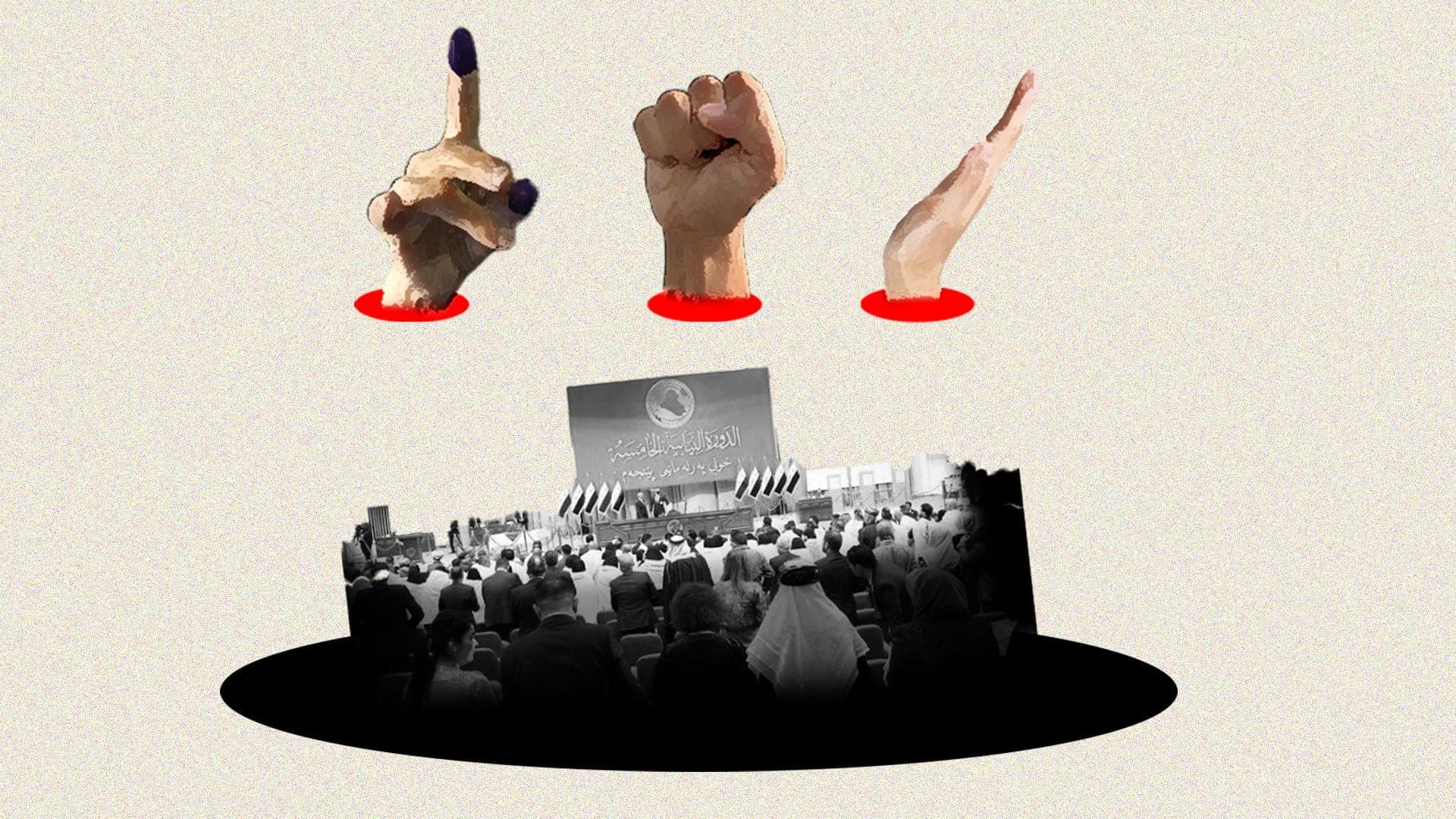
Between those who view boycott as protest, those who wager on participation as a limited chance for change, and those who hesitate between the two, this article explores the three choices facing Iraqis in the upcoming November elections.

Iraq’s 2025 elections take place amid deep public scepticism. For some, abstaining from voting is an act of defiance against a political system incapable of reform. Others place their hopes in the ballot box as the only remaining tool for peaceful change. Between them stand the hesitant—citizens torn between the disappointments of the past and fear that history will repeat itself. Together, these stances reveal the depth of Iraq’s political crisis.

Past election cycles have shown that unorganised and individual boycotts rarely weaken those in power. Instead, they allow the political class to reproduce itself with greater ease. At the same time, participation without coherent organisation or political vision has failed to challenge traditional forces or convert new votes into a meaningful counterweight. As the same drivers persist—from the dominance of armed and financial power to the absence of electoral transparency—the 2025 vote becomes a test of Iraqis’ ability to channel anger into organised political action rather than passive withdrawal or symbolic voting.

To go beyond speculation and measure public attitudes directly, a survey titled “Boycott or participation? What will Iraqis decide in the 2025 elections?” was conducted among 229 politically engaged respondents. It explored motivations behind each stance, the reasons for indecision, and the social groups most likely to shape the upcoming vote.

When asked about their voting intentions, respondents divided into three clear groups: 36.2 percent said they planned to participate (83 people), 43.2 percent said they would boycott (99 people), and 20.5 percent said they were still undecided (47 people).

Boycott as protest

Widespread frustration with poor services and the constant absence of security pushes many Iraqis to revisit the lessons of previous elections. For them, today’s deteriorating conditions are a direct outcome of long-standing political dysfunction.

Boycotts first emerged in 2014 but had limited impact then, as around 60 percent of eligible voters still cast their ballots. By 2018, however, calls for abstention had intensified, and turnout dropped to roughly 44.5 percent. That decline reflected more than boycott fatigue: it coincided with the fragmentation of Shia political blocs into rival lists, ending the image of a unified Shia front that once lent the process a veneer of stability. An electoral law designed to benefit entrenched powers, a commission perceived as partisan, and growing conviction that results were predetermined through fraud and political deals all deepened disillusionment.

When the country’s religious authority lifted its implicit call for participation, many Iraqis interpreted it as further confirmation that voting had lost its purpose. From that moment, boycott became a public, deliberate act—a way to reject a political process seen as self-perpetuating, whatever the ballots said.

At the time, many viewed boycotting as a means to delegitimise the next government and protest what they perceived as a lack of independence within the electoral commission. Their scepticism was rooted in earlier events—most notably the 2010 elections, when Ayad Allawi’s victory failed to secure him the premiership after Nouri al-Maliki retained power through what was widely described as a legal manoeuvre exploiting the term “largest bloc” in the constitution. The episode cemented the belief that elections did not necessarily lead to a real transfer of authority.

More recently, boycotters point to a second “constitutional manoeuvre” in 2021. After the Sadrist bloc won and sought to form a majority government, the emergence of the “blocking third” and subsequent armed clashes in Baghdad’s Green Zone between Sadr loyalists and factions of the Popular Mobilisation Forces (PMF) delivered a fatal blow to what remained of public trust.

Calls for abstention have intensified again ahead of 2025, fuelled by the exclusion of more than 750 candidates on various pretexts—from alleged Baath ties to legal, ethical, or integrity cases. Many of those disqualified were current or former MPs, ministers, and governors.

For large segments of the electorate, these exclusions appear less legal than political, aimed at narrowing competition between rival blocs. Oversight has also expanded: whereas candidate lists once required approval from four agencies, they now pass through thirteen, including the PMF Commission—an expansion seen as politicising vetting rather than ensuring integrity. Add to this the continued impunity of armed party militias, in open violation of the Parties Law and electoral rules, and mistrust deepens.

That disillusionment is also rooted in recent experience. Many of the Tishreen activists and independent MPs who rose from the protest movement later joined the very establishment forces they had opposed. Their shift stripped both the process and their own rhetoric of credibility, reinforcing the perception that elections merely recycle the same elite under new banners.

A rejection of the rules of the game

Those calling for a boycott are not indifferent; their stance reflects a profound loss of trust in the electoral process itself. According to the survey, 41.4 percent of respondents refuse to vote because of the dominance of armed groups and traditional parties over the state. Another 33.3 percent said they had lost all faith in elections as a vehicle for change, 15.2 percent saw no political alternative worth supporting, and 10.1 percent pointed to the weak programmes and vague visions of most candidates.

In their testimonies, boycotters expressed these motives in vivid terms. One said his decision was “more about avoiding catastrophic regret than achieving change”, adding that he “wouldn’t vote for anyone, even if the candidate were his own father”, because disappointment might drive him to “cut off the finger stained with ink”. Another said bluntly: “As long as armed power remains in the hands of every sect and Islamists stay in control, nothing will change.” A third linked his stance directly to the structure of the state: “It’s the same reason Muqtada al-Sadr withdrew—so long as armed factions are stronger than the state, ballot boxes won’t bring change.”

The limits of boycott

Even among those determined to abstain, few believe boycott could topple Iraq’s entrenched political elite. For most, it was a symbolic gesture of protest. Sixty-one percent said they did not see it as a real form of pressure on those in power, compared with 39 percent who believe it could change results if it became widespread.

In that sense, boycott appears less of a political strategy than a withdrawal from a game whose rules are already rigged.

Yet it is not an unshakable position. Of the ninety-nine respondents who plan to boycott, 50.5 percent said they might reconsider if the influence of armed and financial power was curbed. Thirty-one percent said they could change their mind if genuine; national civil forces emerged, and 30.3 percent if the integrity of the elections were clearly guaranteed. Only 22.2 percent said nothing could alter their stance.

These results show that boycott is not an ideological constant but a reaction to mistrust—one that could shift if the political environment improved, and elections became a credible mechanism of representation.

Several political and cultural observers differentiate between passive boycott—a silent withdrawal that leaves the field open to the ruling class—and organised boycott, coordinated by opposition forces with clear public messaging, legal advocacy, and social mobilisation. The latter, they argue, could turn abstention into effective political pressure rather than a form of retreat. From this perspective, boycott is not an end in itself, but a tool that only matters if it can impose new realities or strip legitimacy from those in power.

The case for participation

In contrast, those who advocate participation believe there is no path to change in Iraq except through the ballot box—by weakening the traditional forces and supporting civil and secular parties that have opposed government corruption and foreign interference over the past years.

For them, the 2021 election experience should not serve as a benchmark. Most Tishreen-inspired movements that ran then had little political or organisational experience, having moved directly from the protest squares to the ballot.

The movement Imtidad illustrates this. After winning sixteen seats, it quickly fractured, with several MPs joining the very establishment blocs the protests had risen against. MP Nisan al-Zaer is now running with the State of Law Coalition led by Nouri al-Maliki, while Diyaa al-Hindi and Noor Nafea al-Julihawi joined the Reconstruction and Development Coalition of Prime Minister Mohammed al-Sudani—an alliance that includes figures tied to the ruling elite rejected by the Tishreen uprising. The speed of these shifts exposed the lack of firm political vision and the fragility of the “independent” identity under which these MPs had run.

Still, advocates of participation argue that the 2025 elections differ fundamentally. Most known secular candidates have now completed a full parliamentary term under public scrutiny, giving voters a clearer basis for judgment. Scheduled for 11 November 2025, these elections are also taking place amid broader, better-organised civil alliances, such as the Alternative Coalition, which brings together liberal and leftist candidates, and the Civil Democratic Alliance. These umbrella groups for independents and civil movements did not exist at a comparable scale in 2021.

While turnout in 2021 officially stood between 41 and 43 percent of registered voters—much lower when measured against the total eligible population—it still produced opposition voices in parliament alongside pro-government blocs. For advocates of participation, this outcome proves that gradual change through cumulative gains remains possible.

They also warn that widespread abstention would simply reproduce the current parliament, widely described as one of the weakest since 2005. The present legislature began with replacements for the 73 Sadrist MPs who withdrew, and it has passed several controversial laws, including amendments to the personal status code that undermine women’s rights. It also adopted the “one-basket vote” procedure, approving multiple bills at once without full parliamentary debate or individual roll-call votes—a violation of basic democratic principles. Even sensitive laws, such as a list of dozens of ambassadorial appointments, were passed in this way.

For advocates of participation, such practices highlight the need to push for a more accountable, pluralistic parliament, not to abandon the process altogether. In their view, boycott will not produce a better legislature—it will only leave the field open for those already in power.

Change from within

Those planning to vote do not see participation as a routine civic duty but as a form of resistance against the forces that have monopolised power for years. According to the survey, 38.1 percent said their goal was to reduce the influence of traditional blocs, 32.1 percent wanted to open space for new political figures, and 16.7 percent believed participation could lead to partial policy or legal reforms. Only 7.1 percent said they were motivated by local or personal concerns, indicating a broadly political motivation.

Several respondents reflected a shift in sentiment towards the ballot. One said that “the failure of boycott to produce an alternative project” had convinced him to support candidates “who speak clearly against arms, corruption, and chaos”, hoping that “a single voice might become many—enough to change the laws”.

Another described participation as “the closest path to change”, calling it “a peaceful and legitimate tool in citizens’ hands”. Boycott, he argued, “empties the field of reformist voices and hands traditional forces unchecked dominance”, adding that “change doesn’t come through absence, but through conscious voting and sustained pressure”.

A third respondent said, “Boycott once seemed convincing, but today it feels like fantasy. Secular-leaning figures have shown genuine representation, and I feel a moral responsibility to vote. The road is long—it requires participation and hard legislative work to strip traditional forces of their power.”

What voters hope to achieve

Few expect dramatic change overnight. Instead, they see participation as part of a long process of building a credible civil opposition. Among the 83 respondents who plan to vote, 51.8 percent said their main goal was to strengthen the parliamentary opposition, 45.8 percent viewed this election as a rehearsal for future transformations, and 37.3 percent hoped it would gradually open the door to broader political reform.

Their enthusiasm, however, remains conditional. Belief in incremental change does not mean accepting a contest that feels predetermined or a process dominated by corrupt practices. Many said their decision to participate depends on a minimum level of trust in the elections’ integrity.

A third of participants (32.5 percent) said they would boycott if civil or opposition candidates were excluded. Around 28.9 percent said they would not vote if they lacked a candidate who truly represented them. Another 21.7 percent said a high risk of fraud could make them withdraw, while 15.7 percent cited the growing power of arms and political money as enough reason to abstain.

Conversely, 36.1 percent said they would vote regardless of circumstances—reflecting a small but resolute group that views participation itself as a political act of resistance, even in the worst conditions.

Still, this optimism remains fragile. Any decline in electoral guarantees, restrictions on independent candidates, or expansion of armed influence could easily undermine confidence and reignite the argument that boycott is a more effective form of pressure than playing a game that cannot truly be won.

The undecided

Hesitation is not as clear-cut a stance as boycott or participation. It reflects a blend of three factors: loss of trust in the electoral process, the absence of convincing alternatives, and a sense of political fatigue hardened by years of disappointment.

Yet hesitation does not necessarily mean neutrality. Within it lies the potential to shift towards either side once the right motivation appears. As the 11 November 2025 elections approach, this group has become the main target of political messaging, especially in the final weeks before the campaign silence period.

The media plays a decisive role in shaping the opinions of these undecided voters. Party-affiliated outlets push the narrative that participation is essential to “protect stability”, while opposition forces frame boycott as a legitimate act of protest to delegitimise the ruling elite. However, the most influential voices today are not traditional media but influencers and public figures who have earned the trust of this group online. On social media, short, emotionally charged messages can sway opinions within days.

Beyond rhetoric, some established parties use direct material tactics to win over the undecided in the days leading up to the vote—distributing cash, food baskets, and basic supplies to poor or hesitant voters in an attempt to convert uncertainty into guaranteed support. The Electoral Commission officially defines vote-buying as a criminal act that can lead to legal prosecution, disqualification of candidates, and financial penalties. But in practice, enforcement remains weak, and many undecided voters make their decisions not based on programmes or ideology, but on who manages to appeal to their emotions or meet their immediate needs. This makes them the most easily influenced group in any election cycle.

In reality, the undecided represent the most fragile part of the electorate. Their stance can change quickly depending on the political climate or the promises made to them. Of the 47 respondents who described themselves as undecided, 65.9 percent said they had not yet found a candidate they trusted, 61.7 percent cited a general loss of faith in the process, and 27.7 percent mentioned frustration and fear of a repeat of the 2021 experience. Their uncertainty does not stem from apathy but from vulnerability to persuasion—or to withdrawal—depending on how political forces and realities evolve during the campaign.

What could change their minds?

Undecided voters link their decisions to concrete conditions that could restore their confidence in the process. Thirty-four percent said they would vote if new political forces or credible figures emerged to represent them. Another 27.7 percent said they would decide once they were assured of electoral transparency and fair procedures, while 12.8 percent said they needed to see a reduction in the influence of armed and financial power. Around 14.9 percent were waiting for clear and realistic campaign programmes, and only 10.6 percent said they would likely remain undecided until the last moment.

In other words, the signals they are waiting for are straightforward: genuine candidates, transparent mechanisms, and visible safeguards. If these conditions materialise, they are inclined to participate; if they don’t, they will likely drift towards boycott.

Despite their apparent neutrality, the undecided lean more towards participation. Nearly two-thirds (63.8 percent) said that, once they made up their minds, they would likely vote, compared with 36.2 percent who said they would lean towards boycott. This shows that hesitation is not an entrenched position but a temporary loss of trust that could easily shift in either direction—depending on whether political actors and the media manage to win them over before election day.

The three choices

In past elections, fragmented boycotts created only a vacuum that allowed the ruling elite to reproduce itself. This time, however, a more organised boycott could take shape, especially after the withdrawal of the Sadrist movement, which once represented a major electoral force. The combination of factors feeding the boycott—armed dominance, political money, and distrust in state institutions—makes such a development possible, even if its scale remains uncertain.

Yet participation continues to be framed as the only viable route to reclaim politics from within. Still, experience has shown that simply entering parliament does not guarantee success. Civil forces have often been absorbed into establishment alliances soon after election day. For participation to have real impact, it must be accompanied by sustained organisation, public accountability, and political persistence.

Emerging civil movements continue to struggle with small constituencies and an overreliance on urban, educated voters. Unless they manage to break through public apathy and engage the middle class and independent youth with a grounded, accessible message, they will remain confined to media visibility without becoming a meaningful political force.

Ultimately, the three paths—boycott, participation, and hesitation—are more interconnected than they appear. A scattered boycott does not bring down the system; it merely gives it room to reproduce itself. Participation alone is not enough to change it without structure and oversight. And the hesitation fuelled by mistrust, armed influence, and institutional decay is the same uncertainty that drives boycotters to withdraw in the first place.

Read More

Iraq’s 2025 elections take place amid deep public scepticism. For some, abstaining from voting is an act of defiance against a political system incapable of reform. Others place their hopes in the ballot box as the only remaining tool for peaceful change. Between them stand the hesitant—citizens torn between the disappointments of the past and fear that history will repeat itself. Together, these stances reveal the depth of Iraq’s political crisis.

Past election cycles have shown that unorganised and individual boycotts rarely weaken those in power. Instead, they allow the political class to reproduce itself with greater ease. At the same time, participation without coherent organisation or political vision has failed to challenge traditional forces or convert new votes into a meaningful counterweight. As the same drivers persist—from the dominance of armed and financial power to the absence of electoral transparency—the 2025 vote becomes a test of Iraqis’ ability to channel anger into organised political action rather than passive withdrawal or symbolic voting.

To go beyond speculation and measure public attitudes directly, a survey titled “Boycott or participation? What will Iraqis decide in the 2025 elections?” was conducted among 229 politically engaged respondents. It explored motivations behind each stance, the reasons for indecision, and the social groups most likely to shape the upcoming vote.

When asked about their voting intentions, respondents divided into three clear groups: 36.2 percent said they planned to participate (83 people), 43.2 percent said they would boycott (99 people), and 20.5 percent said they were still undecided (47 people).

Boycott as protest

Widespread frustration with poor services and the constant absence of security pushes many Iraqis to revisit the lessons of previous elections. For them, today’s deteriorating conditions are a direct outcome of long-standing political dysfunction.

Boycotts first emerged in 2014 but had limited impact then, as around 60 percent of eligible voters still cast their ballots. By 2018, however, calls for abstention had intensified, and turnout dropped to roughly 44.5 percent. That decline reflected more than boycott fatigue: it coincided with the fragmentation of Shia political blocs into rival lists, ending the image of a unified Shia front that once lent the process a veneer of stability. An electoral law designed to benefit entrenched powers, a commission perceived as partisan, and growing conviction that results were predetermined through fraud and political deals all deepened disillusionment.

When the country’s religious authority lifted its implicit call for participation, many Iraqis interpreted it as further confirmation that voting had lost its purpose. From that moment, boycott became a public, deliberate act—a way to reject a political process seen as self-perpetuating, whatever the ballots said.

At the time, many viewed boycotting as a means to delegitimise the next government and protest what they perceived as a lack of independence within the electoral commission. Their scepticism was rooted in earlier events—most notably the 2010 elections, when Ayad Allawi’s victory failed to secure him the premiership after Nouri al-Maliki retained power through what was widely described as a legal manoeuvre exploiting the term “largest bloc” in the constitution. The episode cemented the belief that elections did not necessarily lead to a real transfer of authority.

More recently, boycotters point to a second “constitutional manoeuvre” in 2021. After the Sadrist bloc won and sought to form a majority government, the emergence of the “blocking third” and subsequent armed clashes in Baghdad’s Green Zone between Sadr loyalists and factions of the Popular Mobilisation Forces (PMF) delivered a fatal blow to what remained of public trust.

Calls for abstention have intensified again ahead of 2025, fuelled by the exclusion of more than 750 candidates on various pretexts—from alleged Baath ties to legal, ethical, or integrity cases. Many of those disqualified were current or former MPs, ministers, and governors.

For large segments of the electorate, these exclusions appear less legal than political, aimed at narrowing competition between rival blocs. Oversight has also expanded: whereas candidate lists once required approval from four agencies, they now pass through thirteen, including the PMF Commission—an expansion seen as politicising vetting rather than ensuring integrity. Add to this the continued impunity of armed party militias, in open violation of the Parties Law and electoral rules, and mistrust deepens.

That disillusionment is also rooted in recent experience. Many of the Tishreen activists and independent MPs who rose from the protest movement later joined the very establishment forces they had opposed. Their shift stripped both the process and their own rhetoric of credibility, reinforcing the perception that elections merely recycle the same elite under new banners.

A rejection of the rules of the game

Those calling for a boycott are not indifferent; their stance reflects a profound loss of trust in the electoral process itself. According to the survey, 41.4 percent of respondents refuse to vote because of the dominance of armed groups and traditional parties over the state. Another 33.3 percent said they had lost all faith in elections as a vehicle for change, 15.2 percent saw no political alternative worth supporting, and 10.1 percent pointed to the weak programmes and vague visions of most candidates.

In their testimonies, boycotters expressed these motives in vivid terms. One said his decision was “more about avoiding catastrophic regret than achieving change”, adding that he “wouldn’t vote for anyone, even if the candidate were his own father”, because disappointment might drive him to “cut off the finger stained with ink”. Another said bluntly: “As long as armed power remains in the hands of every sect and Islamists stay in control, nothing will change.” A third linked his stance directly to the structure of the state: “It’s the same reason Muqtada al-Sadr withdrew—so long as armed factions are stronger than the state, ballot boxes won’t bring change.”

The limits of boycott

Even among those determined to abstain, few believe boycott could topple Iraq’s entrenched political elite. For most, it was a symbolic gesture of protest. Sixty-one percent said they did not see it as a real form of pressure on those in power, compared with 39 percent who believe it could change results if it became widespread.

In that sense, boycott appears less of a political strategy than a withdrawal from a game whose rules are already rigged.

Yet it is not an unshakable position. Of the ninety-nine respondents who plan to boycott, 50.5 percent said they might reconsider if the influence of armed and financial power was curbed. Thirty-one percent said they could change their mind if genuine; national civil forces emerged, and 30.3 percent if the integrity of the elections were clearly guaranteed. Only 22.2 percent said nothing could alter their stance.

These results show that boycott is not an ideological constant but a reaction to mistrust—one that could shift if the political environment improved, and elections became a credible mechanism of representation.

Several political and cultural observers differentiate between passive boycott—a silent withdrawal that leaves the field open to the ruling class—and organised boycott, coordinated by opposition forces with clear public messaging, legal advocacy, and social mobilisation. The latter, they argue, could turn abstention into effective political pressure rather than a form of retreat. From this perspective, boycott is not an end in itself, but a tool that only matters if it can impose new realities or strip legitimacy from those in power.

The case for participation

In contrast, those who advocate participation believe there is no path to change in Iraq except through the ballot box—by weakening the traditional forces and supporting civil and secular parties that have opposed government corruption and foreign interference over the past years.

For them, the 2021 election experience should not serve as a benchmark. Most Tishreen-inspired movements that ran then had little political or organisational experience, having moved directly from the protest squares to the ballot.

The movement Imtidad illustrates this. After winning sixteen seats, it quickly fractured, with several MPs joining the very establishment blocs the protests had risen against. MP Nisan al-Zaer is now running with the State of Law Coalition led by Nouri al-Maliki, while Diyaa al-Hindi and Noor Nafea al-Julihawi joined the Reconstruction and Development Coalition of Prime Minister Mohammed al-Sudani—an alliance that includes figures tied to the ruling elite rejected by the Tishreen uprising. The speed of these shifts exposed the lack of firm political vision and the fragility of the “independent” identity under which these MPs had run.

Still, advocates of participation argue that the 2025 elections differ fundamentally. Most known secular candidates have now completed a full parliamentary term under public scrutiny, giving voters a clearer basis for judgment. Scheduled for 11 November 2025, these elections are also taking place amid broader, better-organised civil alliances, such as the Alternative Coalition, which brings together liberal and leftist candidates, and the Civil Democratic Alliance. These umbrella groups for independents and civil movements did not exist at a comparable scale in 2021.

While turnout in 2021 officially stood between 41 and 43 percent of registered voters—much lower when measured against the total eligible population—it still produced opposition voices in parliament alongside pro-government blocs. For advocates of participation, this outcome proves that gradual change through cumulative gains remains possible.

They also warn that widespread abstention would simply reproduce the current parliament, widely described as one of the weakest since 2005. The present legislature began with replacements for the 73 Sadrist MPs who withdrew, and it has passed several controversial laws, including amendments to the personal status code that undermine women’s rights. It also adopted the “one-basket vote” procedure, approving multiple bills at once without full parliamentary debate or individual roll-call votes—a violation of basic democratic principles. Even sensitive laws, such as a list of dozens of ambassadorial appointments, were passed in this way.

For advocates of participation, such practices highlight the need to push for a more accountable, pluralistic parliament, not to abandon the process altogether. In their view, boycott will not produce a better legislature—it will only leave the field open for those already in power.

Change from within

Those planning to vote do not see participation as a routine civic duty but as a form of resistance against the forces that have monopolised power for years. According to the survey, 38.1 percent said their goal was to reduce the influence of traditional blocs, 32.1 percent wanted to open space for new political figures, and 16.7 percent believed participation could lead to partial policy or legal reforms. Only 7.1 percent said they were motivated by local or personal concerns, indicating a broadly political motivation.

Several respondents reflected a shift in sentiment towards the ballot. One said that “the failure of boycott to produce an alternative project” had convinced him to support candidates “who speak clearly against arms, corruption, and chaos”, hoping that “a single voice might become many—enough to change the laws”.

Another described participation as “the closest path to change”, calling it “a peaceful and legitimate tool in citizens’ hands”. Boycott, he argued, “empties the field of reformist voices and hands traditional forces unchecked dominance”, adding that “change doesn’t come through absence, but through conscious voting and sustained pressure”.

A third respondent said, “Boycott once seemed convincing, but today it feels like fantasy. Secular-leaning figures have shown genuine representation, and I feel a moral responsibility to vote. The road is long—it requires participation and hard legislative work to strip traditional forces of their power.”

What voters hope to achieve

Few expect dramatic change overnight. Instead, they see participation as part of a long process of building a credible civil opposition. Among the 83 respondents who plan to vote, 51.8 percent said their main goal was to strengthen the parliamentary opposition, 45.8 percent viewed this election as a rehearsal for future transformations, and 37.3 percent hoped it would gradually open the door to broader political reform.

Their enthusiasm, however, remains conditional. Belief in incremental change does not mean accepting a contest that feels predetermined or a process dominated by corrupt practices. Many said their decision to participate depends on a minimum level of trust in the elections’ integrity.

A third of participants (32.5 percent) said they would boycott if civil or opposition candidates were excluded. Around 28.9 percent said they would not vote if they lacked a candidate who truly represented them. Another 21.7 percent said a high risk of fraud could make them withdraw, while 15.7 percent cited the growing power of arms and political money as enough reason to abstain.

Conversely, 36.1 percent said they would vote regardless of circumstances—reflecting a small but resolute group that views participation itself as a political act of resistance, even in the worst conditions.

Still, this optimism remains fragile. Any decline in electoral guarantees, restrictions on independent candidates, or expansion of armed influence could easily undermine confidence and reignite the argument that boycott is a more effective form of pressure than playing a game that cannot truly be won.

The undecided

Hesitation is not as clear-cut a stance as boycott or participation. It reflects a blend of three factors: loss of trust in the electoral process, the absence of convincing alternatives, and a sense of political fatigue hardened by years of disappointment.

Yet hesitation does not necessarily mean neutrality. Within it lies the potential to shift towards either side once the right motivation appears. As the 11 November 2025 elections approach, this group has become the main target of political messaging, especially in the final weeks before the campaign silence period.

The media plays a decisive role in shaping the opinions of these undecided voters. Party-affiliated outlets push the narrative that participation is essential to “protect stability”, while opposition forces frame boycott as a legitimate act of protest to delegitimise the ruling elite. However, the most influential voices today are not traditional media but influencers and public figures who have earned the trust of this group online. On social media, short, emotionally charged messages can sway opinions within days.

Beyond rhetoric, some established parties use direct material tactics to win over the undecided in the days leading up to the vote—distributing cash, food baskets, and basic supplies to poor or hesitant voters in an attempt to convert uncertainty into guaranteed support. The Electoral Commission officially defines vote-buying as a criminal act that can lead to legal prosecution, disqualification of candidates, and financial penalties. But in practice, enforcement remains weak, and many undecided voters make their decisions not based on programmes or ideology, but on who manages to appeal to their emotions or meet their immediate needs. This makes them the most easily influenced group in any election cycle.

In reality, the undecided represent the most fragile part of the electorate. Their stance can change quickly depending on the political climate or the promises made to them. Of the 47 respondents who described themselves as undecided, 65.9 percent said they had not yet found a candidate they trusted, 61.7 percent cited a general loss of faith in the process, and 27.7 percent mentioned frustration and fear of a repeat of the 2021 experience. Their uncertainty does not stem from apathy but from vulnerability to persuasion—or to withdrawal—depending on how political forces and realities evolve during the campaign.

What could change their minds?

Undecided voters link their decisions to concrete conditions that could restore their confidence in the process. Thirty-four percent said they would vote if new political forces or credible figures emerged to represent them. Another 27.7 percent said they would decide once they were assured of electoral transparency and fair procedures, while 12.8 percent said they needed to see a reduction in the influence of armed and financial power. Around 14.9 percent were waiting for clear and realistic campaign programmes, and only 10.6 percent said they would likely remain undecided until the last moment.

In other words, the signals they are waiting for are straightforward: genuine candidates, transparent mechanisms, and visible safeguards. If these conditions materialise, they are inclined to participate; if they don’t, they will likely drift towards boycott.

Despite their apparent neutrality, the undecided lean more towards participation. Nearly two-thirds (63.8 percent) said that, once they made up their minds, they would likely vote, compared with 36.2 percent who said they would lean towards boycott. This shows that hesitation is not an entrenched position but a temporary loss of trust that could easily shift in either direction—depending on whether political actors and the media manage to win them over before election day.

The three choices

In past elections, fragmented boycotts created only a vacuum that allowed the ruling elite to reproduce itself. This time, however, a more organised boycott could take shape, especially after the withdrawal of the Sadrist movement, which once represented a major electoral force. The combination of factors feeding the boycott—armed dominance, political money, and distrust in state institutions—makes such a development possible, even if its scale remains uncertain.

Yet participation continues to be framed as the only viable route to reclaim politics from within. Still, experience has shown that simply entering parliament does not guarantee success. Civil forces have often been absorbed into establishment alliances soon after election day. For participation to have real impact, it must be accompanied by sustained organisation, public accountability, and political persistence.

Emerging civil movements continue to struggle with small constituencies and an overreliance on urban, educated voters. Unless they manage to break through public apathy and engage the middle class and independent youth with a grounded, accessible message, they will remain confined to media visibility without becoming a meaningful political force.

Ultimately, the three paths—boycott, participation, and hesitation—are more interconnected than they appear. A scattered boycott does not bring down the system; it merely gives it room to reproduce itself. Participation alone is not enough to change it without structure and oversight. And the hesitation fuelled by mistrust, armed influence, and institutional decay is the same uncertainty that drives boycotters to withdraw in the first place.