
With a voice heavy with anguish, Murtadha al-Janoubi, a fisherman and environmental activist, sums up the story of drought and displacement in Iraq’s marshlands:
“There are 35,000 people in al-Mashrah, and nobody cares about them. Thirty-five thousand people who aren’t even counted as human beings. Thirty-five thousand people have been without water for years, suffering from drought for years. And for what? For the oil fields! They tell me, ‘Forty million people depend on al-Mashrah.’ What about us? Aren’t we human beings too?”
Al-Janoubi is but one sorrowful voice among thousands of families in southern Iraq. Here, in one of the world’s largest inland delta systems, an unequal battle for survival is unfolding.
On one side lies an abundance of oil, the “black gold,” whose fields continue to expand, swallowing vast stretches of wetlands to make way for exploration and oil companies. On the other lies a scarcity of water, the “blue gold,” which continues to recede. Caught between the two, Iraq’s marshlands now stand on the brink of extinction, having once overflowed with water.

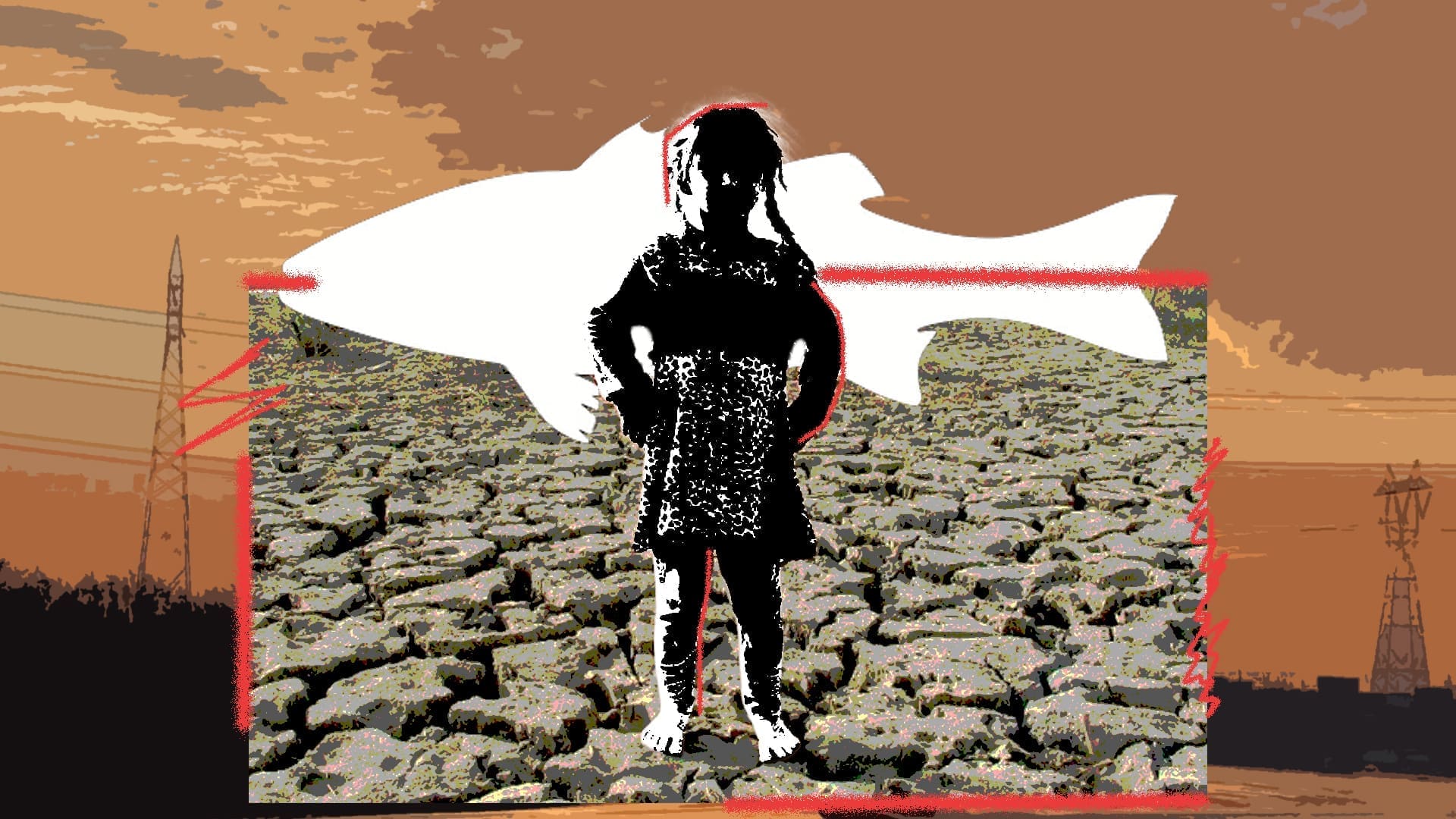
An Iraqi girl stands on a stretch of dried, cracked land. Source: Jassim al-Asadi.
These unique wetlands, historically fed by the flooding of the Tigris and Euphrates rivers and their tributaries, rainfall, and transboundary waterways such as the Karkheh River, were far more than mere figures on a map. They were a source of life, covering between 9,000 and 20,000 square kilometres during flood seasons, and an exceptional ecosystem home to rare and endangered species of birds and reptiles.
Yet this enchanting landscape, which has endured the harshness of history and the passage of millennia, now faces the insatiable thirst of oil wells.
The salty tongues
Archaeologist Amer Abdul Razzaq traces the history of the aquatic environment that emerged in Iraq’s alluvial plain to prehistoric times, before the invention of writing around 3500 BCE. His account draws on ancient cylinder seals depicting details of the lives of the region’s earliest inhabitants, from arched reed houses and traditional marsh boats known as mashoofs to the production of khareet, a traditional sweet made from cattail pollen. These are details of a way of life that has survived for thousands of years. But this historical continuity, long sustained by the free flow of the Tigris and Euphrates, conceals a fatal vulnerability. As Hassan al-Janabi, Iraq’s former Minister of Water Resources, explains, the marshlands are an “extremely fragile ecosystem.” Their survival depends on water travelling thousands of kilometres to reach them, rather than on abundant local rainfall.

The Hawizeh Marsh after drying up. Source: Murtadha al-Janoubi.
This geographical dependence has made it relatively easy to control the waterways that sustain the marshlands and cut off their supply whenever particular interests demand it. More often than not, those interests have been tied to politics and power.
Until the 1970s, the marshlands remained largely sheltered from the threats they face today. But their captivating geography soon became a perceived threat and a military battleground.
The first chapter of systematic drainage began during the Iran–Iraq War in the 1980s, when the authorities started constructing earthen embankments known as “tongues” to divide the Hawizeh Marsh and prevent Iranian forces from advancing.
No sooner had the war ended than the marshlands suffered their greatest blow in the aftermath of the 1991 Shaabaniya Uprising. At the time, a political and security decision was made to drain the Central Marshes and the Hammar Marsh entirely, under the pretext of “agricultural reclamation.” The actual objective, as documented in classified security records from that period, was to eliminate safe havens for opposition groups and facilitate the movement of military units.
Alternative canals, including the Third River, also known as the Saddam River, and the Al-Izz River, were excavated to divert water away from the marshlands. The result was an environmental and humanitarian catastrophe, classified by the United Nations Environment Programme as one of the greatest environmental disasters in human history.
Hundreds of thousands of local inhabitants were forcibly displaced, leaving behind a devastated landscape and a collapsing ecosystem.
The drained paradise
In April 2003, a new hope emerged for the drained paradise. The regime that had carved the Third River and the Al-Izz River through the marshlands had fallen. Marshland residents took matters into their own hands, breaching earthen embankments and tearing down barriers, allowing water to flow back into the wetlands and flood approximately 35 to 40 percent of their total area. The new Iraqi government responded by establishing the Centre for the Restoration of Iraqi Marshes and Wetlands, promising an ambitious programme to bring these lands back to life.
But events took a different course.
While Iran tightened its grip on the marshlands’ water supply through the construction of the Karkheh Dam and earthen embankments that prevented the Karkheh River from reaching the western section of the Hawizeh Marsh in Iraq, a new domestic threat emerged: the Ministry of Oil and the companies operating in the sector.
Oil operations and expanded exploration activities after 2008 contributed to the drainage of vast areas of what remained of the Hawizeh Marsh and both the eastern and western sections of the Hammar Marsh. This encroachment prompted the Marshlands Restoration Committee of the Basra Provincial Council, in mid-March 2010, to express its strong dissatisfaction with the Basra Oil Company over the drainage of marshland areas to make way for its projects.
The Marshlands as a political bargaining chip
The system of sectarian power-sharing and the distribution of political spoils, which became a defining feature of Iraq’s post-2003 political order, turned the marshlands into yet another share of the spoils.
The Ministry of State for Marshlands Affairs was a striking example of how the tragedy of the drying marshlands and the suffering of their inhabitants could be transformed into a bargaining chip and a political reward used to appease competing factions.
The ministry was established under Nouri al-Maliki’s cabinet, with Hassan al-Sari appointed to lead it. On the surface, the move appeared to be a serious attempt to address the plight of a unique ecosystem that had endured decades of systematic drainage. However, a closer look at al-Sari’s political background suggests that the ministry was more of a political privilege than part of a strategic plan to restore the marshlands.
Al-Sari is the secretary-general of the Jihad and Construction Movement, and the commander of the Saraya al-Jihad forces (armed group). He also describes himself as the founder of Al–Bayina, the newspaper affiliated with the movement. He is a senior figure in the Islamic Supreme Council of Iraq and was recently elected chairman of the council’s General Assembly.
The ministry’s history and archival records reveal that its establishment amounted to little more than a symbolic concession within a system that distributed government positions according to political loyalties, rather than an effort to develop meaningful, professionally grounded solutions.
The clearest indication of the institution’s ineffectiveness was its designation as a “Ministry of State,” effectively making it a largely ceremonial position without an independent executive institutional structure or a substantial dedicated budget. As a result, the ministry remained a largely symbolic institution, incapable of delivering strategic solutions to save the ecosystem or developing the infrastructure needed to prevent the displacement of marshland communities.
The paradise of the Sumerians was left to confront drought and pollution, while its future was traded as political appointments in the offices of parties and militia leaders and negotiated across the tables of political deals.
In a televised interview on Iraq’s official state broadcaster, Hassan al-Sari openly revealed the fragile process behind his appointment, acknowledging the nature of these newly created positions, which he explicitly described as little more than an “office without a real ministry.” His admission illustrates how sensitive national issues of sovereign importance, such as the marshlands, were managed according to the logic of political influence rather than state-building.
And because the ministry was little more than a redundant institution created by the power-sharing system, it became one of the first casualties of the protests.
In August 2011, the ministry was dissolved as part of what became known as “ministerial downsizing,” and al-Sari was retired with the stroke of a pen. Thus ended a political charade that had offered the marshlands nothing but promises.
A cry for help that no one hears
The marshlands’ tragedy did not end with the political theatre of the Ministry of State. In the autumn of 2025, residents of villages surrounding the Umm al-Naaj lagoon issued desperate appeals to the Iraqi government and the international community, calling for an end to efforts to turn their lands into oil exploration fields.
Today, the marshlands’ watery landscape continues to shrink. The Eastern Hammar Marsh is now the only marshland located within the administrative boundaries of Basra Governorate. This marsh, which depends on tidal movements to receive water from the Shatt al-Arab through the Shafi, Musahhab, and Sallal rivers, has itself been divided into two sections: a northern section known as the Shafi Marsh, and a southern section known as the Musahhab and Sallal Marsh.
Despite the partial return of life to the area, suffering has taken on new forms.
Hussein Abu Tbeikh, head of the Marshlands Charitable Association, explains that the return of water after 2003 brought a partial revival to the region. However, declining water levels, the intrusion of a “saltwater tongue” from the Shatt al-Arab, and shortages of natural fodder have forced large numbers of residents to migrate to cities. Abu Tbeikh also warns of the spread of diseases and epidemics resulting from the severe lack of basic services. He adds that gas emissions and waste from oil operations have dealt a devastating blow to the agricultural sector, forcing residents to flee pollution and drought.

The Shafi River at sunset. Source: Salman al-Iraqi.
The suffering is compounded by devastating economic losses.
Hadi Badr al-Maliki, head of the General Union of Agricultural Associations’ branch in northern Basra, confirms that the drainage of the marshlands by oil companies has resulted in the deaths of vast numbers of livestock and fish, as well as the departure of migratory birds.
Despite this bleak picture, local communities continue to fight with everything they have to remain on their land.
Salman al-Iraqi, a tour guide and environmental activist, notes that the Shafi Marsh still occasionally welcomes flocks of migratory birds and attracts groups of tourists seeking the beauty of its natural landscape and the renowned hospitality of southern Iraq.
Caught between an abundance of oil and a scarcity of water, Basra’s marshlands remain a testament to a cruel paradox: How can people living on land that holds oceans of wealth be left struggling with thirst?