
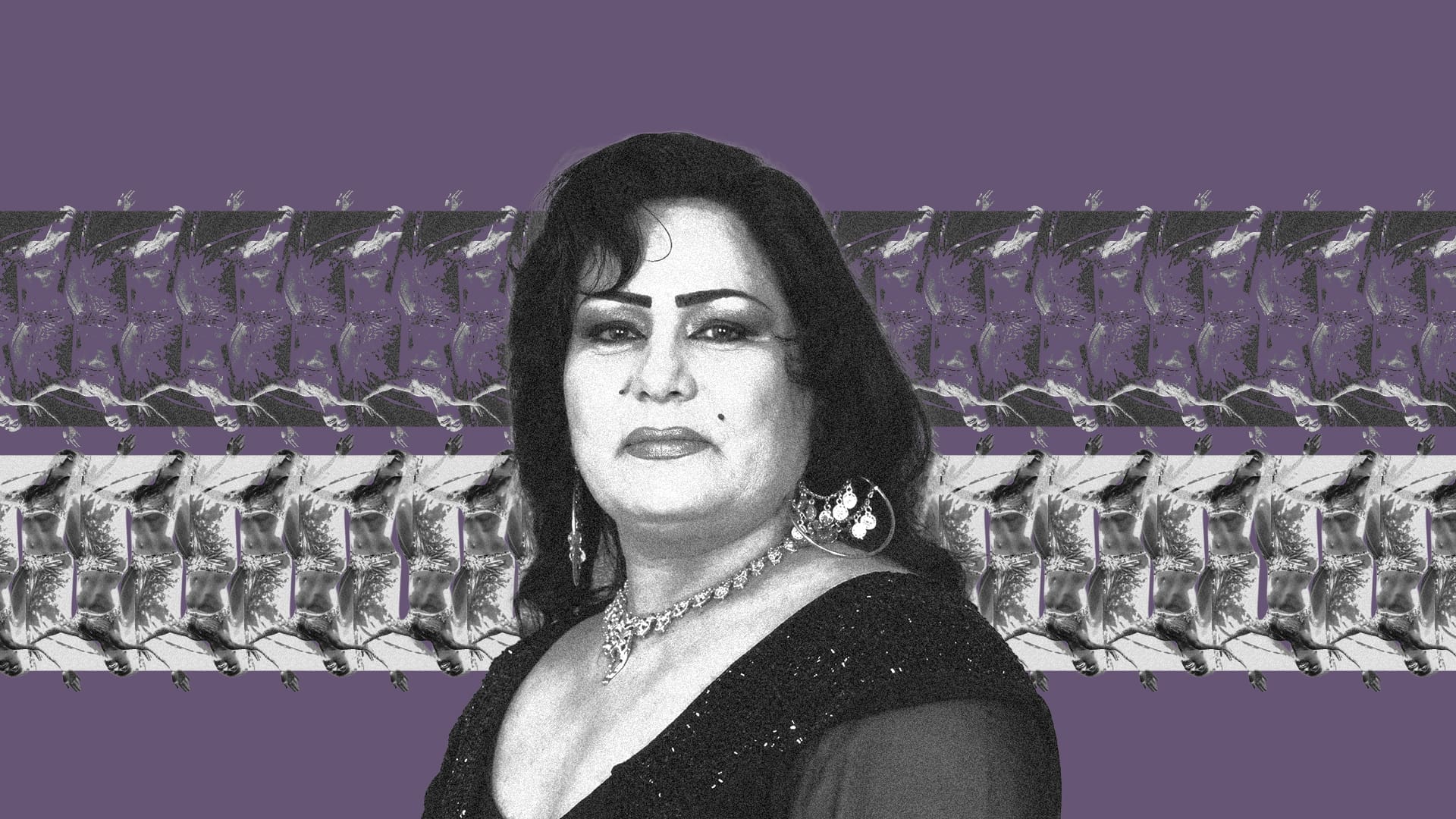

When LUMA played “Hala Ya Nour Einy” at London’s Southbank Centre, my parents and I began to dance. Around us were friends, siblings, creatives and strangers drawn from their riverside walks towards the music. Iraqis recognised Sajda Obaid. So did other Arabs, Armenians and Europeans who had discovered her through social media, Habibtination or another DJ’s set.
Behind us was the Thames. Thirty years earlier, Sajda had sung at my parents’ wedding in Baghdad.
At Hekayyatna’s 1001 Movements in summer 2026, those different routes to her music briefly occupied the same space. Some people recognised a voice from their childhood; others recognised a recent obsession. Sajda’s place in contemporary Arab pop culture is being made through precisely these encounters, as performances acquire new listeners and familiar songs gather unfamiliar company.
A wedding under sanctions
My parents married in 1996 at Salhiya complex, مجمع الصالحية. My father is a percussionist; my mother works in theatre. Their wedding was assembled through the community around them. Friends contributed catering, decorations and flowers. My mother borrowed her wedding dress from the Iraqi Fashion House. Everyone was invited; everyone brought something to the occasion.
Musician friends, including Qasim al-Sultan and Mohammed Abdul Jabbar, were expected as guests and performers. Their availability, my father remembers, depended on another calendar.
“Our wedding was on a Thursday, Uday Hussein held parties on Thursdays, and all my musician friends had to remain on standby in case they were needed,” my father recalls.
Sajda was a close friend of my father’s. She agreed to take on the singing herself, then joined the guests in chobi, a traditional Iraqi dance. Her place in the celebration moved between performer and friend.
“It was the sanctions period,” my father recalls. “There weren’t many female singers, much music coming in from abroad, or many television channels.”

In the world he remembers, music travelled through live performances and cassettes, becoming woven into people’s memories of each celebration. Songs became inseparable from the lives unfolding around them: the food shared, the conversations, the friends who danced beside you. For Iraqis in the diaspora, hearing Sajda in another city can bring that company close again. Her voice carries the intimacy of those gatherings across time and distance, allowing a familiar world to take shape around a different dance floor.
The gatherings behind those memories took place in sanctions-era Iraq. By 1996, Iraq had endured six years of comprehensive UN sanctions, compounded by the damage of war. Shortages of food and essential medicines, alongside deteriorating public services, shaped the daily lives of the people coming together to celebrate.
The wedding belongs within that history, with its borrowed dress and shared preparations. People continued to marry, cultivate friendships and make occasions for one another. The work involved in gathering became part of the celebration itself. For artists, those gatherings also sustained relationships between musicians, performers and their audiences.
Sajda’s voice accompanied weddings, birthdays and graduations. It became attached to moments people would spend years remembering. For my mother, hearing her now, she recalls friends, parties and cassettes played in her room. Her voice also recalls boat parties on the Tigris, where Sajda would come to sing at mixed gatherings, with men and women dancing together.
The icon in circulation
Born in 1997, I encounter a singer whose relationship with my family began before mine. Many younger listeners have similarly layered attachments: a song inherited through relatives becomes something chosen for a night out, exchanged between friends or requested from a DJ.
What changes is the setting, and with it the meaning of recognition. At a family wedding, knowing the words might feel ordinary. In a London crowd, the same recognition can establish an unexpected connection with somebody you have just met.
Sajda’s performances give that recognition a personality. Her delivery is direct, her audience exchanges part of the entertainment. A clipped command or expression can retain the presence of the woman conducting the room. People respond to her words, her humour and the energy she brings to a room. With songs such as “Inkasarat al-Sheesha” (انكسرت الشيشة), the pleasure is in joining in.
An icon emerges through these repeated acts of attention. Listeners share her image, circulate favourite passages and introduce others to her voice. Among younger Arabs in the diaspora, this can turn an inherited reference into a language of friendship. The enthusiasm includes humour, admiration and the pleasure of recognising something familiar in an unexpected place.
Affection for Sajda can also unsettle hierarchies within Arab music. The division between refined and vulgar, or between music worthy of an archive and music played at a party, carries assumptions about class and cultural authority. A joke reported among younger listeners answers those judgements. “Enough worrying what people think. Sajda Obaid is my taste in music (“كافي خوف من المجتمع ساجدة عبيد ذوقي”).” The humour makes affection public.
Her Anghami profile shows around five million plays and over 160,000 followers. Carmen Fragoso’s dance video to “Asmar Wal Oyoun Wisaa”, a staple of Iraqi chobi, has exceeded 55 million YouTube views. As her recordings circulate through dance videos and LUMA’s sets, listeners help determine which sounds become visible in the diaspora’s account of itself. Their enthusiasm places the repertoire of celebration among the cultural references through which they recognise and represent one another.

In the cassette era, Sajda’s performances could travel beyond the gatherings where she sang. Recordings preserved entire stretches of performance, including greetings, exchanges with musicians and transitions between songs. They carried an atmosphere as well as a repertoire, allowing another gathering to borrow something of the original occasion.
The Syrian Cassette Archives preserves Bahrain Concert 2003, issued by the Aleppo label Sawt al-Hafez, with songs and mawwal leading towards a closing chobi selection. Another cassette in its collection pairs Sajda with the poet Khudair Hadi and also lists Aleppo as its place of release. These recordings offer a tangible reminder that her music was travelling between audiences long before its current visibility online.
The generational story is therefore less straightforward than a rediscovery. A singer already embedded in Iraqi celebrations keeps finding new audiences and settings. Her songs become a meeting place between generations, where the celebrations one remembers find new meaning in the life another is making.
The musicians inside the rhythm
For listeners beyond Iraq, the invitation can begin with percussion. A repeated phrase becomes something to anticipate. A rhythmic change offers something to answer. Understanding every word may come later. Participation can be the beginning of familiarity.
“This dance is joyful, known for four rhythms: hewa, hacha’a, ruba‘ and khashaba,” says my father, Baha Jawzy, a percussionist specialising in khishba, a traditional, slender, hourglass-shaped wooden hand drum originating from southern Iraq. He describes kawliya as a dance involving the whole body, from jumps to expressive movements of the neck.
To hear Sajda is also to hear the musicians who have shaped her sound. Across this repertoire, percussion gives a vocal phrase its lift and a dancer something to answer. My father’s playing and rhythmic arrangements feature in recordings by Sajda, Hussam al-Rassam and Hatem al-Iraqi. These contributions become part of what audiences recognise as a singer’s signature sound: the pulse beneath the voice, the shifts in emphasis, the momentum that passes from the musicians to the room.
Kawliya dances make that exchange visible across the body. Jumps, changes of weight and expressive movements of the neck and head give feeling a physical form. Its intensity requires control and responsiveness, qualities that invite a comparison with contemporary dance. Movement becomes an interpretation of what the singer and musicians are doing.
Its international appeal has also produced spaces for formal learning. In Stockholm, Layali held a course incorporating kawliya alongside khaleeji and maalaya, rapid, rhythmic head-banging and hair-tossing dances. Music and movement encountered at celebrations enter another kind of gathering, where people learn through repetition, explanation and practice.
That fascination also carries a history of unequal recognition. Kawliya is widely used for dances involving hair-whipping, although it is also a label, often pejorative, applied to Iraq’s Ghajar communities. The word carries ethnic and sexualised stereotypes, particularly when applied to women. A dance can become celebrated while the people associated with it continue to face prejudice.
The umbrella term can also obscure regional differences and the contributions of Black Iraqis. In Basra, traditions including hewa and khashaba belong to a musical landscape deeply shaped by Black communities and African connections. Folding this variety into a single, apparently uniform dance can make those histories harder to hear.
As these forms enter European studios and diaspora dance floors, naming their practitioners becomes part of how their histories travel. Crediting dancers, musicians and teachers, and preserving the context of the footage we share, connects admiration to the labour and knowledge behind it. It gives the people who sustain the celebration a place within its growing visibility.
Where the Tigris meets the Thames
The musicians, theatre actors and creatives in my parents’ stories had helped me imagine their lives before they were my parents. Dancing beside them at Southbank gave those stories a new intimacy. The music that had accompanied their friendships was now part of an occasion we could remember together.
Luma, the Iraqi-British DJ behind the music platform Habibtination, had brought Sajda’s voice into that gathering. I was surprised by how readily strangers recognised her. Our affection was finding company beyond the people who already knew our family’s history.
I often look for glimpses of Iraq in the places around me, the cities I migrate to, making associations that help me make sense of my life in the diaspora. At times, the Thames brings the Tigris to my mind. Here, that connection also came through Sajda Obaid’s voice and the people dancing beside me.

Diaspora often involves finding connections between places that might appear to have little in common. A voice can make the association immediate. Hearing Sajda gave this stretch of London an intimacy I recognised through my parents’ memories, while also allowing us to create a new memory together.
The rivers might remain different. The impulse to gather around her music, however, was familiar. My parents were dancing to Sajda again, and this time I could join them.


