
The city as an archive
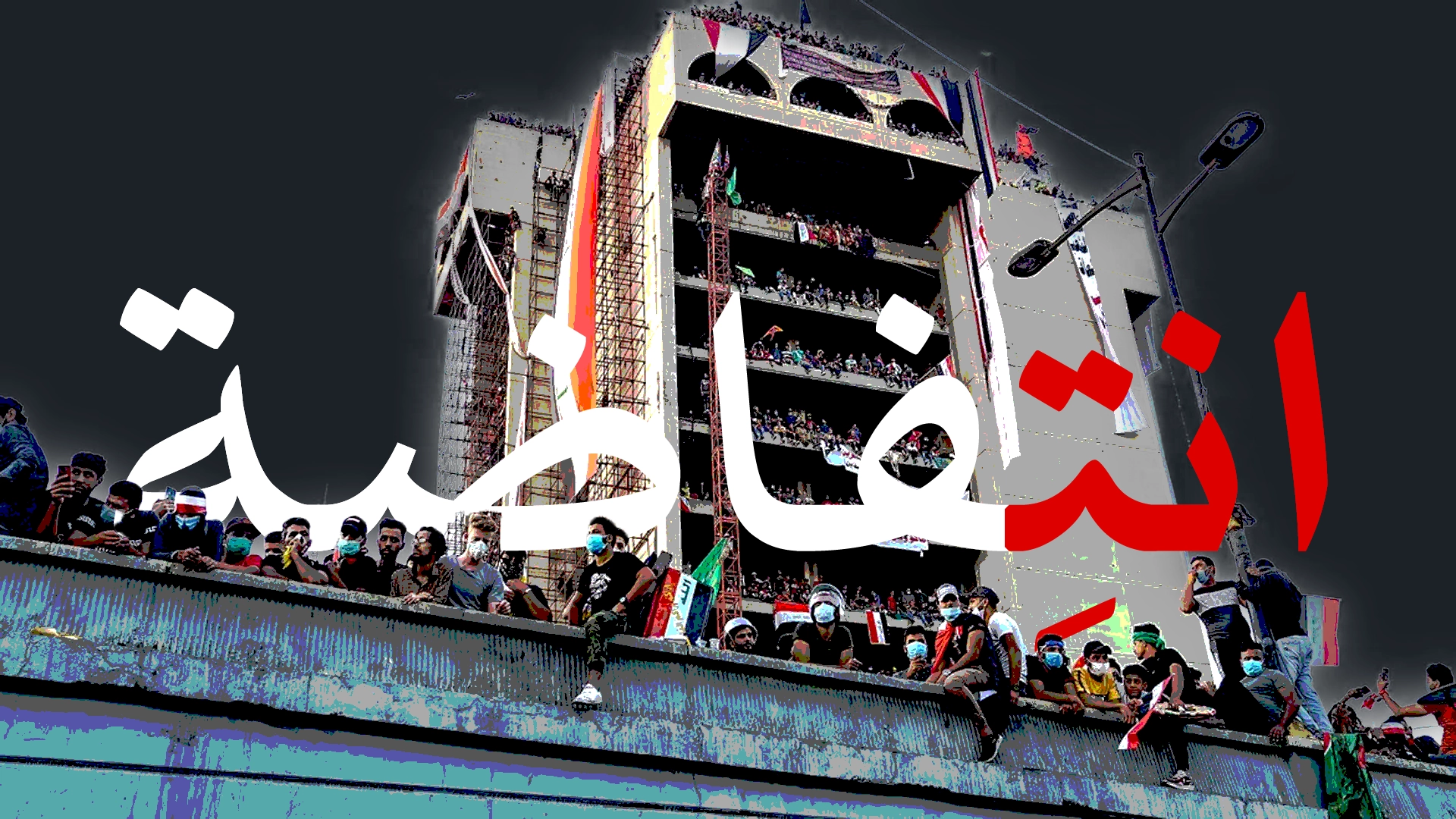
In the centre of Baghdad stands a tall, abandoned building, commonly referred to as the Turkish Restaurant. During Thawra Teshreen, the popular uprising that began in October 2019 and shook Iraq for several months, protesters took control of the building and made it their headquarters. They named it Uhud Mountain, after the famous prophetic battle.
The building overlooks the Tigris, the Green Zone and the Jumhuriyya, Sinak and Ahrar bridges. On the other side stand Tahrir Square, its Freedom Monument and the streets where protests usually begin. Iraqi security forces had long used this vantage point to surveil and shoot at protesters.
The Green Zone, established by the US-led occupation administration in 2003, holds government buildings, foreign embassies, international institutions, Saddam Hussein’s former palaces and much of Iraq’s post-2003 political class. Unlike the rest of the capital, where public services and infrastructure barely function, it has electricity, clean streets and greenery. It is accessible only to those with a badge or special authorisation. A substantial division in Iraq today is between people with a badge and people without one.
Uhud Mountain tells the story of Iraq’s political and economic history over the past 40 years. Built in the 1980s as a shopping centre and a Turkish restaurant on the top floor, it was bombed by the US-led coalition in 1990–1991 and again in 2003. Later attempts to turn it into a luxury hotel failed after political parties and leaders took control of the money. Its abandoned shell carries the marks of dictatorship, war, sanctions and the corruption, nepotism and failures of the post-2003 Green Zone regime.
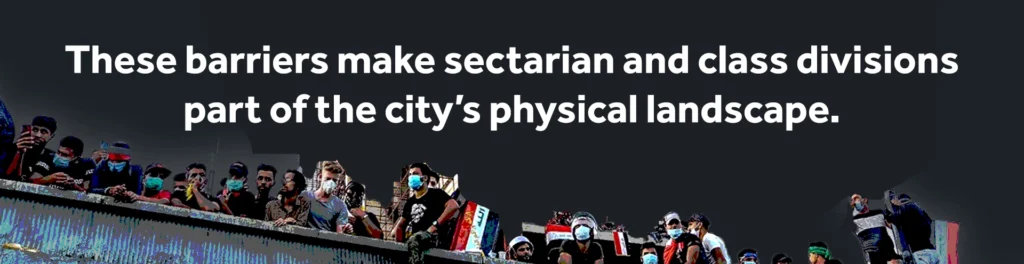
Across Baghdad, concrete T-walls, razor wire, sandbags and armed checkpoints shape daily life. These barriers make sectarian and class divisions part of the city’s physical landscape and affect how people move through it. Access to resources often depends on connections to those with badges, while public spaces are handed to private interests through bribery, nepotism and violence.
Celebrating life, mourning the dead
In October 2019, protesters faced bullets and tear gas as they took Uhud Mountain floor by floor, climbing on one another and using their bodies as ladders and shields. They occupied Tahrir Square and the surrounding streets, bridges and tunnels, to then build a vibrant social space. Hundreds of tents became places to live, cook, debate politics, draft constitutional amendments, dance and sing. Protesters opened a theatre, cinema, libraries, medical units and a beach along the Tigris. They covered the walls with murals and erected memorials to those killed by security forces and armed groups.
The uprising brought together people of different social and educational backgrounds. Women of all ages participated on a massive scale and assumed leadership roles. The poor and unemployed remained at its centre: tuk-tuk drivers, street sellers and porters were among its leading forces. Protesters named militia leaders responsible for killings, kidnappings, torture and disappearances, breaking with the fear of armed groups and security forces.
The uprising was brutally repressed. More than 700 unarmed people, mostly young and poor, were killed within weeks, shot or struck by tear-gas canisters that pierced their bodies and skulls. Some 25,000 were injured and hundreds disappeared. The COVID-19 pandemic eventually forced protesters from the squares. Security forces retook Uhud Mountain, but its paintings and graffiti remain beside the marks of bullets and tear-gas canisters.
Remaking the political
Women artists created many of the uprising’s iconic works, and women appear throughout its murals in different ways. Some images reproduce nationalist ideas of women as bearers of the nation; others challenge dominant gender norms and expose women’s suffering and oppression.
One recurring figure is the hajjiah: the poor, dark-skinned older woman from the south, often imagined as a widow or mother who has lost a son. She appears as the grieving mother before her martyred son’s coffin, as a fellahah, or an elder woman dressed in black on her boat in the marshes. Her loss becomes the loss of a nation; her protest, the protest of the people.
The murals also preserve particular acts of defiance. Dunya, a woman who sold tissues, ran through tear gas and live bullets to distribute her only source of income to protesters. Schoolgirls confronted a head teacher who tried to stop them joining the demonstrations. Young women were portrayed standing beside young men, dressed in ways that challenged dominant codes.
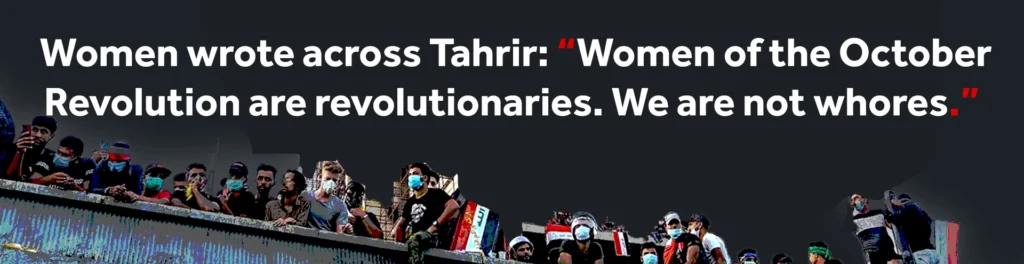
Feminist slogans answered a conservative backlash that declared gender mixing forbidden and women’s voices shameful. After the slogan “Your young women, oh country” (Banatek Ya Watan) was twisted online into “Your whores, oh country” (‘Aheratek Ya Watan), women wrote across Tahrir: “Women of the October Revolution are revolutionaries. We are not whores.”
The uprising centred the poor not only as protesters, but as people whose lives and deaths mattered. Shrines and murals honoured those killed, including Safaa al-Sarai, 26, whose skull was pierced by a tear-gas canister. Safaa insisted on being called the son of his mother, Thanwa. Ibn Thanwa became a name for participants in Thawra Tishreen, placing the figure of the mother and her experience at the centre of both memory and an imagined future.
Tahrir gathered people divided elsewhere by gender, sect, education and class. Demands for bodily freedom stood beside calls for electoral and constitutional reform. Dancing, joking and singing shared space with funerals and memorials. Graffiti demanding the fall of the regime appeared beside the word “falafel”; a martyr’s portrait beside a couple sharing a romantic moment. These walls remain the living archive of an emancipatory moment: its energy, playfulness and disorder.
Poetics of archives
Uprisings in the region are often judged against predetermined frameworks: not feminist enough, without a real agenda, or insufficiently political. Such analysis tries to impose order on the uprising’s disorder and misses the poetic, the unexpected and the political subjectivities still taking form.
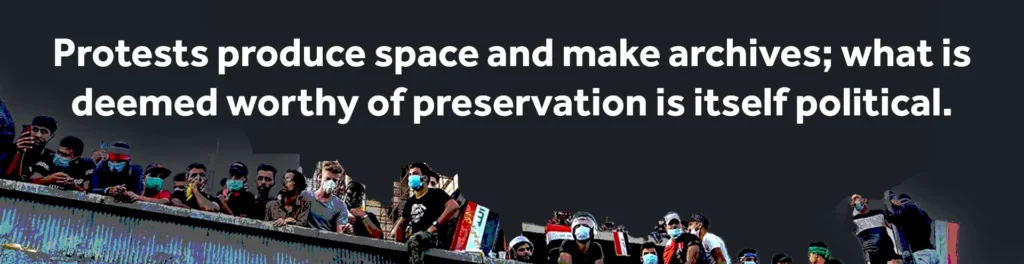
Archives of the present can expand our political imagination. An archive is not merely a fixed document or memory, but an ongoing material trace: a recorded voice, a poster, a mural or the concrete remains of a checkpoint. Protests produce space and make archives; what is deemed worthy of preservation is itself political. Their traces allow us to find the future in the present.
In Arabic, انتفاضة (intifada) comes from نفض (nafid) to shake something until what clings to it falls away. I like to imagine that the feminine pronoun أنتِ is constitutive of this shaking. This does not rely on a gender binary but uses gender as a lens through which the feminized, the poor and the powerless shake the order of things. Reading the traces of Iraq’s uprising as an archive opens our imagination to a politics that cares more about poetics than power.


