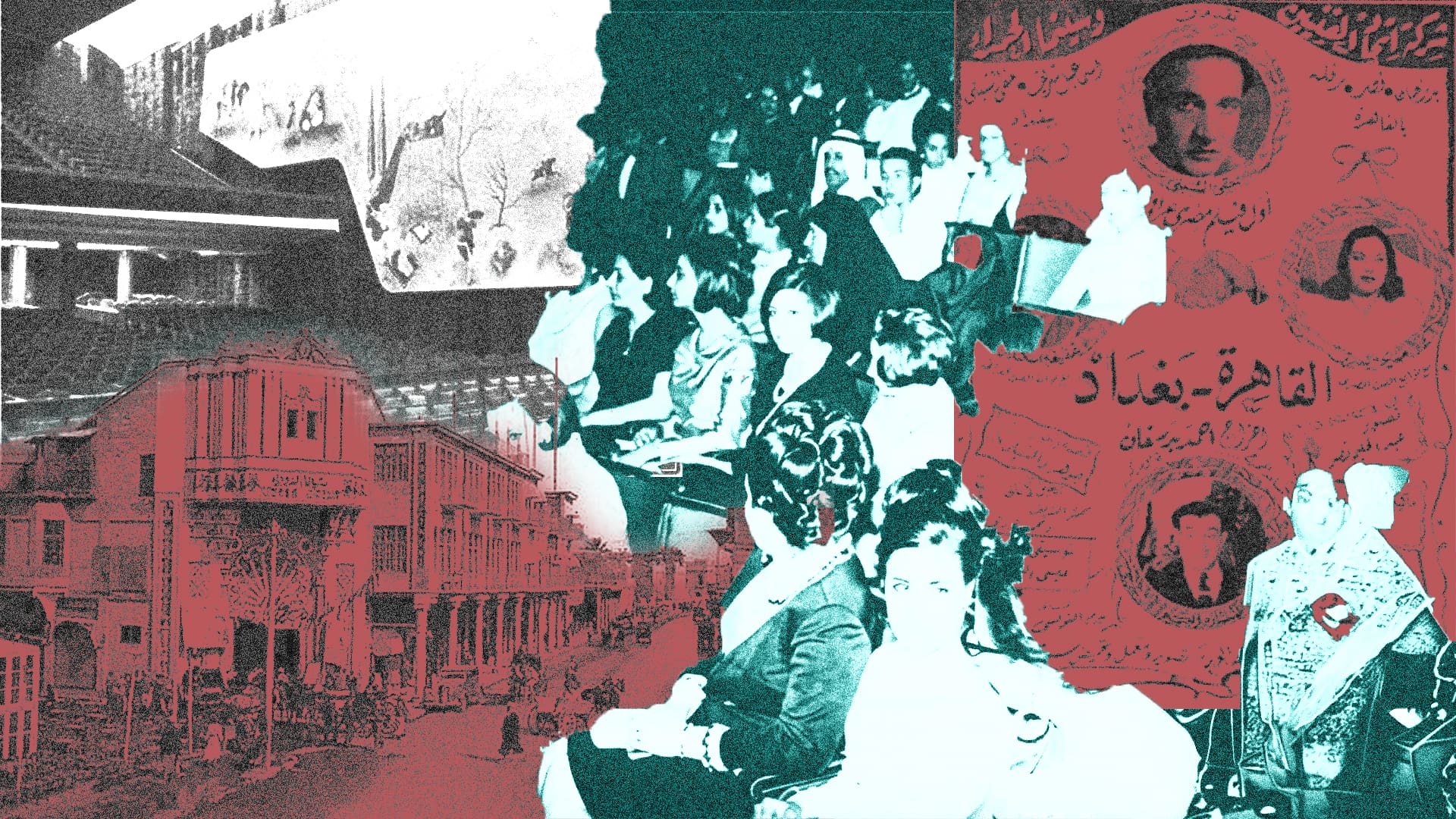

During the first half of the twentieth century, which included the late Ottoman period, the British mandate and the years of the monarchy, Iraq experienced modernisation, rapid urbanisation and political reform. At the same time, Baghdad transformed from a regional city to a fast-growing capital. As the urban landscape and layout of Baghdad and other cities changed dramatically, commercial entertainment became increasingly prominent.
By the 1920s and 1930s, across Iraqi, cafés, cinemas, theatres and nightclubs occupied a growing place in urban life. These spaces brought Iraqis together, although class, gender and social expectations shaped who could enter and how they participated.
Among these new institutions of leisure and entertainment, cinema was unchallenged in terms of popularity. The first cinema in Baghdad was cinema Baluki, opened in 1911. Permanent cinemas began to appear in Baghdad in the 1920s and spread across the country in the following decades. In 1947, there were 71 cinemas in Iraq. By 1954, that number had risen to 105, including 47 open-air cinemas, with a combined seating capacity of around 80,000. Three years later, in 1957, there were 137 outdoor and indoor cinemas in Iraq. This emergence of cinema as a form of leisure in Iraq was met with significant excitement and enthusiasm while at the same time it created new opportunities for entrepreneurs and investors, many of whom, at least in the beginning, were Iraqi Jews, including members of the Sawda’i, ‘Aizer, Danus, and Shohet families.
While many Iraqis were avid cinemagoers, feature film production only began in Iraq in the late 1940s. Egyptian-Iraqi co-productions appeared in the mid-1940s, followed by films made by Iraqi studios and production companies later that decade. Until recently, many histories of film and cinema, in the Middle East, have been written through a national or nationalist lens. As a result, the fact that national film production only began relatively late in Iraq has partially obscured cinema’s enormous popularity and long history in the country. At the same time, the ways in which Iraqis carved out temporary leisure spaces and practices, some of which made cities available to groups otherwise excluded from most public leisure, including women, and families with limited means,have not been a central theme in historical accounts of modern Iraq.

While much of Iraq’s cinematic past has been lost, or destroyed by war, foreign occupation, and neglect, it is crucial to acknowledge the past and present efforts of Iraqis to remember and restore their cinematic heritage. From the establishment of Iraq’s first cinema in 1911 until today, Iraqis have been writing about their experiences with and love for cinema. The restoration of films and cinema archives, however, takes time. However, if we think about Iraq’s cinematic past beyond individual films, a rich archive already exists. This archive of cinema leisure and entertainment allows us to approach history in ways that center the experiences of those who frequented Iraq’s many cinemas.
The emergence of new forms of leisure in Iraqi urban landscapes, such as cinema, gave rise to writing about leisure, including debates about its dangers and potentials. The result of this process is a vast, albeit scattered, archive of texts that deal with practices, experiences, and institutions of leisure. This archive of leisure is located across a variety of fictional and non-fictional texts. These include advertisements, poetry, short stories, novels, autobiographies, photographs, police records, private and family archives, popular song and music, and memoirs produced in multiple languages by Iraqis from across the country’s political and religious landscape. The darkness of the cinema halls, which provided new forms of privacy, in public, and opportunities for romantic encounters and gender mixing, but also for harassment. Iraqi fictional texts, especially those produced by male writers, allow us to trace the moral tensions that existed around cinemas as spaces where men and women, boys and girls, came into close contact
If we look beyond the screen and individual films, cinemagoing is a visual, physical, gendered, and classed experience that encompasses elements stretching from pre-screening to post-exhibition. In Iraq, cinemagoing extended far beyond the screen and changed urban spaces and soundscapes. Films were advertised, through newspapers, film magazines, movie posters, publicity stills, flyers, collectables, and other non-film sources and products. Employees of cinemas would shout out titles and screening times or walk or ride around the city holding up posters and programmes. Sometimes, cinema staff would use horse-drawn carriages, and later cars, with a band to accompany them. As the carriages and cars made their way through the city, they would hand out flyers, often produced in English by foreign film companies, but with space for Arabic translations. Since the flyers had pictures on them, children and teenagers would run after them to get a handout. Such flyers became collectibles that Iraqi children and teenagers exchanged with each other.
Beginning in 1934, the Iraqi magazine al-Funun dedicated its pages to cinema, theatre, and music. When cinema and theatre magazines, such as al-Kawakib and al-Sinama wa al-‘Aja’ib, arrived from Egypt and Lebanon, those who could afford to purchase them cut out pictures of their favourite actors and actresses. While Egyptian films were often the most popular, Hollywood dominated the Iraqi market, but countless films from India, Europe, and elsewhere also made it to Iraqi screens.
In his memoir, Victor Sasson, who came of age in Baghdad in the 1930s, devotes several pages to his experiences in the city’s many cinemas:
“The cinema was a great attraction to me as a child, as a teenager. It opened the gates to new, different, and exciting worlds – real or imaginary.”
The cinema was also where Sasson had his first “encounters” with the opposite sex on screen. “The cinema and especially American films that showed actresses with scant clothing opened one’s eyes a bit. Betty Hutton or Betty Grable, or some female dancer, scantily dressed, titillated the imagination a little.” he recalls in his memoir. At the age of 12, Sasson was allowed to visit the cinema without adult supervision. He preferred Roxy, al-Zawra’, al-Hamra, and al-Rafidayn, all located on al-Rashid Street. Sasson was a fan of Tarzan, Zorro, and Flash Gordon films. He also had a keen musical ear, and the cinema was where he was introduced to the songs and compositions of Muhammad ‘Abd al-Wahhab and Umm Kulthoum.

The arrival of talkies from Egypt in the late 1930s, changed the experience of cinemagoing for Iraqis who did not know English or could not read subtitles. Mahmoud Saeed, the Mosul-born Iraqi novelist, recalls the cultural importance of Egypt during his childhood in the 1940s, in a talk he called “Egypt through Iraqi eyes” at the University of Chicago. Together, Saeed and his Jewish neighbor, whose older brother worked at one of the Jewish-owned cinemas in Mosul, would frequent the cinema as often as they could afford to. They developed crushes on Egyptian actressesand saved up to buy film posters and Egyptian cinema magazines, which Saeed would read aloud since his friend did not know how to read.
Sasson’s and Saeed’s experiences area reminder that cinemagoing was a form of leisure shared by Iraqis across communities. The cinema also played an important role for young musicians who would go there to learn and memorize new compositions. At a time when records and gramophones were expensive and formal education in modern music was scarce, cheap cinema tickets allowed musicians to watch the same film enough times to learn the compositions by heart.
While everyone in the audience watched the same film, not everyone had equal access to the best seats. The architecture of the cinema and the differently priced tickets kept cinemagoers apart. The cheapest tickets cost 40 fils, 0.20 USD, and gave access to a seat on the ground floor. These tickets were mostly purchased by boys and young men and were colloquially referred to as Abu al-Arba‘in (forty-fils seats). A seat on the upper-level costs 70 fils, 0.34 USD. Private boxes were usually reserved by wealthy families and couples. At the most expensive cinemas, boxes cost as much as 300 fils, 1.46 USD. Discounts for children and students were available at some cinemas, and special matinee prices also decreased students’ prices. Soldiers only paid half of the cost, and in some cinemas, young children were allowed to share a seat for the price of one in the Abu al-Arba‘in section.
Nissim Rejwan, who spent his youth in Baghdad before emigrating in the early 1950s, was an avid cinemagoer. His aunt had married a wealthy Jewish merchant who owned part of Cinema Royal. Rejwan used to loiter in front of Royal, and if the cinema had empty seats, one of the employees, almost all relatives of the owner, let him in free of charge. Later in life, Rejwan wrote film criticism and reviews for the English-language newspaper The Iraq Times. Rejwan received a free press pass to Baghdad’s cinemas and wrote up to four reviews a week.
The anonymity of the cinema allowed cinemagoers, or cinema crashers, to sneak in free of charge and disappear in the crowd. Therefore, most cinemas, although not always successful, employed guards and watchmen to keep people from sneaking in without payment. During the Second World War, the British organised screenings in some of Baghdad’s residential neighborhoods free of charge. The purpose of these screenings, which included news from the front and propaganda, was to bolster support for the British war effort. The screening also included a film or several short sketches. It was these that drew large crowds. Colloquially known as Sinama al-Balash (free cinema), these screenings took place on different days in different neighborhoods, allowing people with enough time to watch multiple shows for free. According to anecdotes, a baker in Baghdad’s Safina neighborhood, whose roof perfectly overlooked the screening site in that neighborhood, began selling baked goods to the audience and admitted people to his roof for a small fee.
After the arrival of talkies, listening to films from afar was also an option for those who lived close to Baghdad’s many open-air cinemas. Many who grew up in Baghdad recall how, during the hot summer months when families would sleep on the roof of their house, they would be entertained by the music from the nearby cinema. Since many Egyptian films played for up to two weeks, some were able to memorize several films’ complete soundtracks.
Initially, mostly boys and men shared the experience of cinemagoing. This changed, however, when some cinemas, like al-Rafidayn, began offering gender-segregated showings and Cinema al-Watani reserved special sections for women. Victor Sasson mentions in his memoir that “one could hardly imagine an Iraqi girl interested in a Flash Gordon film or any film that had action and adventure in it.” His statement reflects strict ideas about gender, propriety, class, and taste that shaped cinemagoing. Sasson mentions that most women and girls did not visit the cinema unless accompanied by an adult, a male relative, or a husband. But this was not always the case, and women and girls also went to the cinema on school trips or accompanied by female friends and relatives. For girls belonging to wealthier families, going to the cinema was often a family activity that allowed for socialising outside of the private home. In summer and spring, some families brought their dinner to the open-air cinemas, thereby transforming the cinema into a family picnic. Some Iraqi women recall how their parents banned them from watching certain types of romantic films as they were considered inappropriate.
For couples and singles who had money to spend on their appearance, dressing in the latest fashion was part of the ritual of going to the cinema: the cinemagoing experience was as much about being seen as it was about seeing. Orozdi Bek, the large department store on al-Rashid Street, made the latest fashions available, and young men emulated their heroes by growing moustaches and slicking their hair like Clark Gable, Humphrey Bogart or Abd al-Wahhab.
Simultaneously, images of American and Egyptian masculinity and femininity on screen influenced Iraqi cinemagoers and created new fashion trends. James Dean hairstyles, dance moves, particular ways of holding and smoking cigarettes, and the correct way of popping one’s collar were all meticulously studied and emulated by audiences in Baghdad and elsewhere in the country. It is histories and experiences such as these, including more overtly political and anticolonial practices of cinemagoing, that the many texts produced and left behind by Iraqis and contained in the archive of leisure allow us to reconstruct.
The significant contributions of Iraqi journalists, historians, social scientists, musicians, and literary scholars, both lay and professional, make up a cornerstone of this archive. These texts have often been overlooked or treated solely as primary sources, rather than as authoritative and enlightening commentaries on the history of cinema and cinemagoing. While they must be read critically, the encyclopedic knowledge and attention to detail that characterise many of these texts make them valuable historical sources. Since everyday experiences and practices of cinemagoing tend to fall through the gaps of official archives, these often-overlooked sources are better equipped to capture what it was like to seek out fun and free time in Iraq’s many cinemas. Taking cinemagoing, and by extension leisure more broadly, seriously as a category of analysis can challenge narratives of sectarianism, authoritarianism, and nationalism, that have characterisedthe study of Iraqi history and representations of Iraq in the media.
While the archive of leisure tells us little about the material and economic history of cinema in Iraq, including the forms of labour and exploitation that sustain it, it is a good place from which to begin writing a different history of cinema and of modern Iraq.