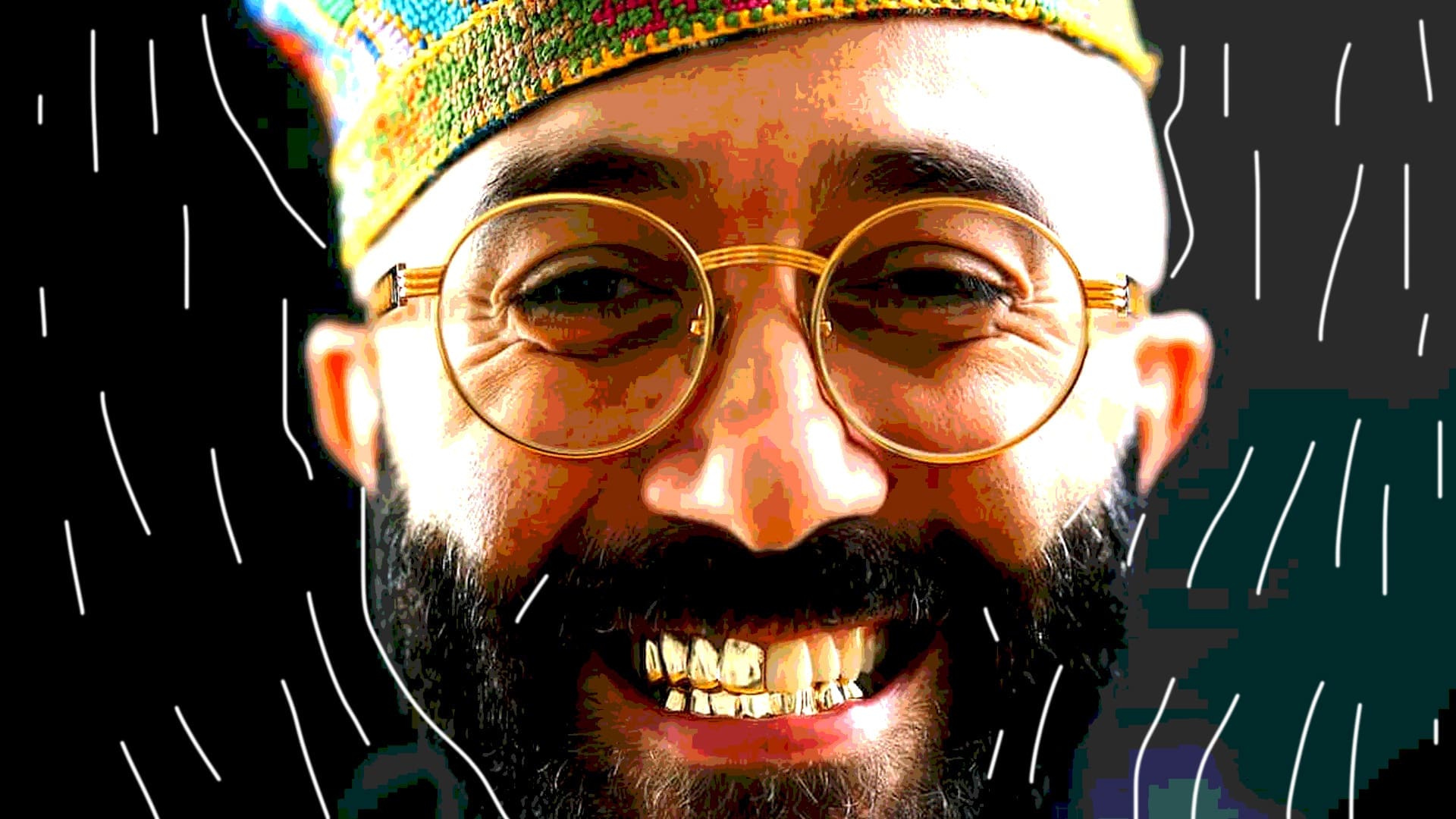

When the clients left, Yassin al-Salman stayed.
Between 2004 and 2006, he worked at a recording studio in Canada, learning audio engineering from the man who mixed his band’s music. Once the other musicians had finished their sessions, he recorded his own songs. The work of helping others make themselves heard gave way to the work of finding his own voice.
He had first entered a studio in 2001. By then, hip-hop had already accompanied him through his teenage years, when he began writing raps, and through his return to Canada in 2000 to attend university and live alone. Music offered a way to confront experiences he was still learning to name.
Today, Alsalman is known as Narcy: a rapper, writer, multimedia artist and professor teaching hip-hop at Concordia University in Montreal. Behind those roles lies an urgency that preceded his career: the need to understand a world at war with his country.
‘Music was a way of coping with the state of the world and what was happening to our people, especially as an Iraqi, with the world at war with our country,’ Narcy tells Jummar.
War shaped both the Iraq his family could not return to and the Iraq presented to the society around him. News broadcasts made the country visible through bombardment; its people appeared within a story largely told by others. In music, Narcy could question who controlled that story, and begin telling his own.

A visitor finding his voice
Born in Dubai to an Iraqi family from Basra, Alsalman grew up moving between the UAE and Canada before settling in Montreal. Geography changed around him; the question of belonging travelled with him.
In Canada, he carried his Iraqi and Arab identity. In the Gulf, he was someone who had arrived from elsewhere. Hip-hop offered another space to enter, with its own history, an art form rooted in the Black American experience, in resistance and in the struggle to be heard under conditions of exclusion.
Narcy describes himself as ‘a visitor in multiple spaces’: Canada, the Gulf and hip-hop. Music became the place where that condition could turn into something creative. He could speak from the threshold, draw on the worlds he moved between and shape a voice that belonged to him.
Returning to university for a master’s thesis on Arab identity and hip-hop sharpened his understanding of that relationship. Studying the art form’s Black roots meant recognising the history that had made his own expression possible.
He tells Jummar, these experiences created ‘a space that gave people like me the opportunity to have a voice’.
His early work with the Iraqi-Canadian group Euphrates emerged at a moment when the stakes of that voice were particularly acute. The group released A Bend in the River in 2003, amid protests against the invasion of Iraq and growing hostility towards Arabs after the attacks of 11 September. Stereotypes Incorporated followed in 2004.
As the invasion of Iraq unfolded and hostility towards Arabs grew, Narcy joined protests against the war, in solidarity with Palestine and in defence of migrants’ rights. These struggles also shaped his music, giving him a way to challenge how his country and community were portrayed.
The title A Bend in the River suggested a change in direction. For Narcy, music offered the possibility of intervening in a story whose course seemed to have been decided elsewhere.
A country travelling through music
Successive wars kept Narcy’s family from returning to Iraq for years. Music became one way of sustaining a relationship with a country they could not reach.
‘Iraq is all over my music,’ he says.
At first, that presence was carried through lyrics and historical storytelling. Iraq’s ancient history offered a scale of time that exceeded the wars dominating its contemporary image. His songs reached beyond sanctions, invasion and occupation to draw on a history those events could neither contain nor erase.
Then Iraq began to move deeper into the music, from the lyrics to the rhythms.
Where Arab hip-hop producers often reached for the oud and other familiar markers of Middle Eastern music, Narcy and his collaborators sought out Iraqi sounds that had received less attention: small drums, the kasur, folk recordings waiting to be heard in another context.
These choices made room for a more particular musical inheritance. Iraq could be present through the pulse of a drum or the movement of a rhythm, carrying differences that a generalised idea of ‘Middle Eastern music’ flattened.
On SpaceTime, released in 2018, Narcy began sampling chobi. Its rhythm became central to his sound. The country he had written about was now helping determine how the music moved.
In ‘Makoo’, a chobi recording by Iraqi artist Suad Abdullah enters a song confronting Islamophobia and stereotypes about Iraqis. The video features a wall in Quebec marked with racist graffiti telling him to return to Iraq. His answer comes from the place where that rejection is written, with Iraq audible in the track itself.
The encounter brings the forces shaping his music into sharp focus: a country carried across borders, an identity challenged where he lives, and a rhythm through which he asserts his presence. Basra, Dubai and Montreal meet within the same musical life. Their histories travel through kasur, chobi and rap.

Who brought politics into it?
By the time Narcy began making music, politics had already entered his life. It had shaped his family’s movements, prolonged their separation from Iraq and helped determine how people around him understood Arabs.
The question of whether his music was political therefore began long before the first song. War and racism had already made his identity a matter of public argument.
Music gave him some power over the terms of that argument. Through his platform, he could speak about the world and restore the historical context so often stripped from accounts of it.
He tells Jummar his presence carries a responsibility to communicate a message grounded in knowledge and provide the background needed to explain ‘why things happen the way they do’.
That commitment followed him into the classroom. An invitation to speak to a university class about hip-hop eventually led him to take over the course and develop it further. At Concordia, the art form became a way into questions of racism, colonialism and the exploitation of artists.
His teaching also returns to something more intimate: the conditions a person needs to express themselves. He asks students to think about love, fear and their lives in the internet age, giving them two hours each week in which they can feel like artists.
He also wants students to recognise the institutions and structures directing their choices. His classes bring questions of racism, colonialism and the exploitation of artists into conversation with their own experiences and creative ambitions.

The burden of the ‘Arab artist’
For Narcy, the identity that helped him find a voice also became a way of limiting what others heard. As his profile grew, the category of ‘Arab artist’ increasingly framed his work, placing expectations around what he should make and whom he should represent.
An identity can give an artist material, history and community. It can also become an assignment: speak for these people, explain this experience, remain recognisable within this category.
On To Be an (Arab), Narcy examined the distance between being Arab and being expected to represent Arabs. Across the album, he confronted a role he had inhabited for years and the demands that had gathered around it.
His objection is to the conversion of identity into a commodity, something that can be packaged and sold while dictating the boundaries of an artist’s imagination.
‘I played the role of the Arab artist for a long time, before this identity became a commercial venture. It was time to be my natural self,’ he says.
After the album, he wanted to return to his first name: Yassin. A man who makes music and happens to be Arab. There is a claim to artistic freedom in that apparently simple description, the right to create without every song having to account for an entire community.
Iraq remains woven through his work. It lives in the stories, the drums, the chobi rhythms and the memories; in his understanding of what a voice can do and the responsibility that comes with being heard. That inheritance is part of his imagination, with all the possibilities an inheritance can hold.
Narcy’s journey began with the need to make himself heard in a world that spoke about Iraq while waging war on it. Music gave that voice somewhere to live. More than two decades later, he is asking for the freedom to inhabit it fully: to carry his history, follow his imagination and decide for himself what comes next.