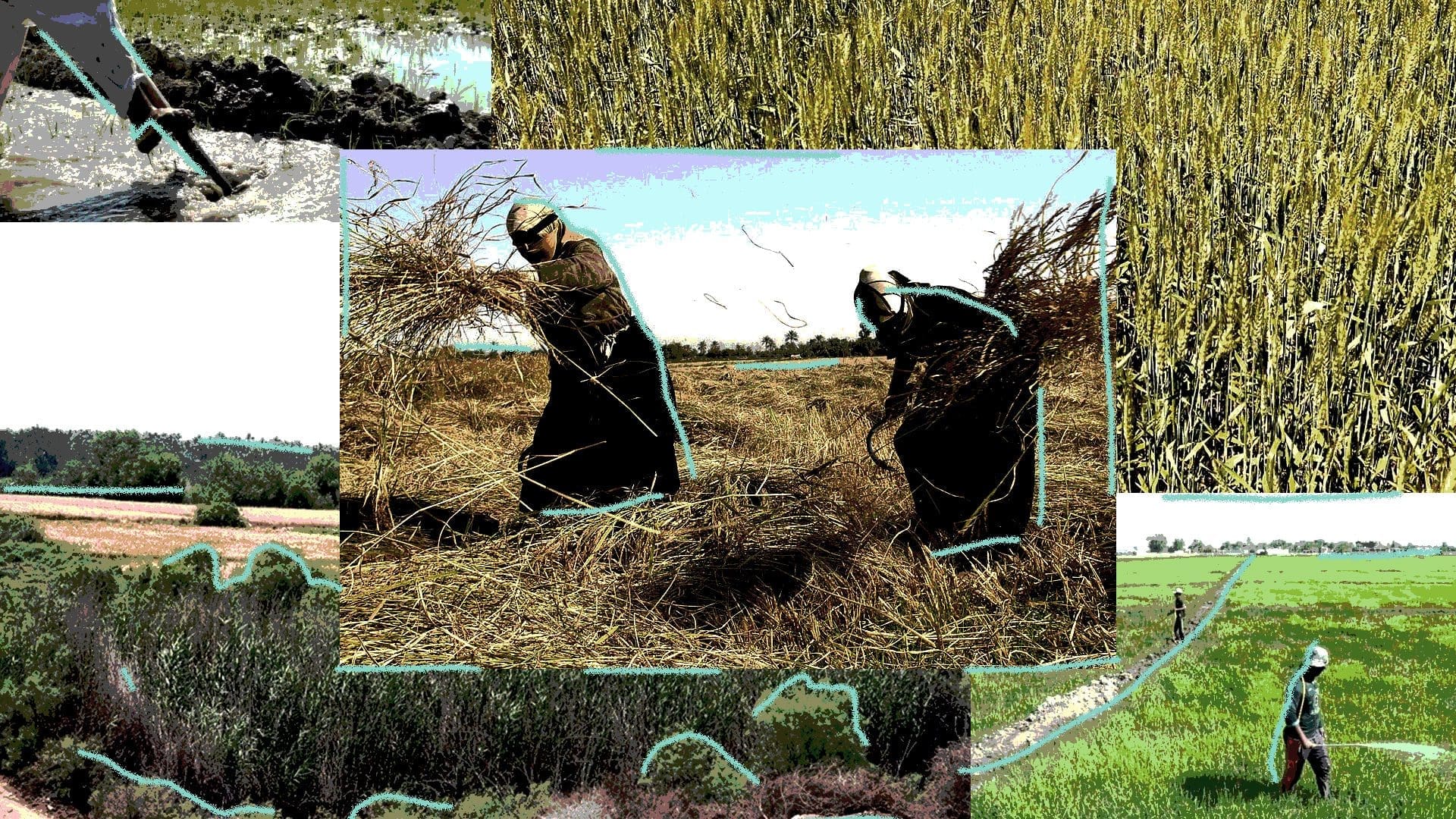
Southern Najaf’s agricultural landscape has undergone a startling decline. Once defined by abundant harvests, the region now faces a deepening water crisis and prolonged drought that threaten not only farming itself, but the way of life built around it.
As water supplies dwindle, so too has the landscape that shaped the region. Farmland is steadily losing its green cover and giving way to barren ground. Farmers speak of a stark divide between today’s reality and the decades when reliable flows of freshwater sustained productive harvests and stable livelihoods.
Now, persistent water scarcity is forcing difficult questions about the future of agriculture in the region.
A history of abundance, a present of drought
At the beginning of the twentieth century, Al Mishikhab was known as Al Suwariya, named after Suwar Al Fatlawi. It later became Al Faisaliya, in honour of King Faisal I, before earning the title by which it is best known today: the City of Amber Rice.
The title came from its fertile clay soil and the branch of the Euphrates that cuts through it. Located around 35 kilometres south of Najaf and covering roughly 375 square kilometres, Al Mishkhab is surrounded by fertile clay fields and palm groves. Around 80 percent of the district’s residents have long depended on agriculture, especially the cultivation of Shillab, the paddy rice from which Iraq’s prized Anbar rice is produced.

Shillab is a summer crop grown in clay-rich soils across Iraq’s Middle Euphrates region. Highly dependent on water, it is processed into rice (timman), one of Iraq’s staple foods. The remaining plant material is used as animal feed and for other agricultural purposes.
Al Mishkhab’s rice is widely regarded among the finest and rarest rice varieties in the world. It is known for its distinctive aroma and flavour, as well as its natural nutritional value, containing vitamins and minerals without the hybridisation common to many other varieties.
Outside of agriculture, many of the town’s remaining residents work in trade, traditional crafts, or in the post-harvest processing of rice.
As the water crisis has intensified, anxiety has spread across farming communities. The rivers they once depended on have diminished, pumps no longer draw water as they once did, and the amber rice that once occupied a celebrated place on Iraqi tables has become increasingly scarce.
The Tragedy of the Golden Stalks
Standing beneath the harsh July sun, farmer Abbas Al Ghazali, 53, looks across fields that were once covered with golden rice stalks.
“This land belonged to my ancestors,” he tells Jummar. “I grew up here, just as I grew up with the story of Al Mishkhab amber rice. Nothing could match its taste or aromas.”
“Years ago, the fields were full of life. The fields were alive with the sounds of farmers working from dawn and children laughing as they ran beside the waterways branching from the Shatt Al Hilla.”
Today, he says, everything has changed.
Water is scarce, and local families face an impossible choice: remain and endure the drought or leave the land behind in search of work elsewhere.

Zuhair Al Ibrahimi, head of Najaf’s Volunteer Agricultural Engineers Team, says Al Mishkhab, once synonymous with amber rice and home to the Shallaba, has been transformed into barren land due to droughts. The suspension of rice cultivation has altered daily life across the district. Farmers have lost their primary source of income, bringing the rural economy that revolved around the crop to a standstill. The farmer’s day no longer begins at the canals. It begins on the pavement, waiting for temporary work in construction or transport. These jobs are unstable and often insufficient to support farming families.
Al Ibrahimi believes the collapse is directly linked to the sharp drop in the Euphrates water levels, the river that serves as the main source of irrigation across Al Mishkhab’s fields. Climate change has accelerated evaporation rates, while large dam projects in Turkey and Iran have reduced water flows reaching Iraq. Meanwhile, successive Iraqi governments have failed to secure adequate water allocations through diplomatic agreements or binding arrangements, leaving farmers to shoulder the consequences.
Limited Solutions, Rising Costs
Faced with these realities, some parts of Al Mishkhab began experimenting in 2024 with mechanical rice transplanting, a cultivation method that reduces water consumption by around 35 percent while lowering seed requirements from approximately 50 kilograms per dunam to between 10-15 kilograms per dunam.
Although the trials yielded promising results, they covered only 70 dunams, far too little to transform the broader situation.
At the same time, rising production costs of seed and agricultural supplies have further complicated the crisis. The price of rice seed has increased from roughly 70,000 Iraqi dinars per dunam to more than 200,000 dinars in local markets, lacking government intervention to regulate prices or provide support.
The Ministry of Agriculture has also failed to provide sufficient fertilisers and pesticides during critical growing seasons, placing additional burdens on farmers.
The repercussions extend far beyond agriculture alone; local estimates suggest that hundreds of families have lost their primary source of income as rice cultivation has declined. Markets have been affected, and the price of Al Mishkhab amber rice has risen dramatically, reaching 4,000 Iraqi dinars per kilogram, compared with imported rice from India and Thailand costing no more than 1,800 dinars per kilogram.
Despite the quality difference, the rising price of local rice has reduced people’s ability to purchase locally, increasing Iraq’s dependence on imports.

Entire production chains connected to rice cultivation, including milling, packaging, and distribution, have suffered as a result. The crisis has pushed families to migrate from rural communities to urban centres, altering long established patterns of life and production while placing further pressure on provincial cities. Despite this, experts maintain that saving rice cultivation remains possible, provided there is sustained political will and a long-term strategic vision.
Hardship Through the Eyes of Farmers
Um Hussein, 45, a farmer and homemaker from the village of Umm Khashm, says the crisis now affects every aspect of daily life.
“Our livelihood depends on farming,” she says. “But today even drinking water is scarce. How are we supposed to irrigate our crops? We left half our land uncultivated this year. Every time I look at those dry fields, I feel heartbroken, because only yesterday they were green and brought joy to the eye.”
Um Hussein speaks of fields that once produced abundant rice and wheat but have now become barren. The issue is no longer simply about water, she says. It has become a question of survival.
Many of her relatives and neighbours have abandoned their land and moved to Najaf city in search of alternative work. Some now drive taxis to support their families.
“Many of our relatives and neighbours have left their land and moved to the city centre in search of another source of income. Some of them now work as taxi drivers.” she adds.

Ali, 35, a resident of rural Al Mishkhab, speaks of a similar dilemma to Jummar:
“We have farmed this land for generation after generation,” he says. “Now we’re thinking of leaving it and moving to the city in search of other work.”
According to Ali, many villagers who once relied on rice cultivation have begun migrating in search of temporary jobs in trade or industry, but these alternatives offer little stability by nature. The economic consequences of abandoned agriculture are increasingly visible in everyday life.
Meanwhile, Shaker Fayez, Director of Water Resources in Najaf Governorate, told Jummar that this year’s summer water plan includes no allocation of water for agricultural irrigation. Available supplies are reserved and limited for drinking water and orchards in order to meet essential needs.
The Official Figures
According to statistics provided by a source within the Najaf Agriculture Directorate, who declined to be named, rice cultivation has been suspended during several major seasons over the past decade, including the 2017 and 2018 seasons, as well as 2020, 2023, and again in 2025.
The losses suffered by farmers have not been compensated, the exception being in 2020, when financial support was provided, though many considered it inadequate compared to the actual economic value of rice cultivation.
In 2020, approximately 205,810 dunams of rice were cultivated across Najaf Governorate, producing nearly 251,580 tonnes. At the time, this accounted for more than half of Iraq’s total rice production, which stood at around 464,000 tonnes.
However, within just a few years, those figures fell dramatically. By the 2023 season, the cultivated area in Al Mishkhab had shrunk to just 10,000 dunams.

A Future Under Threat
Al Mishkhab now stands at a critical crossroads. The water crisis has transformed the district’s agricultural landscape and directly affected the livelihoods of its residents. Land once known for its fertility, now faces the growing threat of desertification, while agricultural production has declined to unprecedented levels.
Addressing this reality will require practical, sustainable solutions that ensure better management of water resources, direct government support for farmers, and long-term policies capable of preserving one of Iraq’s most significant agricultural traditions before it disappears altogether.