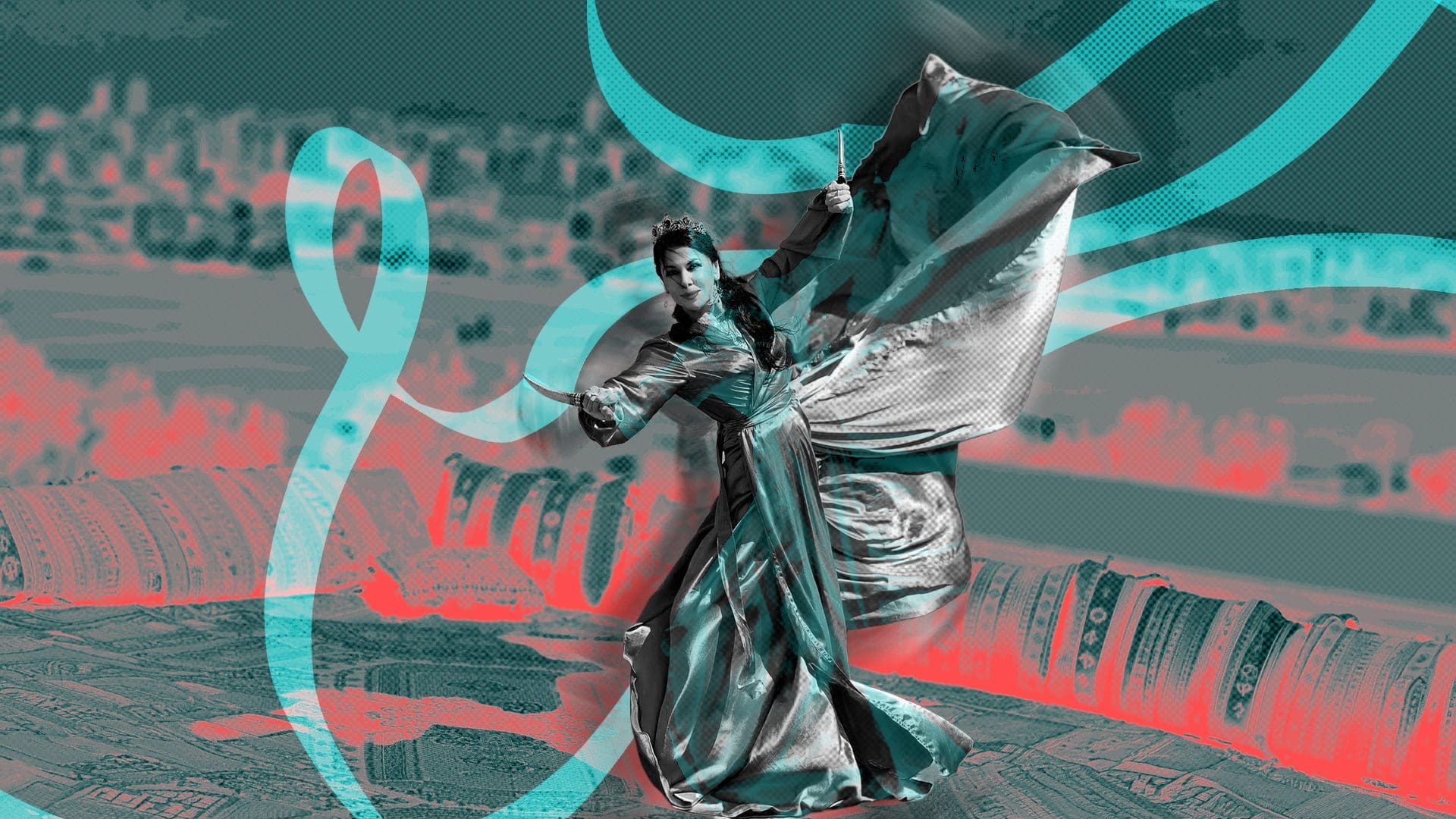

Born and raised in Basra, Assala Ibrahim grew up surrounded by music and public dance performances. After studying at the University of Baghdad, Assala worked briefly as an English and Arabic teacher before dedicating herself fully to dance.
Widely recognised as one of the leading contemporary ambassadors of Iraqi dance, her practice moves between performance, education and research, with particular attention to Basrawi and southern Iraqi traditional dance traditions1 such as the Hewa (also known as Lewa), Hacha’a and Raqs al-Khashaba.
Ibrahim looks at dance not only as movement, but as a form of memory: a way of carrying stories, gestures, music and social customs that might otherwise be lost.
In her own words: “I fill my life with dance, and my dance with life.”

Please share what first drew you to Iraqi dance. How did your journey begin?
My fascination with this art form began in childhood.
I was born and raised in Basra, where different dance styles and a rich culture were present. I was captivated by the beauty of everyday life in Iraq; people at the market; the people of the marshes, the way they lived, and their style of clothing; I loved listening to old Basrawi songs. My mother used to joke that I had an “old soul,” perhaps a thousand years old, because of how deeply I connected with the past.

As a child, I watched dance groups perform at public gatherings along with hundreds of other spectators. At school, we learned Basrawi and Hewa dances for school performances and local events.
Dance acts as an archive of history, social structures, and human emotion. For me personally, Iraqi dance is a conversation with our ancestors in its rawest and most natural form, preserving memory and sharing fulfilling and joyful energy. Dancing is a way of honouring the lives of those who danced before me, their history, and their contributions. Because of this connection, I feel a strong responsibility to preserve dance with respect and to protect its cultural meaning.
Iraqi women have always played an important role in carrying traditions, music, celebrations, and social customs from one generation to the next. Women have never been peripheral to Iraqi cultural history. They have shaped it, preserved it, and carried it across generations, even when their role has been overlooked or undervalued.
Therefore, through dance, I seek to help preserve Iraqi identity and women’s cultural memory, to ensure that these cultural expressions are not lost or forgotten.
Have you seen a rise in interest in Iraqi dance? Where is it coming from, and how do you ensure culture is taught alongside dance?
Yes, especially among international students, Iraqi and Arab women in the diaspora, and online audiences. But this rise in popularity is a paradoxical one. On one hand, there is growing curiosity about Iraqi dance and culture. On the other hand, the art form is often presented without its historical and cultural foundations.
In recent decades, traditional Iraqi dance has not received institutional support, whether through national ensembles, independent cultural initiatives and support for artists. Short, entertainment-focused performances have become increasingly popular on social media, however, in many cases, these performances are presented as “Iraqi dance,” ignoring any nuance, social context, and cultural significance that define the form. This blurs the line between rooted tradition and entertainment inspired by it.
Still, the global curiosity is valuable. We are seeing artists from countries around the world incorporating elements of Iraqi dance into their practice, performances and competitions. While our dance is often celebrated abroad, dancers and people interested in the discipline are socially restricted and discouraged from pursuing dance in Iraq.
It is my hope that we leverage the international interest in Iraqi dance, and that the Iraqi Ministry of Culture and other local cultural institutions will be encouraged to showcase authentic Iraqi heritage, support artists, and foster pride in our culture. We need to be proactive in documenting, sharing and promoting our heritage.
Because of this, I believe my role as an educator is not simply to teach steps, but to act as a bridge back to the source. My workshops have been held around the world, including in Italy, Germany, Mexico and the UAE, and bring together participants of all nationalities and backgrounds, from the Iraqi diaspora and the wider Arab region to students encountering Iraqi dance for the first time.
In my lessons, I teach various Iraqi dances while grounding each class in the historical, social and regional context of the form. Without understanding the “why” and the “where” of a movement, it risks becoming only a physical exercise. My goal is to ensure that students understand the dignity, symbolism, and cultural codes embedded within our dance and can practice it with a better understanding of its origin and place within Iraqi history and society.
How important is dance in preserving culture? What reactions do you get when you say you teach it?
Dance is a living library. It carries stories, values, emotions, and ways of life that are often absent from written records.
The reactions I receive are often deeply divided. I have had the privilege of presenting Iraqi dance and culture across many parts of the world, where it has been received with immense respect, love, and appreciation. Within Iraq, the subject of dance is more complicated. Dance is a part of Iraqi culture that people remember and wish to celebrate, however, it is often discouraged and almost considered forbidden to practice in public, so many people do so in private. As a result, many Iraqis aren’t exposed to the discipline alongside the cultural significance. Instead, the one-dimensional portrayals reduce it to commercialised entertainment.

My own journey reflects the complexities surrounding dance in our society. When I lived in Iraq, opportunities to pursue this path freely were impossible. After leaving Iraq, I was able to continue my education, study various dance traditions and bodywork, and dedicate myself to researching and preserving Iraqi heritage. This experience also made me realise how much cultural knowledge can disappear when it is not actively documented, taught, and protected. Much of my work today is driven by a sense of responsibility to safeguard these traditions for future generations.
The most moving responses come when I meet Iraqi and Arab women in my classes. For many of them, traditional dance is more than movement; it is a means to reconnect and reclaim their cultural heritage and strengthen their sense of identity and belonging.
When I created an online tutorial in Arabic, I received tremendous support and encouragement from younger generations. It was inspiring to see so many young Iraqis actively searching for their roots and taking pride in their cultural heritage. It is their enthusiasm, curiosity, and willingness to learn that give me hope for the survival of Iraqi dance in the face of criticism and hostility; and keeps me committed to supporting Iraqi and Arab women and ensuring they have access to the knowledge, history, and cultural context needed to reclaim their place within these artistic traditions.
How has public discourse around Iraqi dance changed in recent years? Why do you think this is the case?
Public discourse has changed significantly given that social media is now where many people first encounter Iraqi dance. Therefore, visibility is important. However, on these platforms, algorithms tend to favour spectacle over cultural depth. As a result, highly acrobatic or entertainment-focused performances can become more familiar than the traditional forms themselves and lack cultural context.
I believe that we’re at a pivotal moment, where understanding the history and cultural context of Iraqi dance is just as important as learning the movement itself.
For me, women are central to this conversation. Women have the right to move, to be visible, and to play an active role in preserving their cultural heritage. Women have always been part of the cultural fabric of Iraqi society. Preserving dance therefore means safeguarding an important part of women’s cultural legacy.
If artists, researchers, educators, and cultural institutions do not actively safeguard these traditions, there is a real risk that the traditions become fragmented or forgotten due to a lack of national and institutional support is concerning.

At the same time, I remain hopeful, encouraged by the students, researchers, and artists I meet all over the world who seek more than aesthetics. It is their desire for historical understanding, cultural connection and deeper learning that inspires my work and gives me confidence that Iraqi dance will continue to survive, evolve, and be appreciated with the dignity it deserves; protected, understood, and passed on to future generations in all its richness and complexity.