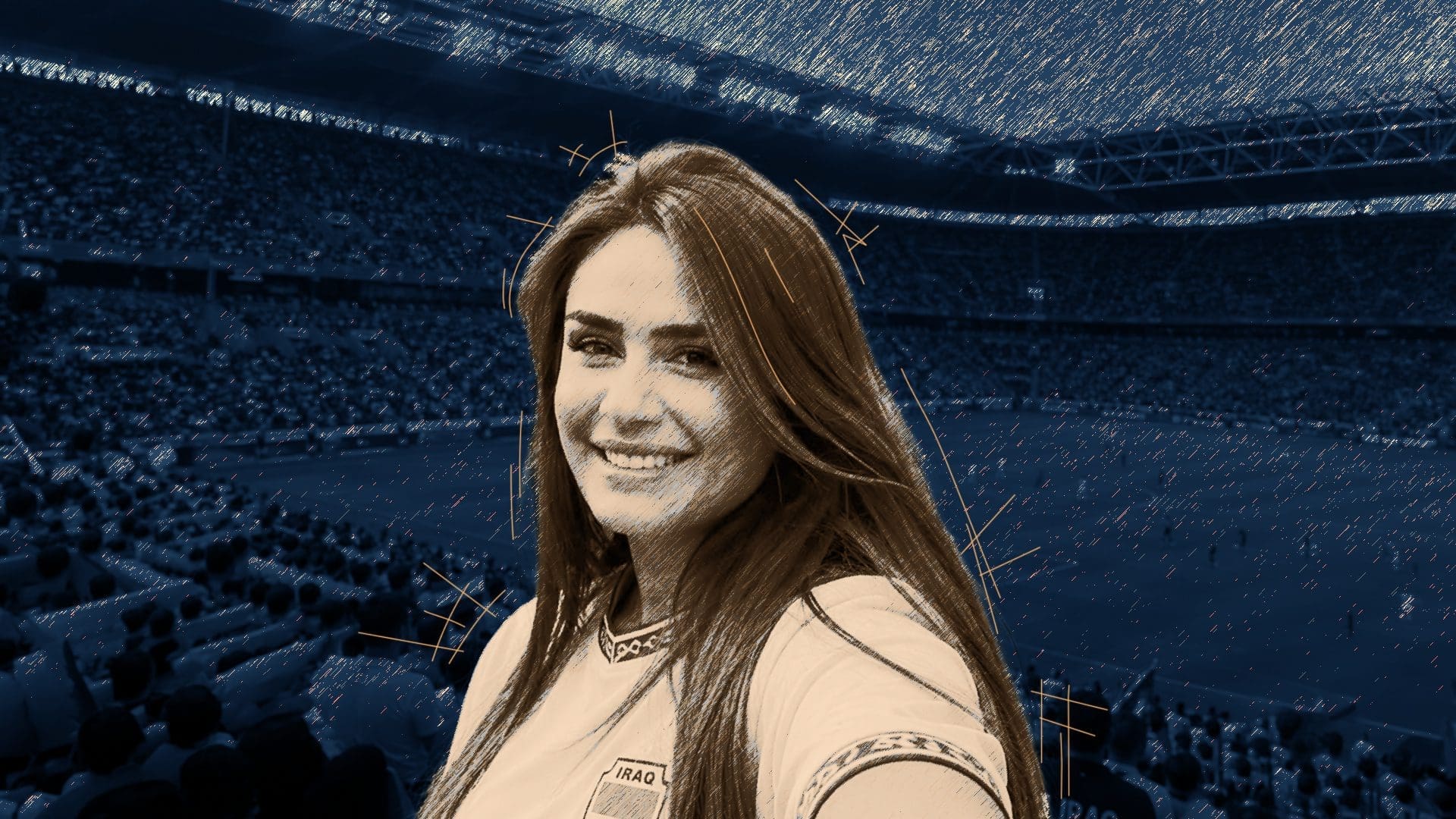

I find myself stopping mid-scroll to watch a familiar, goggle-clad face zip down the streets of Al-Karrada. Of course, it’s Ishtar Obaid.
It wasn’t always a bike. One-time world champion, one-time world silver medallist athlete, Asian and European champion in jujitsu, Ishtar Obaid has spent years building initiatives that extend beyond competition. As the founder of Baghdad Skate Park, co-founder of Iraqi Female Photographers, founder of an NGO focused on youth empowerment, women’s sport, and community development, and advisor to the President of Iraq’s National Olympic Committee, it comes as no surprise that she is on the move again. This time, on a mission to reframe the narrative around female cyclists in Baghdad.
Returning to Iraq
Like many Iraqis in the diaspora, Ishtar Obaid spent years witnessing Iraq’s upheavals, challenges and moments of resilience unfold through screens, phone calls and fragments of news whilst growing up between the United Kingdom and the United Arab Emirates (UAE).

After building her career as a national, European, Asian and world jujitsu champion, her inbox was filled with messages from young Iraqis asking how they could follow a similar path.
Obaid became increasingly aware of the disparity between her own accomplishments and the limited visibility, access and support afforded to many girls and women in Iraq.
Obaid felt a familiar feeling of guilt for being in the diaspora. With each message from Iraqis inside the country came an uncomfortable question: Why should her reality be any different from the reality experienced by the girls and women living in Iraq?
“I felt a sense of responsibility,” she said. “I felt like this is so unfair.”
It is a feeling that many in the Iraqi diaspora will recognise, though it is rarely straightforward. It reflects the arbitrary nature of opportunity, and the recognition that the gap between one life and another is often not a matter of talent or ambition, but circumstance based on who was able to leave Iraq and who wasn’t.
With that realisation comes a sense of duty, not born of charity, but of proximity to a life that might easily have been your own. A duty to help widen access to the opportunities, experiences, networks, and support systems that shaped the lives of many of us raised abroad.
Moving to Iraq in 2023, Obaid’s objective was to empower the same young Iraqi women who had been reaching out to her for years. Her goal was to see female athletes practice their sport with equal opportunities, and for all athletes in Iraq to be given the tools, support and environment to succeed and actualise their full potential. What she quickly realised, however, was that meaningful change would take time, andrequired understanding the realities on the ground.
“I had to earn my badge by being there,” she says. “I needed to understand how sport works in Iraq. Where does the problem start?”
Re-strategising and representation
What Obeid discovered is that sustainable progress happens both top-down and bottom-up. She began focusing on building small, self-sustaining communities focused on sports, that could grow organically over time. Through the NGO she founded focused on youth empowerment, women’s sport, and community development, Obaid created a framework connecting her grassroots initiatives. In parallel, she also worked to make sport more accessible to girls and women through formal institutions.

Obaid regularly travels to governorates across Iraq and speaks directly to athletes. Rather than relying solely on federations or administrators, she prioritises athletes’ own experiences and concerns, making sure their voices are heard. “Even though the change is small, it’s still change,” she says. Through her role as advisor to the President of the National Olympic Committee, she can contribute to initiatives related to athlete development, governance, and inclusion.
Her observations have also reinforced a belief that she developed through her grassroots projects. Iraq does not suffer from a lack of talented female athletes. “There are girls who are world champions and nobody has ever heard of them,” she shared.
The challenge is not talent, but the lack of visibility, support, and infrastructure that can limit female athletes, whose achievements often go unrecognised and underfunded. Obaid’s goal is to platform these women and ensure they receive the resources and recognition they deserve.
The sisterhood of sidewalk surfers
What started as a message on her Instagram story, inviting women and girls to skate with her, soon grew into a community. The interest and ambition were there. The opportunities and the space to enable it were not. Obaid’s first project began with establishing the first skate park in Baghdad alongside Baghdad Skate Girls, a safe space for girls wanting to be part of a skater community within the city.

“Making these micro-communities is what’s going to make the change,” she stated. And it did.
For young women in particular, sport often becomes one of the few spaces where they can express themselves freely.
Obaid’s experience is that the girls and women she encounters are often highly motivated, ambitious, and eager to participate. “They’ve been ready for so long,” she says. “They’re just waiting for the door to be opened.” Obaid believes it is social expectations, limited opportunities, and the lack of representation and visibility that remain significant barriers which make it challenging for women in Iraq to participate in sports publicly.
Obaid is on a mission to change this. In empowering others who share the same passions, she is able to offer both the opportunities and representation needed to build a community of skaters.
Among those women was Danya, a young woman who had never even seen a skateboard before joining the programme led by Obaid. Through Baghdad Skate Girls, Danya had access to support and training, allowing her to develop her skills and passions. Today, she is a certified coach, leading her own classes and empowering others.
“I can’t skateboard for them.” Obaid quipped. The objective was never dependency, it was sustainability. “I have to pull out of things eventually,” she says. “They have their certificates. They know how to run a class. They have everything they need. They need to carry on.”
The resistance didn’t just come from outside the home. Some girls hide their skateboards at home, while others are only allowed to practice in private, hovering between two identities: who they are, and who they are allowed to be. Their experiences reflect the social expectations that continue to shape how many young women navigate sport and public space in Iraq and highlight the importance of visible and supportive communities where young women can pursue their interests with confidence.
When I asked Obaid about how we can move past this hurdle as a society, she emphasised that, “We’re not rebelling. We’re normalising it. We’re desensitising.”
She stressed that these young women are talented, strong and ready and all they need are the visibility and encouragement to be themselves and participate confidently in sports.
In bringing together people with the same interests and ideas, it becomes easier to reshape public perceptions and allows for space to reclaim and reframe the narrative. These spaces are necessary to encourage and empower girls and women to continue to pursue their passions.
Change is at the end of the day a marathon, not a race.
Cycling for change
Like her previous initiatives, cycling was no different. Obaid recognised a gap in the Iraqi sports ecosystem and began developing the initiative as part of her broader strategy to expand visibility and access for women in sport. This decision was met with passing comments from people saying, “You can’t”.

“I didn’t understand. What do you mean I can’t? I have two legs and I want to go out on my bike,” she bantered when recounting the start of her cycling initiative.
Since then, Obaid has been cycling through Baghdad and in the process empowering others to do the same.
As with her skateboarding work, the goal is visibility. By creating more opportunities for women to be seen cycling on the street, in public spaces, Obaid hopes to accelerate a process she believes is already underway.
Documenting and posting her rides on her Instagram page resulted in an influx of messages from women in and around Baghdad expressing their interest.
One woman told Obaid that her “biggest dream is to cycle through Baghdad”. Others asked for cycling lessons seeing as they had never been taught to ride a bike. In response, Obaid is now in the process of developing a cycling initiative for women in Iraq.
Moving forward
Obaid’s focus is on being part of the broader cultural shift taking place across Iraq: Iraqi girls and women learning to skate, cycle, coach, compete, and occupy space in ways that redefine the status-quo.
In recent years, Baghdad has seen a surge in sporting events and recreational activities for men and women alike. This comes with the rise in young Iraqis looking beyond the traditional social spaces that have for decades dominated urban life.
“We are bored of restaurants, cafes, and malls,” said one young Iraqi woman. She added that, “going to the gym is fun but is still a solo, indoor activity, and can become mundane”.
Instead, many are seeking out activities that combine movement and a sense of community. Running clubs, yoga sessions, cycling groups, hiking trips, and fitness communities have proliferated across Baghdad and other Iraqi cities, creating new opportunities for people to gather in public space around shared interests.
Women have played an important role in shaping this landscape. Yoga instructor Dalia Al-Soufi has cultivated a following through classes held in gyms and local cafés, introducing wellness practices to audiences that might otherwise never encounter them.
Meanwhile, Noor Younus has taken yoga beyond conventional fitness spaces, leading outdoor sessions that encourage participants to reclaim public parks and open-air spaces.
In doing so, both Al-Soufi and Younus have also helped normalise women-led fitness initiatives and expanded ideas about where women can be active and visible. This is in addition to the rising number of studio spaces around Baghdad and other Iraqi cities offering yoga, Pilates, spin and dance classes.
Another example is Baghdad Run Club. Regular group runs have attracted growing numbers of Iraqis of all backgrounds eager to exercise collectively and reclaim the city’s streets as places for recreation.
These initiatives signal more than a growing interest in exercise. They reflect a broader appetite for community-oriented activities that extend beyond consumption and entertainment.
For decades, Iraqis have had limited access to public spaces due to political turmoil and civil unrest, as such choices for entertainment were equally limited. However, now that everyday life has found a steadier rhythm, and given the rise of social media and its perpetuation of a homogenised culture, young Iraqis have taken to the streets to reclaim and reimagine third spaces, turning away from typical choices and turning towards connection, community and expanding on the social and cultural experiences available in Iraq.
What Obaid and others are helping shape through their initiatives, communities and advocacy work is a return to movement. Not rebellion, not disruption, just movement, in sport, in space, in society, reinforcing the idea that fitness belongs in everyday life.
But more importantly, also reinforcing the idea that women belong in everyday life. By expanding visibility, access, infrastructure and support, these initiatives help create a generation for whom women’sparticipation, in sport, in space and in society, is the norm rather than the exception.