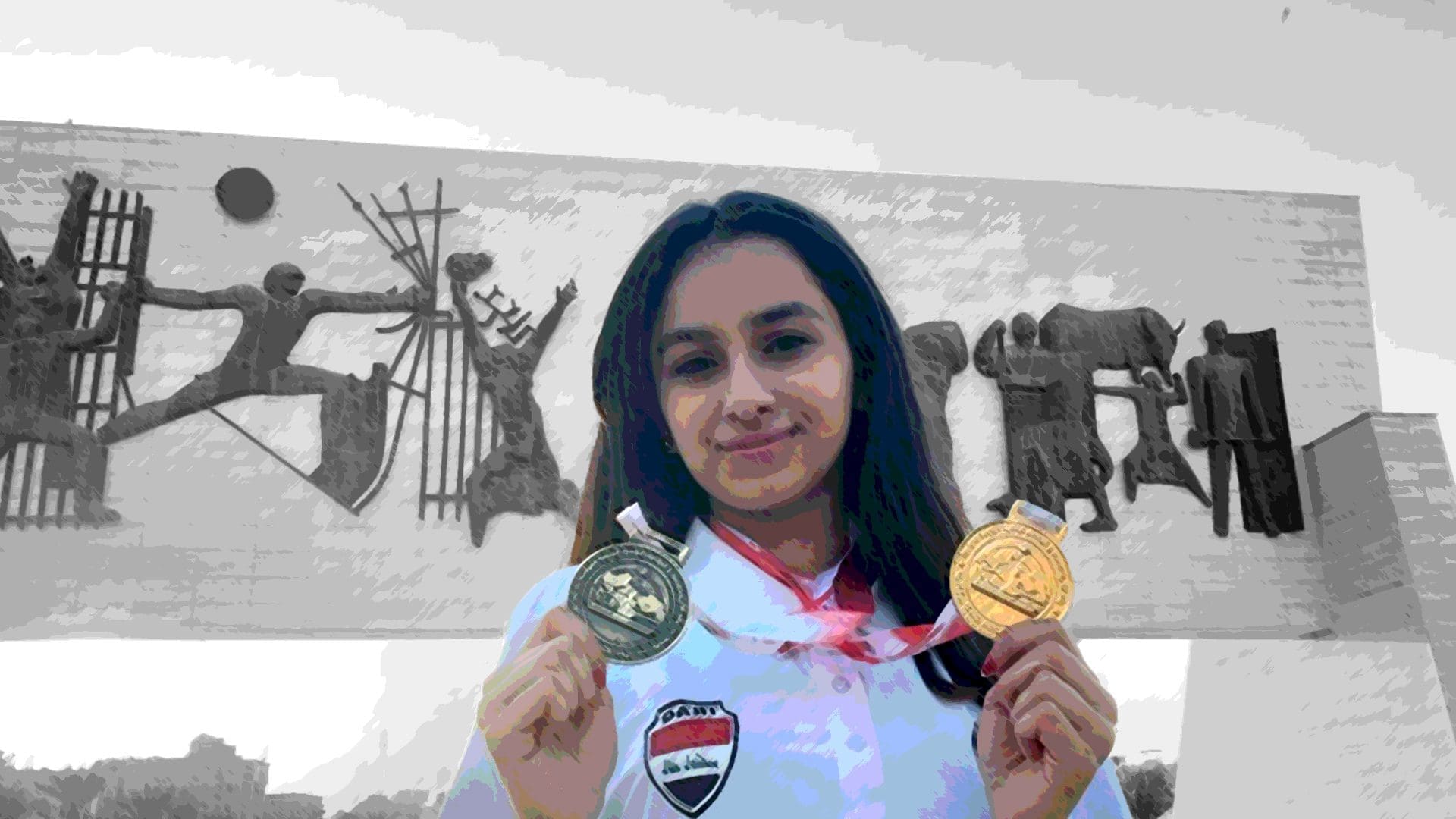

My eldest daughter, Durr, stumbled into this world by chance. Like many Iraqi stories, what happened next was unplanned, but was a fortunate coincidence. At a scientific conference, I met a colleague who worked in education and coached the Iraqi national shooting team for junior boys and girls. Durr was 14 years old at the time, and she had a simple dream, to play sports. Football, running, taekwondo, or anything that could fulfil a lifelong passion. But that chance encounter led the coach to suggest a sport she had never even considered: shooting.
The sport, he said, required focus and composure. We knew nothing beyond the basic concept which included a fixed goal, precise aim and the idea that success depended on the player’s calmness, concentration and inner peace. But what peace could my colleague be talking about? We, the residents of eastern Baghdad, have practically internalised the noise around us. It has become inseparable from our daily lives.
Cities of noise
Streets that never rest, day or night; suffocating traffic jams; incessant car horns; overcrowded schools; tuk-tuks speeding through alleys; blaring music; no parks to catch our breath; green spaces swallowed up by encroachments. Our nights are devoid of tranquillity, our days devoid of peace. There is no Fairouz here drifting from balconies and shopfronts. These are cities of noise.
Amidst this, shooting arrived to impose its harsh yet noble conditions. “The player must be calm and psychologically and physically stable.” Two stark contrasts: a game that demands absolute tranquillity, juxtaposed with a life that is chaotic to no end.

The decision raised questions that went far beyond sport. How do we separate the sport of shooting from shooting as a term steeped in violence in our collective memory? How do we confidently place girls on the sports field? How do girls break into a field unjustly classified as exclusively male, like shooting?
How can we convince people, relatives and friends, that this is simply a sport, a game measured by numbers, a target, and an air rifle loaded with neither bullets nor gunpowder, with no connection whatsoever to killing or death?
Nevertheless, Durr liked the idea. Alongside her mother, we agreed that she would take the test and see how the story unfolded.
A male-dominated world
A glance at the statistics reveals the vast gap between male and female shooters in Iraq. In the junior air pistol category, only nine female trainees currently compete nationwide compared with more than 20 male trainees. This imbalance extends beyond athletes. There are no women coaches at shooting ranges, or in national teams, and only one woman referee. Similarly, the Shooting Federation has only one female member compared to nine male members, a representation mandated by international shooting quotas.
This is what shooting looks like in Iraq. It is a sport that demands balance, precision, and fairness, yet still reflects the societal imbalances that hinder women’s access to equal opportunities.
Hitting the target
We went to the testing location at the time specified by the coach. The busy road roared with traffic. How could one maintain their composure in such commotion?
With youthful enthusiasm and great confidence, Durr hit the target, more than once. The first test was with a rifle, a heavy instrument, larger than her young frame. I waited for a reaction, but the coach remained calm, and simply said, “Come back next week”.
The first test gave nothing away. Shooting demands psychological stability, composure, physical fitness and mental well-being, quality nutrition, and neuromuscular coordination. All of this cannot be measured in a single day. Over the following weeks we returned to the training ground repeatedly as Durr was assessed across different disciplines, one week with a pistol, the next with a rifle.
After more than a month of weekly tests, the coach finally determined Durr was suitable for shooting. It was agreed that Durr would join the pistol team.

Obstacles do not extinguish hopes
The challenges had just begun. Traffic jams, the long commute from eastern to western Baghdad, all affected her performance. Disruptive noises destroyed concentration. With every step forward, I realised the road was longer than I imagined, and that the discipline was more than just a gun and the target. It demanded much more including patience, organisation, and small sacrifices that accumulate until the target is hit and the goal achieved.
Durr chose the 10-meter air pistol: an Olympic-standard firearm that uses compressed air to propel a pellet at a stationary target 10 metres away, using only one hand.
According to Olympic standards, the pistol must be equipped with a carefully designed wooden handle that fits the anatomy of the player’s hand. Its price ranges, in Iraq, from between one thousand to three thousand dollars.

Here lies another paradox. The cost of equipment is prohibitively expensive for athletes, given their lower incomes and the limited support of sports clubs.
This pushes many to abandon the sport prematurely, despite possessing the talent and desire to succeed. The coach asked me to “imagine driving a brand-new 2025 Ferrari and racing against someone driving an old 1980 model car… The outcome is decided before the race even begins.”
“The same applies to shooting. Countries that excel in this sport use state-of-the-art, high-tech weapons. We try to keep up with them using outdated weapons. Under those circumstances, fair competition becomes difficult, and sometimes almost impossible.”
“The model of the weapon makes all the difference in international competitions,” the coach concluded.

Just before the Arab Championship, we searched locally for a suitable weapon. We scoured local markets and visited hunting supply stores but could not find what we needed. Luck struck when a contact within the Shooting Federation helped us find a 2010 model air pistol. We purchased it on an instalment plan for two thousand dollars—not as a luxury, but as a necessity for Durr to continue in the sport.
The glue grip and the rooftop shooting range
In many countries, a 3D image is taken of an athlete’s hand, and they receive a custom-made grip tailored to its exact dimensions. This precision allows for greater control when shooting.
In Iraq, coaches often improvise by manually modifying the grip using a mixture of sawdust and glue. The shooter is then asked to place their hand on the grip to mould it to their shape. The result is rarely as precise as a custom-made grip.

To accommodate Durr’s training, we built a simple shooting range on the roof of our home. It had a target made of cardboard, behind it a barrier resembling an earthen berm, and a small lamp to illuminate the target. We measured its height from the ground at 140 centimetres. We set the distance between it and the aim point at ten metres, exactly as stipulated in the shooting regulations. From this modest rooftop training ground, Durr went on to achieve remarkable results.
Practicing on a residential rooftop has its own challenges. In a working-class neighbourhood, with houses stood close together, a neighbour expressed concern that a stray pellet might injure someone.
I spoke to him calmly and explained the sport’s attention to safety, as well as Durr’s discipline and training. He was reassured when he learned that we had placed sandbags behind the target, and that the range of the pellet was limited and harmless.
As a family, we strive to meet the needs of our three daughters and our young son on all levels, social, material, and emotional. We provide them with a good education, proper care, and genuine support for their talents and aspirations as an inherent right.
Amidst life’s hardships, society’s harshness, and its unforgiving complexities, we strive to be a source of support, to provide our children with a safe space to grow and dream. We believe without hesitation that this endeavour is not a favour or an exceptional sacrifice, but rather our moral duty to stand with our children and choose hope for them, as they learn to face the world.

She came with gold
In 2023 and 2024, Durr achieved first place in the Iraqi Shooting Championship (10-meter air pistol/junior women), while her sister, Rahma, achieved sixth place nationally.
At the 2024 Arab Shooting Championship in Tunisia, Durr won gold in the doubles event and bronze in the individual event, two significant achievements for her first international competition.
We arrived at Baghdad International Airport at dawn to give her a hero’s welcome, but the wait stretched for more than three hours due to a lengthy security inspection of sporting weapons, which raised eyebrows and drew questions.

We returned home with our dreams intact, and a champion no bigger than her suitcase.
We all celebrated her achievements—family, friends, and fans. Media outlets covered the story. Yet no sports federation or official sporting body formally recognised her accomplishment. The only official acknowledgement came during a flag-raising ceremony at her school, a gesture that meant a great deal to us.

After these achievements, and after an official test conducted by the Iraqi Shooting Federation, Durr qualified to represent Iraq regionally, carrying with her the story of an old weapon with a glue grip, a homemade rooftop range, and dreams that know no limits.
Paper targets, pistols, and the price of success
In Iraq, half of the shooting range targets are paper, and the other half are electronic. The paper target is simply a piece of cardboard with numbered circles from 5 to 10. Shooters aim at it from 10 metres, and the referee estimates the hit by sight, without using a machine.
Iraqi shooters face a shortage of training facilities and a severe lack of equipment. At the Iraqi Shooting Federation’s range, athletes of all levels train side by side, often sharing limited resources.
Ideally, each shooter should have access to their own target. Instead, dozens of athletes can find themselves rotating between targets, with more than 30 shooters sometimes training at the range on a single day.
In Iraq, Olympic-standard pistols and rifles are not treated as sporting equipment but are classified as firearms. Their sale is only permitted through complex official government approvals. This effectively closes the door on Iraqi athletes before they have even begun. They cannot purchase their sporting weapons from abroad or import them through global online marketplaces, unlike in many other countries. The reason is not a shortage of weapons, but rather the absence of clear mechanisms and organised laws regulating the purchase and sale of sports equipment and shooting gear.
Athletes find themselves trapped between their passion for sports and a legal system that has yet to differentiate between a weapon for Olympic competition and a weapon associated with violence.
Shooting demands exceptional accuracy and mental and physical stability. To achieve peak concentration, athletes employ relaxation techniques to relax the body and lower their heart rate. At the highest levels of the sport, sometimes their shots are between heartbeats. Shooting teaches not only how to hit the target but also how to maintain balance and stand firm in a constantly shifting world.
The financial burden is significant. A 10-metre air pistol costs between one thousand and four thousand dollars. A 10-metre air rifle costs around four thousand dollars and a rifle suit approximately two thousand dollars.
A special rifle suit is required, tailored to precise measurements from a rare fabric not available locally, forcing athletes to source it abroad or purchase it during international competitions.
For a sport that recognises only precision and rewards only unwavering patience, Durr’s experience highlighted the harsh reality of underfunded and unsupported sporting communities within Iraq
At the beginning of 2025, I received a call from the management of a sports club in Baghdad, regarding contracting with Durr and Rahma for a full sports season.
The offer was shockingly modest: 100,000 Iraqi dinars (around USD 76) per month for Durr, the Iraqi champion for two consecutive seasons, and 50,000 dinars (around USD 38) for Rahma, the promising player.

On the same day, I inquired about the football players’ contracts. Salaries range from 750,000 to one million dinars per month (around USD 570–760), even despite the club’s lack of notable achievements in football. It was clear that Iraqi clubs do not prioritise individual sports. For decades, we have had heard promises that the state and the Olympic Committee would pay greater attention to the Olympic Games but,from our perspective, little has changed.
Learning balance: Between books and birds
Studying is a challenge no less demanding. Durr works hard to balance her athletic training with her academic commitments, striving to excel in both.

The Shooting Federation and some clubs deduct from an athlete’s salary when they miss training, even if the absence is due to educational obligations. The salaries are modest in all cases, but deductions don’tspare anyone… not even champions. A family invitation to the orchards of Diyala, north of Baghdad, offered a welcome escape from the crowded capital. The trip included a chance to enjoy the greenery, fresh air, and the opportunity to hit a moving target, birds, with rifles.
As soon as Durr heard this, she firmly refused.
“I am not a killer,” she said, “I will not kill birds. I am a professional shooter. I shoot at a specific target, and I will not kill a soul created by God.”
Still moving forward
2025 was a difficult year for Iraqi shooting. National competitions were suspended, and international participation was disrupted due to administrative disputes within the Shooting Federation and allegations of corruption within the Olympic Committee. As the chaos subsided, a newly elected federation pledged a new beginning for the sport, including modern training facilities, international coaching expertise, access to equipment, higher athlete salaries, and long-term investments to benefit both the sport and its athletes.

The challenges remain significant. Life in Iraq is rarely simple, and sport reflects many of the same complexities. Shooting is a discipline built on stillness and precision yet is practiced in an environment where uncertainty often prevails. Nevertheless, athletes like Durr, along with their families and supporters, continue to persevere, refusing to let limited resources define the limits of their ambition.