Across three fronts this year, Iraqi state has asked the public for the same thing: trust, without any rationale.
Take the anti-corruption campaign led by the government of Prime Minister Ali al-Zaidi. After a wave of arrests, the closure of the Green Zone, and heavy media coverage, what reaches the public now is mostly photographs of confiscated cash and gold, with little information about the cases behind them.
More than three weeks after arrests affected dozens of public figures, there is still no clear account of how many remain in custody, on what charges, or how far investigations have gone.
What does surface are leaks attributed to security sources, involving significant political figures such as Hanan al-Fatlawi, Ahmed al-Assadi, and Shibl al-Zaidi. Each time, the accusations are met with denial and threats of legal action. Some of the details of investigations do need to be kept hidden to protect evidence and ensure fairness , but that does notexplain the complete silence that has followed the arrests and raids.
The ambiguity deepened as the anti-corruption campaign turned to negotiating recovered funds. The judiciary has said it is working with the government on mechanisms that could include reduced sentences or amnesty, without publishing which crimes qualify, how sums are assessed, or what prevents suspects with stronger political connections from receiving longer terms. A campaign whose goal is unclear, whose steps cannot be reviewed, and whose settlements are undisclosed may still produce arrests and striking footage, but is not on its own a sustainable anti-corruption policy.
A related gap appears with Iraq’s main oversight body. When parliament reviewed the Federal Board of Supreme Audit’s (FBSA) 2025 report, Speaker Haibat al-Halbousi called it “disappointing” and accused the Board of favouritism. Other MPs pointed to slow work and a failure to name those responsible.
Some of that criticism is fair. By al-Zaidi’s own account, some state companies have gone unaudited for more than five years. But the annual report is only a summary of the Board’s output, which includes more than 7,950 individual oversight reports, exceeding 70,000 pages, according to the Board’s own head, documenting violations across ration cards, national IDs, government contracts, public spending, and the oil sector.
Under Iraq’s constitution, the Board, which is Iraq’s primary audit institution, answers to parliament. Parliament can request further information and investigations, making parliament also responsible for summoning the officials named in the reports and monitoring work on its recommendations.
Reprimanding the Board years after receiving its reports, without disclosing what became of them, turns an accountability session into political theatre. The Board can publish only what parliament approves, meaning most of its work is never made available to the public.
The same pattern shapes how the state is handling its money. For weeks, officials insisted salaries were secure and would be paid on schedule.
Government spokesman Haider al-Aboudi has now acknowledged that payment dates depend on the Finance Ministry’s available liquidity and may slip until the required sums are collected. This followed a disclosure by Finance Minister Faleh al-Sari that salaries for employees, retirees, and welfare recipients require about 7.8 trillion dinars a month, more than the ministry has been able to raise.
The gap predates the regional war. Iraq spent about 27.1 trillion dinars in the first quarter of 2026 against revenues of 25.2 trillion. The gap increased even further once the closure of the Strait of Hormuz disrupted oil exports.
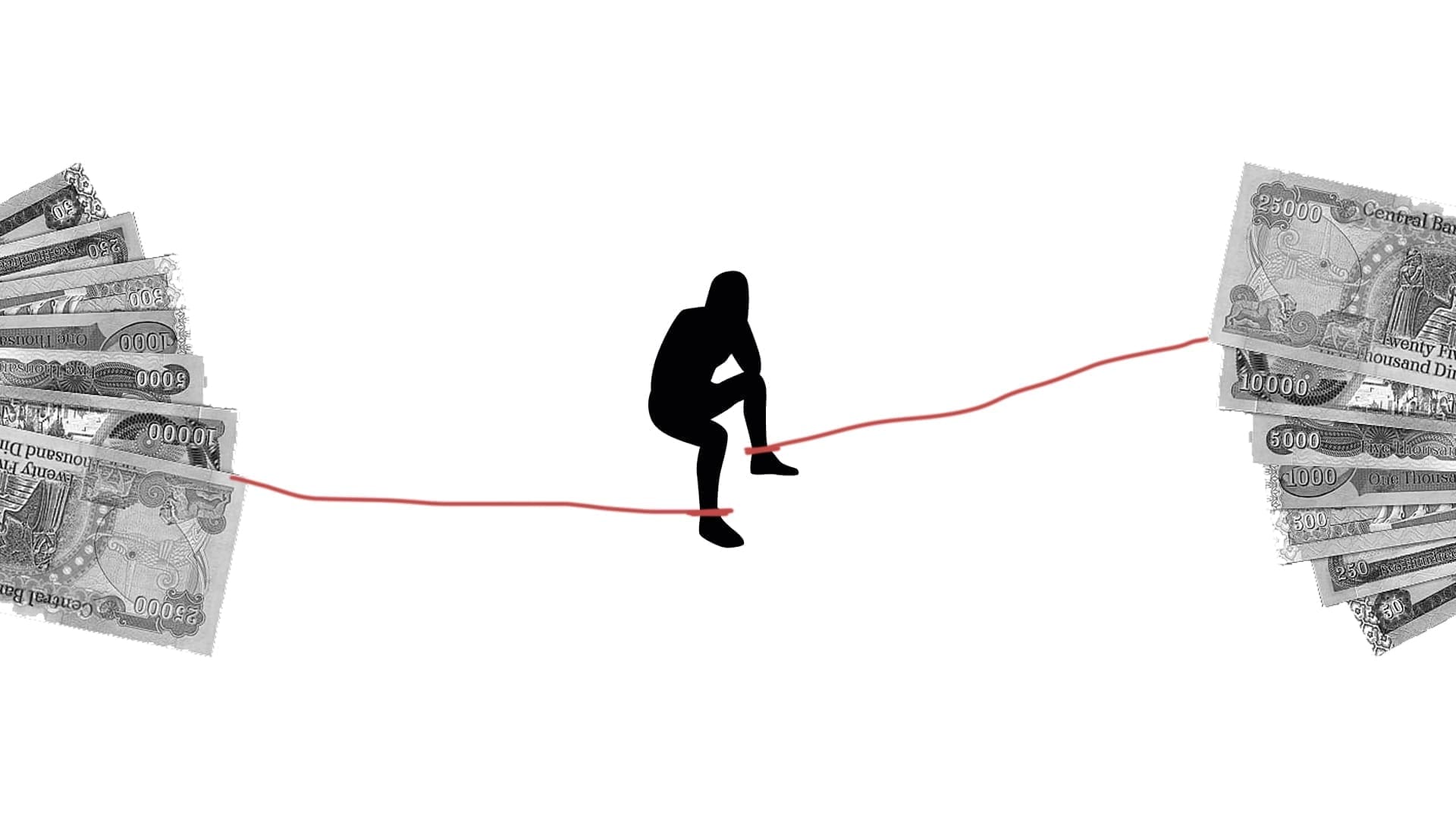
Even so, the reassurances continued. In June, the prime minister and his spokesman maintained that salaries were secured, even as Foreign Minister Fuad Hussein acknowledged the government had printed 25 trillion Iraqi dinars, nearly 20,000 US dollars, to meet the crisis. The Central Bank disputed the claim, calling it temporary liquidity against government debt, to be repaid at a later date.
Parliament is now moving to pass a borrowing law for 2026 to cover salaries and basic spending in the absence of a budget. The draft has not been published, so its scale, its lenders, and its repayment terms remain unknown.
The prime minister’s financial adviser, Mazhar Mohammed Saleh, calls this a liquidity crisis, not bankruptcy, and points to alternatives such as more borrowing, or advance payment against future oil exports. In every case, this entails financing today’s spending with tomorrow’s revenue.
Salaries, once an entitlement with a fixed date, now follow what Iraqis call a policy of “God is Generous” or Allah Kareem, paid out when the treasury collects enough, or the government is able to borrow it.
None of this is a failure of capacity. Iraq has people who can investigate corruption, audit spending, and manage a budget. It is a failure of disclosure. The information already exists, inside investigation files, audit reports, and a borrowing law which is still being drafted. It just stops there, in the hope that no one will ask where it went.
Subscribe to Jummar’s monthly newsletter for the full issue.