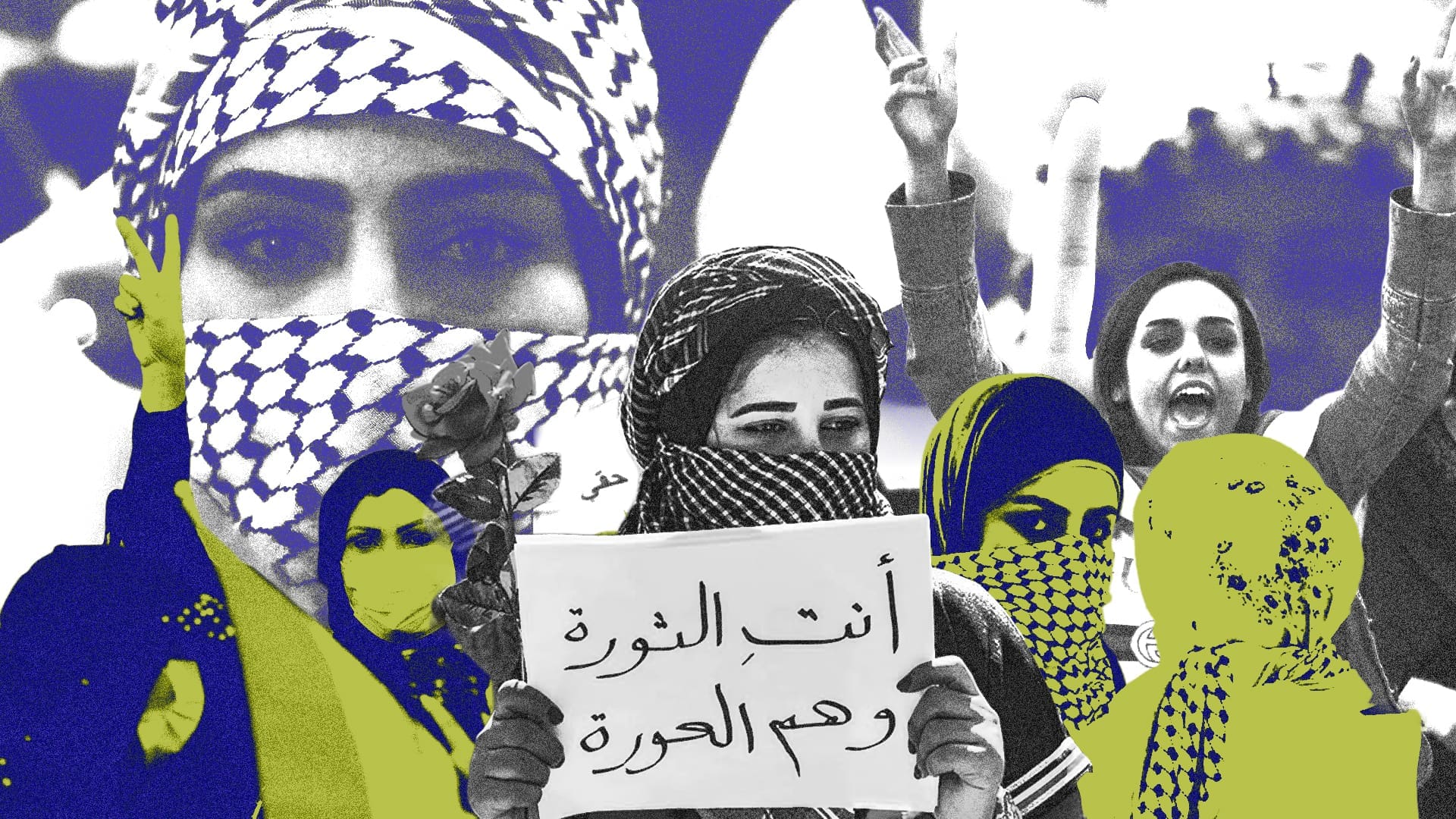

Tishreen began on 1 October 2019. It was sparked by an incident that took place a week earlier. On 25 September 2019, unemployed graduates had taken to the streets demanding public sector job opportunities. They were met with state violence including the use of water cannon. A young female graduate protester was knocked to the ground with the force of the water displacing her headscarf. A video of the incident was shared by thousands of Iraqis who found the images humiliating and deeply offensive. The incident was one of the reasons why many men joined Tishreen – the largest uprising in the country’s post-war history.
Since the 2003 US-led invasion, violence against women in Iraq has reached alarming levels. The Iraqi Human Rights Observatory reported 36,000 cases of domestic violence in 2025 alone. State violence against female protesters has also been a frequent occurrence, including kidnappings, killings and other human rights abuses. In 2020, Reham Yaqoub, an outspoken activist from Basra, was murdered in cold blood. Recently, Yanar Mohammed, a prominent Iraqi women’s rights activist, was killed outside her home in Baghdad.
The violence against this female graduate protester must be understood in this context. Men took to streets in solidarity with their female compatriots. However, the reasons that men often gave as to why the incident was so offensive also point to an underlying story about what is considered to be women’s “place” in Iraqi society, and the gender politics of Tishreen more broadly. Many men felt outraged by the incident because they considered it to be a violation of dominant gender norms. Those norms put women on a pedestal, while ensuring they remain under the paternal care of men – a phenomenon that feminist scholars have identified as benevolent sexism.
Why the attack struck a nerve
A protester in his twenties from the Baghdad’s, Sadr City, where more than 15% of Baghdad’s Tishreen protesters lived, told me:
“The ruling groups are all criminals, we know that. Criminals and liars, they robbed us. How many wars did we see? I saw friends and family die. I am unemployed. What did we get from them?
All these things filled me with anger and made me want to do something, that’s why I joined Tishreen. But, you know, it was when I saw the way they treated the female graduates that the buildup really began. That is something that is unacceptable in Iraqi society because a woman has a certain place. “
In other interviews, male protesters and activists emphasized that the event was unacceptable in “Arab or Iraqi society”. A young, middle-class communist party activist and journalist told me that “society was most affected by the treatment of the female graduate protester whose clothes came off because of the water cannon. Iraqi society has traditions that give women a certain importance and don’t allow them to be hit.”
In Iraq, gender norms are governed by what are often referred to colloquially as “customs and traditions” (Aadat wa taqalid). These are uncodified but widespread social and cultural norms. References in these interviews to Arab or Iraqi society are pointing to these norms.

A supporter of the uprising, and academic quoted by an Iraqi news website specifically linked the incident to Iraqi masculinity:
“…a low-life is one who strikes a young woman; a truly honorable man stands before her, taking on board whatever she says without reacting—for otherwise, by the standards of Iraqi manhood, he is nothing but a low-life and a man devoid of honour.”
Iraqi men often used the word gheera to describe their motivation for joining the uprising. Gheera is an Iraqi term which, when used in relation to a woman, translates to a kind of protectiveness or jealously. When used in relation to the country, it can be translated as patriotism. In the case of this young female graduate, the gheera for the homeland, and for her as a woman, coincided.
The question is how it is possible for otherwise restrictive and conservative gender norms to be mobilized in anger and outrage at state brutality against women? Is it not those very norms that would otherwise restrict this female graduate’s presence in the public realm? Italian communist Antonio Gramsci’s idea of common-sense can help explain this apparent contradiction.
For Gramsci, “common sense” means the worldview people absorb from family, religious institutions, schools, popular culture, tribal mores, amongst other things. That worldview can work to uphold the existing social order, but it can also be turned against it, particularly when the ruling groups are seen to be acting in a manner that threatens its values.

Seeing Iraqi customs and traditions through this lens allows us to better understand how they could both restrict women and drive anger at the state. The response to the graduate incident was rooted in a sense of justice derived in part from traditional gender norms, which the state was seen to have violated.
Women at the centre of Tishreen
The uprising was often lauded specifically for the centrality of women. Women had participated in social protest throughout the post-2003 period, but never in such numbers and with such frequency. At various points in the uprising, women marched through Baghdad over-turning, if only briefly, the deeply engrained gender norms which govern a heavily male-dominated public space. In the increasingly conservative cultural context of post-2003 Iraq, the sight of women marching and chanting through the streets of Baghdad was nothing short of revolutionary.
Although men sought to “protect” women from the state, the presence of women in the streets was not granted to women by men. Women in Tishreen constantly came up against conservative gender norms enforced by their male (and sometimes female) relatives. One woman, a young university professor, described to me her struggle to convince her husband to allow her to join the uprising. She told me it was “difficult in the Iraqi family” for a woman to go out to protest. “On one side” she says, men “are open in terms of how they deal with women – they have respect and value women in a big way – but on the other, side the idea of a woman going out on the streets for a political reason is not easy.” Even her sister was judgemental about her decision to join the uprising. On top of this of course were the difficulties of arranging child-care.
This woman’s testimony highlights the kinds of gendered dilemmas she faced in her decision to protest. Women’s participation in politics is often restricted by their husbands, their caring responsibilities, and the social stigma and scrutiny that they can face from being political. It also shows the dichotomy of chivalry and respect, combined with restrictions on entering the public realm, that characterize gender norms in Iraq – exactly what feminist scholars refer to as benevolent sexism. Iraqi men often use this kind of logic to justify preventing their wives from working, arguing that women are better off at home where they are “cherished and honoured” – muazzaza mukarrama.
Many woman that joined the uprising underwent a similar struggle of having to seek the permission, potentially defy, and be scorned by their male (and female) relatives and society. Tishreen saw unprecedented numbers of women force their way into the public realm against these restrictions. However, despite this the protest squares remained overwhelmingly male-dominated, and women’s demands were generally sidelined. Women’s rights activists have recounted their struggles to have their voices heard in the protest squares.
Although women led protests and set up protest tents, protest coordinating committees were male-dominated. Political parties that formed were led mainly by men. Men set the agenda, identified the demands and negotiated with the authorities. None of the Tishreeni demands that were put forward clearly related to the question of gender. Although women broke into the public realm with force, traditional roles were often maintained, with women responsible for caring labour – cooking, cleaning, medical care etc, while men did the serious business of resistance politics.
If a woman helped spark the uprising, the dominant symbolism of Tishreen was male. Tuk-tuk drivers who showed solidarity by ferrying protesters to and from the protest squares, became an emblem of the “heroic” revolutionary subject of the uprising: young, poor, precarious, fearless and ubiquitously male. One woman in the protest squares declared that she would “only marry a tuk-tuk driver, for his is a man of chivalry and honor.”
Many accounts of Tishreen rightly emphasise the liberatory aspects of the uprising. However, the internal gender politics of the uprising are often glossed over or neglected entirely. The squares were seen as spaces in which dominant social norms – whether based on sectarianism, gender or class – began to break down. Categories like “civic-minded” (madani), which have been used to characterize the uprising, work to collapse its cultural complexity into a particular mould, ignoring the various ways in which conservative and restrictive gender norms continued to operate in the protest squares.

Why does all this matter now? The struggle against the ethno-sectarian system is not over and, if Iraqi history teaches us anything, it a matter of time before the next Tishreen. It is important therefore to understand some of the internal politics of Tishreen that created and sustained divisions across gender lines.
Tishreen was an event with transformative potential; it saw women defy cultural norms that restrict their political participation. However, even in the protest squares, women continued to face a conservative common sense that sought to keep them in “their place.” That common sense has been enforced and adhered to not only by the state, but by many of the men marching in the protest squares.