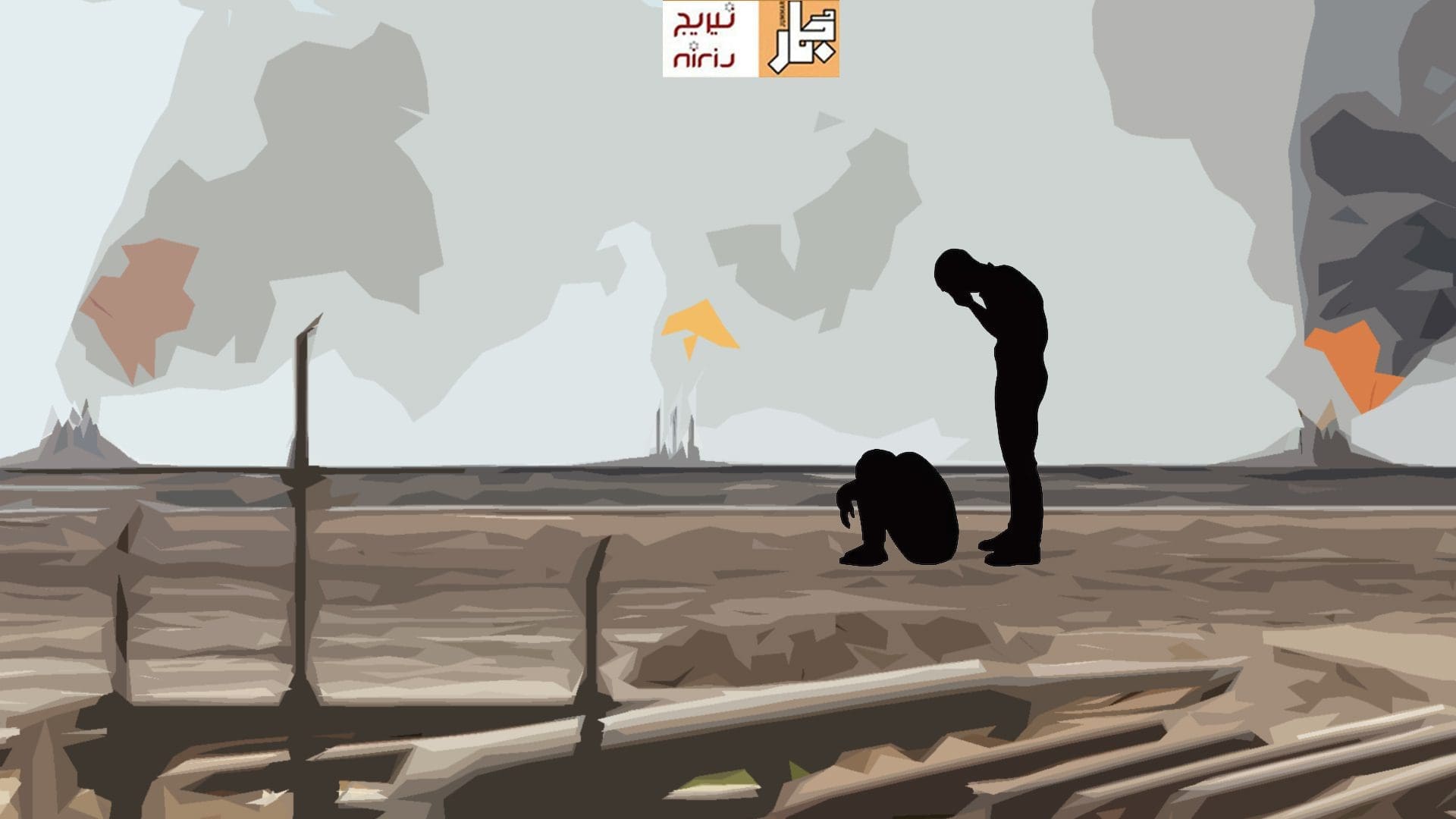
What does it mean for oil to stop in a country where everything depends on oil? This article unpacks how Iraq reached this economic crisis, why its options appear so limited, and what may await people if the halt in production and exports continues.
The question today is no longer “What if oil stops?” but rather: “What do we do now that it already has?”
With oil export platforms halted and supply chains disrupted by an intensifying regional war, Iraq finds itself face to face with a stark reality: a rentier economy with no buffers, and an explosive budget its survival hinging on a constant, moment-by-moment flow of liquidity from abroad.
While neighbouring countries benefit from sovereign wealth fund umbrellas that protect their generations from political volatility and wars, Iraq confronts its existential crisis with limited emergency tools. Its foreign reserves have become the last line of defence. In this article, I dissect the fragile financial structure of the Iraqi state, examine why a safety net that should have been built decades ago is absent, and explore the bitter options now available to a government managing a country that quite literally lives on the flow of oil to global markets and its revenues to the treasury.
The Last Line of Defence: What does the state actually have?
With oil pipelines no longer pumping, the state is left without safe strategic options, facing instead a stark and unforgiving arithmetic reality. From the critical moment Iraq announced a reduction in production, talk of development plans and mega-projects vanished. Everything has become focused on securing liquidity to provide daily sustenance for millions of citizens.
Iraq, which for years turned its back on the idea of sovereign saving, now finds itself confined to a limited set of tools that some consider shock absorbers, however closer inspection reveals they resemble first aid in an intensive care unit: designed to keep the pulse going, not to cure the structural disease.
In this context, the foreign reserves of the Central Bank of Iraq (CBI) are the government’s last refuge in confronting the crisis. As part of its constitutional and legal responsibilities to safeguard monetary and financial stability and ensure the resilience of the banking system, the Central Bank’s board held an extraordinary session on 8 March 2026 to monitor current economic and financial developments, review key macroeconomic indicators, and assess future expectations in light of domestic and international changes.
CBI stated that foreign reserves cover 12 months of imports. It also discussed alternatives to ensure the payment of salaries and essential expenses in the coming months, in a way that maintains the state’s financial commitments, supports economic and living stability, strengthens confidence in fiscal and monetary policies, and allows economic activity to continue normally.
The statement carries an implicit acknowledgment of the intense pressure on monetary policy in addressing the problem of financing salaries. These alternatives often lead to domestic borrowing through legislation passed by parliament; a measure aimed at preventing social paralysis. CBI’s reassurance that reserves cover 12 months of imports signals that food and medicine supplies are secured for the year. But this timeframe is a hard ceiling; the longer oil exports remain halted, the faster this coverage will erode.
The Sovereign Fund Puzzle: Why is it absent in a country of billions?
While neighbouring countries maintain sovereign wealth funds as global investment arms securing the future of their generations, such as Qatar’s Investment Authority or Saudi Arabia’s Public Investment Fund, Iraq remains a fund empty of anything but rentier income.
The idea of establishing a sovereign fund was missed at the right moment, namely in 2003, in the period following the U.S. invasion, when conditions were more favourable. Today, it has become far more difficult due to population growth, which has multiplied obligations, and global inflationary pressures.
This absence is not due to a lack of money, but to a structural failure in managing wealth. Successive Iraqi governments treated oil surpluses, especially during boom years, as cash for immediate consumption rather than investment. Instead of directing billions toward international assets or productive income-generating projects, the pattern was to absorb public anger through excessive government hiring and inflated operational spending.
This approach effectively meant the state was “eating its oil,” leaving it hostage to oil market fluctuations or sudden disruptions, such as a potential closure of the Strait of Hormuz today.
Establishing a sovereign fund requires legislation that protects its assets from successive governments. Previous attempts have failed due to political forces wanting to keep funds under the annual budget, which is subject to bargaining. Over time, Iraq’s budget has become a political contract renegotiated each year, where financial surpluses serve as leverage in disputes over provincial shares, projects, and public sector jobs.
A sovereign fund, by nature, requires strict financial insulation and rules preventing access to its money – effectively stripping politicians of a major financial lever. This clash between saving and political bargaining has left Iraq financially exposed. Instead of a fortified reserve for crises, it has an open treasury, depleted whenever oil prices fall or flows are disrupted, leaving Iraqis stunned and disoriented.
The absence of a sovereign fund is not just a missed opportunity; it is a political choice favouring immediate consumption over strategic stability, one where the cost is now borne by citizens in their daily lives.
Managing the State “Bit-by-Bit” When Shock Hits
When oil exports stop, the state does not collapse instantly but it enters a phase of gradual erosion, where strategic vision disappears. The first emergency step is domestic borrowing from state banks.
In practice, this means injecting liquidity into the market without productive backing, creating inflationary pressure that drives up prices and weakens the dinar.
Given that monthly salary and social welfare payments exceed seven to eight trillion dinars, any liquidity shortage quickly translates into delays in payments. These delays are not merely administrative; they shock the market. Even a few days’ delay can paralyze purchasing power, halt trade, deepen economic stagnation, and transform a financial crisis into a social one.
Trust between citizens and the state erodes, caution spreads, and rumours of financial collapse begin to circulate. People shift toward hoarding rather than spending, worsening liquidity shortages and turning a technical financial crisis into a severe social and psychological one that could erupt into protests at any moment.
In this spiral, the state sacrifices “quality” for “quantity”: maintenance is neglected, medicine purchases are halted, and water projects are frozen, all to redirect every available dinar toward covering salaries.
This approach keeps the state alive on the surface but eats away at its infrastructure and services, making the cost of post-crisis recovery extremely high.
This reality shows that Iraq’s economy is not a productive cycle, but a distribution mechanism for oil income. If the distributor (the state) stops, the entire “machine” shuts down, placing millions of families at the mercy of port operations and shipping routes, in a system lacking even the most basic standards of strategic financial security.
What Iraq’s economy faces today with halted exports is not just a temporary liquidity crisis, but a full exposure of a fragile financial structure whose problems have been deferred for decades. The current safety net of foreign reserves and legal manoeuvres for domestic borrowing is merely a temporary shock absorber, designed for mild disturbances, not the loss of the country’s only revenue source.
Iraq now stands at a historic crossroads: either continue “eating its seeds” and waiting for oil price miracles or begin building a real protective system for future generations.
Crises are not just disasters; they are final opportunities for reform. If the current shock is not enough to reshape the financial relationship between the state and its wealth, the next major collision may leave no room for even first aid.
It is time for Iraq to move from a day-to-day survival economy to a sustainable state economy, before successive crises drain what remains of its last safety net.
This article is published in partnership with the Iraqi Network for Investigative Journalism (NIRIJ). Adapted by Jummar from Arabic, available here.